Food Dehydrator Energy Consumption: Real Lab Test Data
Direct answer
A full food dehydrator batch consumes roughly 1-7 kWh depending on the food: herbs about 1-2 kWh, jerky 2.8-4.2 kWh, vegetables 3.6-6.0 kWh and fruit 4.8-7.2 kWh (BestDehydrator, 2026). At the 2026 US average electricity price of about $0.16/kWh, one batch costs well under $1.20. Home machines draw 300-1,000W, commercial cabinets 850-1,730W, and metered tests show a dehydrator uses about one-third of the energy a kitchen oven needs for the same job.
1. What the Kangye Lab Data series measures, and under which conditions
Energy claims about dehydrators are usually guesses based on nameplate wattage alone, so we compiled this first "Kangye Lab Data" article the way our engineers check a spec sheet before quoting an OEM program: every number below is either a published rating from our own product line, a metered result from an independent test we can cite, or a calculation whose assumptions are stated in the text. All figures were compiled and cross-checked in October 2026.
Three test-condition rules apply throughout. First, trays are run full, because a half-loaded chamber heats the same air volume and wastes energy (BestDehydrator, 2026). Second, ambient conditions are assumed to be a normal indoor kitchen at roughly 20-25°C and moderate humidity; drying in a cold garage measurably increases runtime and cost. Third, rated wattage is a ceiling, not a constant: the thermostat cycles the heater, and a real metered run settles at roughly 70% average duty (EatHealthy365, 2026). Where a number is derived rather than measured, we label it as an estimate.
2. Wattage by tray count: the roughly 100W-per-tray rule holds
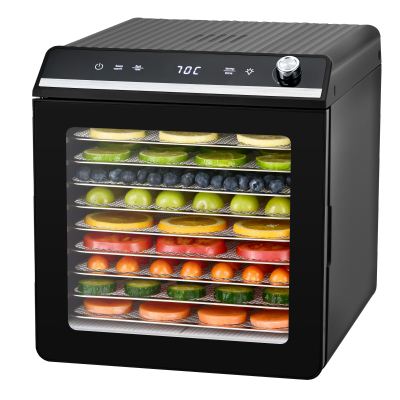
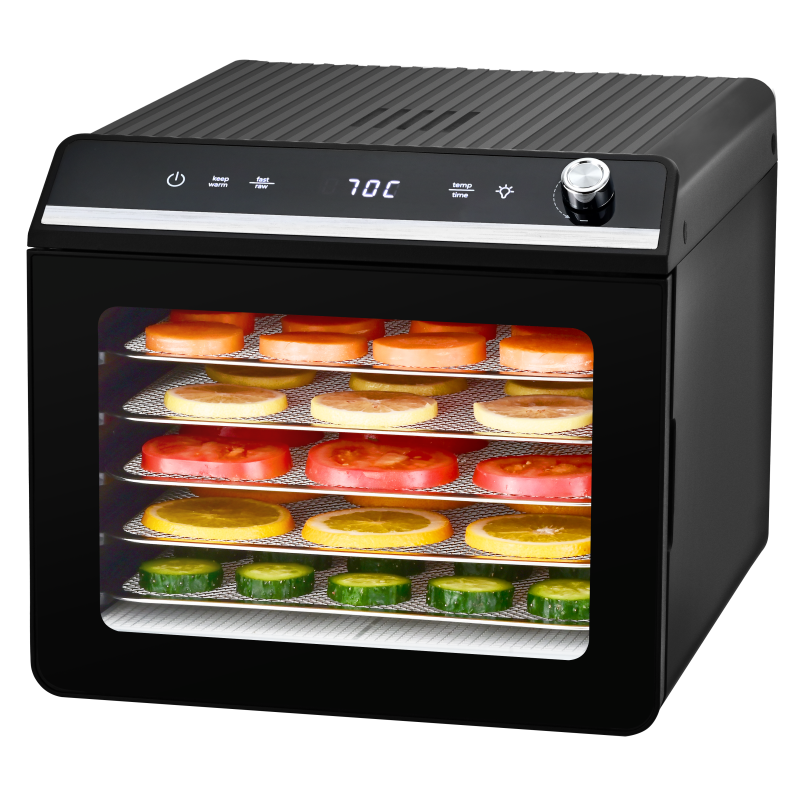
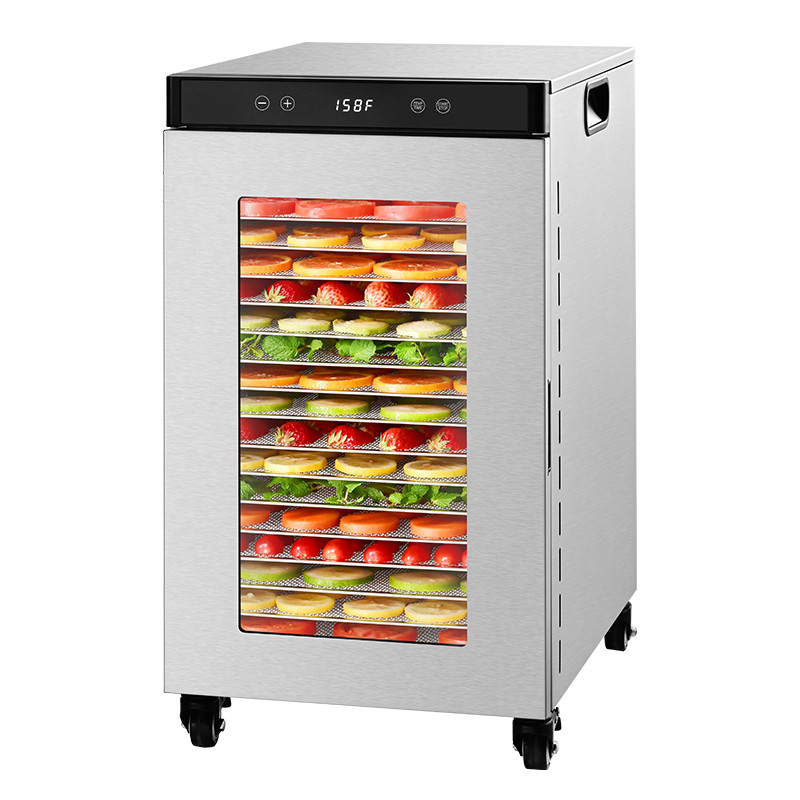
Across home and commercial classes, dehydrator wattage scales with drying area at close to 100W per tray (Cuip.org, 2026), and published classes match it: 4-5 tray units draw 350-500W, 6-9 tray units 500-700W and 10+ tray cabinet units 800-1,000W or more (BestDehydrator, 2026). The Kangye Electric dehydrator line follows the same curve, which matters to buyers because it lets you predict running cost before you choose a platform:
| Model (Kangye spec sheet, 2026) | Trays | Rated power | Class benchmark (BestDehydrator, 2026) |
|---|---|---|---|
| KYS-329 home compact | 5 | 320-380W | 4-5 trays: 350-500W |
| KYS-365 home digital | 6 | 550-650W | 6-9 trays: 500-700W |
| KYS-315 home/commercial | 10 | 600-700W | 10+ trays: 800-1,000W+ |
| KYS-500 commercial cabinet | 16-17 | 850-1,010W | 10+ trays: 800-1,000W+ |
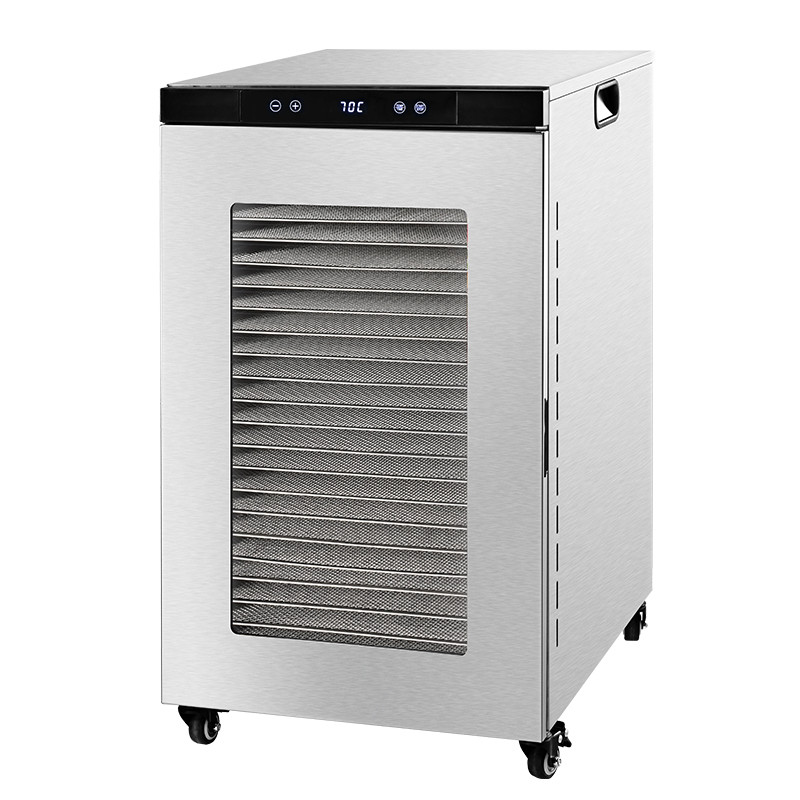
| KYS-510 commercial cabinet | 20-22 | 1,450-1,730W | Large cabinet class |
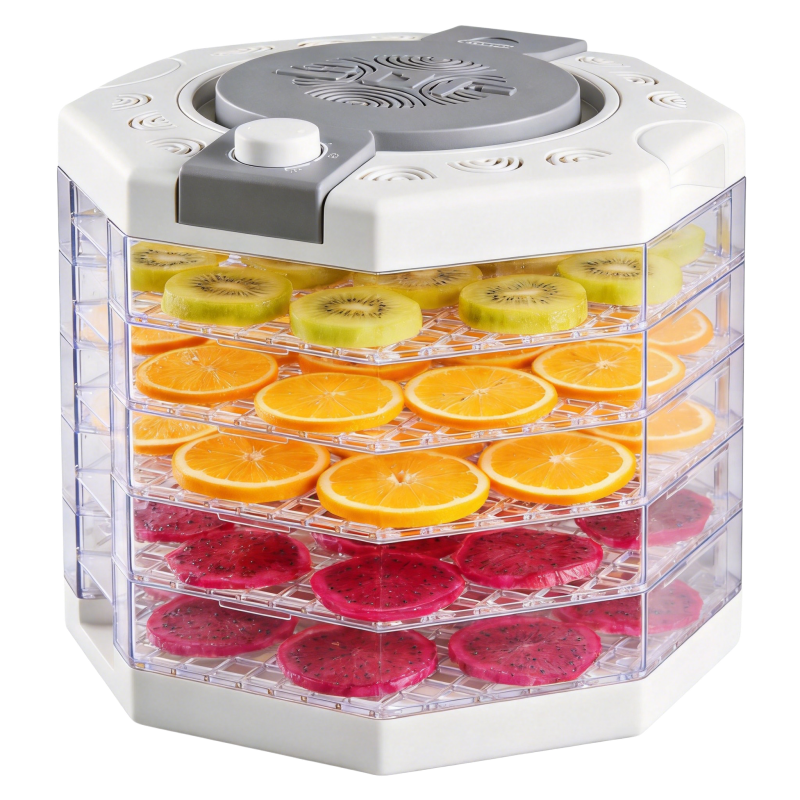
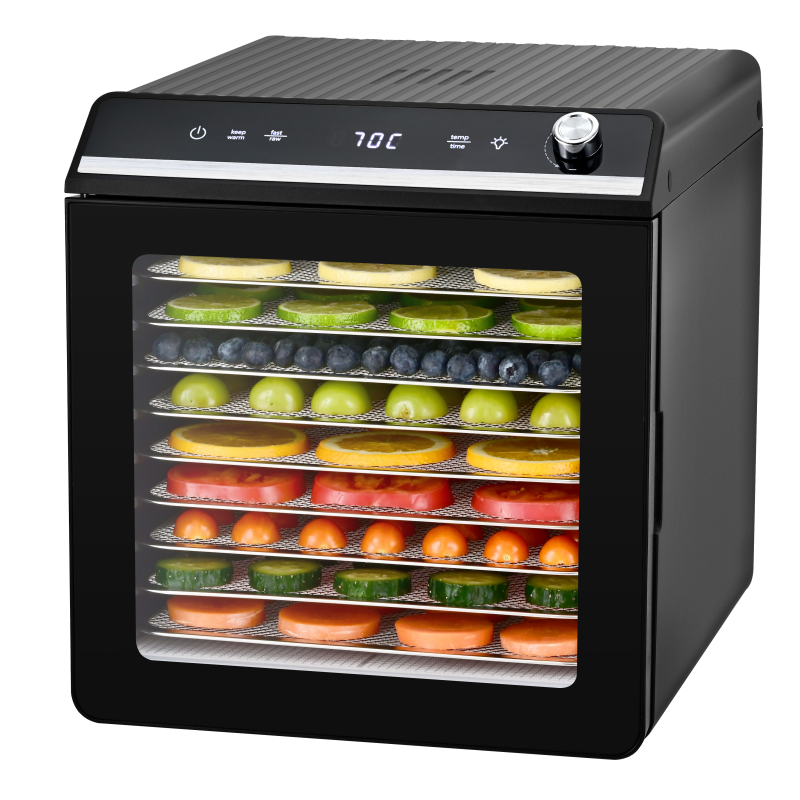
Notice that the KYS-315 ten-tray unit sits below the generic 10-tray benchmark: rear-heated stainless cabinets with insulated chambers need less wattage per tray than stackable round units, and that difference compounds over thousands of running hours. Home users mostly live in the 320-700W band; commercial buyers should budget for the 850-1,730W band on a dedicated circuit.
3. Energy per batch: what each food type actually costs to dry
Runtime, not wattage, decides the bill. A 600W dehydrator running a 10-hour apple batch consumes 6 kWh, about $0.96 at $0.16/kWh (BestDehydrator, 2026), and overall running cost lands between $0.03 and $0.16 per hour, or $0.30-$2.00 for a 10-12 hour batch (LatestCost, 2026). Because the heater cycles, actual metered consumption usually comes in below the rated-wattage calculation (LatestCost, 2026).
| Food | Typical setpoint & time | Energy per batch (calc.) | Cost at $0.16/kWh |
|---|---|---|---|
| Herbs | 2-4 h at ~500W | 1.0-2.0 kWh | $0.16-$0.32 |
| Beef jerky | 4-6 h at ~700W | 2.8-4.2 kWh | $0.45-$0.67 |
| Vegetables | 6-10 h at ~600W | 3.6-6.0 kWh | $0.58-$0.96 |
| Fruit (apple, banana) | 8-12 h at ~600W | 4.8-7.2 kWh | $0.77-$1.15 |
Energy columns calculated from wattage and published runtimes (BestDehydrator, 2026); cost column derived at the 2026 US average residential rate of $0.16/kWh. Actual figures vary with ambient humidity and load.
The safest summary for a buyer's planning sheet: budget under $1 of electricity per full batch on a home machine, and expect the thermostat to shave roughly a quarter to a third off the nameplate estimate on longer runs.
4. Energy per kilogram of dried food: how to normalize the data
Batch numbers are useful for a household, but importers and private-label brands compare machines per kilogram of output. Drying removes water, and evaporating one kilogram of water requires a theoretical minimum of about 0.63 kWh (latent heat of vaporization, 2.26 MJ/kg). Real convective dryers never reach that floor: published specific energy consumption for convective food drying ranges from about 3 to 12 kWh per kg of water evaporated depending on airflow and temperature (ScienceDirect drying literature, compiled 2026).
A worked example ties the two views together. Apples yield roughly 12% of their fresh weight as dried rings - 5 kg fresh becomes about 600 g dried (GardenUK, 2026) - so a 5 kg batch evaporates roughly 4.4 kg of water. The physics floor is therefore about 2.8 kWh; a consumer dehydrator session for 2-4 kg of fresh fruit is metered at 0.6-0.8 kWh per session in UK 2026 testing (GardenUK, 2026), and scaled to a full 5 kg load the estimate lands near 2-3 kWh - about $0.32-$0.48 of electricity for a kilogram of dried apple, before the fruit itself. We label this paragraph an estimate because it combines measured sessions with calculated yield; it is the number we would defend in a buyer meeting.
5. Dehydrator vs oven: what metered tests show
Metered head-to-head tests agree: the dehydrator wins on energy by a wide margin, even though the oven looks free because you already own it. Consumer NZ's test used a 2,500W oven against a 500W dehydrator on the same apple-slice job: the oven needed 7.5 kWh over 3 hours while the dehydrator needed 3 kWh over 6 hours - a 60% saving at New Zealand rates (Consumer NZ, 2026). A 2026 US test with a 600W unit at 70% duty measured 3.36 kWh for an 8-hour apple batch against an estimated 9.6 kWh for a door-propped 2,400W oven - close to one-third of the energy (EatHealthy365, 2026).
The pattern behind the numbers is simple: an oven heats 3-5 cubic feet of cavity and loses heat through a propped door, while a dehydrator heats a sealed, insulated chamber one-tenth the size with forced airflow. Energy is only one axis, of course - temperature precision, case hardening and nutrient retention are covered in our separate dehydrator-vs-oven comparison, and setpoint selection per food type is covered in our temperature-control guide.
6. What actually drives consumption, and four ways to cut it
Four variables move the meter more than any spec-sheet difference between models. Ambient temperature and humidity change runtime first: a cold garage or a humid summer adds hours, and hours multiply watts (BestDehydrator, 2026). Load size is second - the chamber costs the same to heat whether you dry one tray or ten, so partial loads waste energy. Door openings are third, because every peek dumps the heat you paid for. Setpoint is fourth: running hotter than the food needs wastes energy and quality at the same time.
The countermeasures follow directly. Run full loads and slice evenly so all trays finish together. Match the setpoint to the food and use the timer so the machine stops at doneness instead of over-drying. Run long batches overnight where time-of-use tariffs apply. And choose the right machine class for the job - a 20-tray commercial cabinet run half-empty at home is the most expensive way to dry herbs, while a 5-tray unit run flat-out in a small workshop will bottleneck a jerky program. For OEM buyers, these same variables are why we spec rear heating, insulated chambers and 48-hour timers across the Kangye Electric dehydrator range: the hardware decides where on the 3-12 kWh/kg curve a machine lands.
Featured machine
KYS-510 commercial food dehydrator - 20/22 trays, 1,450-1,730W, 48H timer
Stainless-steel cabinet built for volume jerky, fruit and pet-treat programs, with OEM/ODM customization supported by Kangye Electric's 150,000 sqm manufacturing base.
7. Frequently asked questions
How many kWh does a food dehydrator use per batch?
Between about 1 and 7 kWh depending on the food: herbs 1.0-2.0 kWh, jerky 2.8-4.2 kWh, vegetables 3.6-6.0 kWh and fruit 4.8-7.2 kWh (BestDehydrator, 2026). A typical 600W machine running 8-10 hours lands near 4.8-6 kWh, and thermostat cycling usually brings the metered figure below that.
Is it cheaper to run a dehydrator or the oven?
The dehydrator, consistently. Metered tests show 3 kWh vs 7.5 kWh for the same apple job (Consumer NZ, 2026) and 3.36 kWh vs an estimated 9.6 kWh against a door-propped oven (EatHealthy365, 2026) - roughly one-third the energy, plus no kitchen heat penalty in summer.
Does higher wattage mean a dehydrator is less efficient?
No. Higher wattage means faster heat-up and more drying area, usually more trays. Efficiency depends on airflow design, insulation and how fully you load the trays - a 400W unit with poor airflow can cost more per kilogram dried than a 700W cabinet running full loads (BestDehydrator, 2026).
What does a 10-hour dehydrator run cost in 2026?
At the 2026 US average of about $0.16/kWh: a 500W unit costs roughly $0.80, a 600W unit about $0.96, and a 1,000W commercial cabinet around $1.60, before thermostat cycling savings (LatestCost, 2026; BestDehydrator, 2026). Typical monthly cost for regular home use is a few dollars.
8. Sources and data notes
- BestDehydrator (2026): wattage classes by tray count, energy per food type, ambient/load factors, US average rate $0.16/kWh.
- CookGearLab (2026): 300-1,000W home range, 6-12 h batch runtimes, 2-12 kWh per use.
- LatestCost (2026): $0.03-$0.16 per hour and $0.30-$2.00 per 10-12 h batch; rated wattage as maximum draw with thermostat cycling.
- Consumer NZ (2026 buying guide): metered 2,500W oven vs 500W dehydrator comparison, 7.5 kWh vs 3 kWh for apple slices.
- EatHealthy365 (2026): metered 600W dehydrator at ~70% duty, 3.36 kWh vs 9.6 kWh oven estimate; 2,000-5,000W oven draw range.
- GardenUK (2026): 0.6-0.8 kWh per dehydrator session for 2-4 kg fresh apples/pears; ~12% fresh-to-dried apple yield.
- Cuip.org (2026): ~100W per tray rule for larger machines.
- ScienceDirect drying literature (compiled 2026): specific energy consumption of convective food drying, ~3-12 kWh per kg water evaporated.
- Kangye Electric product spec sheets (2026): rated wattage for KYS-329, KYS-365, KYS-315, KYS-500 and KYS-510 series.
Derived figures in sections 3-4 are estimates calculated from the sources above; assumptions are stated inline. Rates and tariffs vary by region - recompute with your local electricity price before publishing cost claims.