Home / All / Technical Articles / How to Choose a Food Dehydrator: Tray Count, Wattage and Heating Type
How to Choose a Food Dehydrator: Tray Count, Wattage and Heating Type
Sep 9,2026
How to Choose a Food Dehydrator: Tray Count, Wattage and Heating Type
Most food dehydrator buyers start from the wrong place. They compare wattage numbers, then pick the biggest tray count their budget allows, and only discover after a few batches that the unit cannot hold its set temperature with a full load, dries the bottom trays twice as fast as the top trays, or heats beyond the delicate range that herbs and raw jerky actually need. Choosing a food dehydrator — whether for your own kitchen, a private-label program, or a wholesale order — is a three-part engineering decision: how much food you need to dry at once (tray count), how much heating capacity the element can deliver and sustain (wattage), and where the heat and airflow are positioned (heating type). This guide explains how the three specifications interact, what the numbers do and do not tell you, and how to match them to the foods, volumes and markets you actually serve.
Key takeaway: wattage is not a speed rating and tray count is not a size rating. Tray count sets your batch capacity per cycle; wattage determines whether the unit can keep air at your target temperature when the chamber is full and moisture is evaporating; heating type decides how evenly that heat reaches every tray. A rear-heated, horizontal-airflow dehydrator generally dries more uniformly without tray rotation, while a bottom-heated vertical stack is cheaper and fine for light loads if you rotate trays every few hours. Match all three to your food types and weekly volume, then verify the temperature control range covers your lowest (herbs) and highest (jerky pre-heating) needs.
Why "How to Choose a Food Dehydrator" Starts With a Workload Question
The world market for food dehydrators keeps expanding because consumers want shelf-stable snacks without additives. PW Consulting values the global household food dehydrator market at US$648.5 million in 2025, heading toward US$963.6 million by 2032 (a 5.8% CAGR), with North America the largest region at roughly US$233 million; a separate 360iResearch study sizes the home-use segment at US$786.6 million in 2025 and expects it to reach US$1.34 billion by 2032 (7.9% CAGR). But a growing category does not make the buying decision easier — it makes specification more important, because retailers and importers are now differentiating on drying uniformity, temperature stability, batch capacity and ease of cleaning rather than on brand alone. Before you compare any spec sheet, answer one question: what, and how much, will this dehydrator dry in a normal week? A buyer who dries a handful of herbs once a month needs a different machine from a jerky producer running 10 trays every weekend, and both need something different from a brand sourcing units to resell across a whole customer base.
Food Dehydrator Tray Count: Capacity, Not Prestige
Tray count is the first and most frequently misread specification. It is not a measure of quality; it is a measure of how many square inches of usable drying surface you can load in one cycle, and the honest way to compare two dehydrators is usable tray area (tray width × depth × number of trays), not the number of trays alone. A 10-tray unit with 275 × 250 mm trays offers roughly 6,875 cm² of surface; a 4-tray compact with 236 × 181 mm trays offers only about 1,708 cm². Both are perfectly good dehydrators — they simply answer different workloads.
Typical Use
Recommended Tray Count
Why It Fits
Occasional herbs, spices, fruit snacks
4–5 trays
Small footprint and lower cost; fine for light, short cycles of 2–12 hours
Regular family use — jerky, fruit leathers, garden produce
6–10 trays
Handles full weekend batches; 10-tray cabinets are the mainstream "serious home" tier
Frequent bulk batches, produce from a large garden
10–16 trays (or expandable stack)
More usable area per cycle; reduces the number of sequential runs
Small commercial or pet-treat production
16+ trays / multi-shelf commercial
Throughput matters more than counter footprint; see our commercial guide
Two tray-count traps deserve honesty. First, an expandable stackable dehydrator lets you add trays, but stacking too many trays on a bottom-heated vertical unit can restrict airflow and stretch drying time — more trays can sometimes mean worse results on the same footprint. Second, high tray counts on a single element increase the drying-time gap between the first and last tray; for vertical stacks, experienced reviewers report the difference between top and bottom trays can exceed 40%, which is why rotation is recommended. If you dry dissimilar foods together — fish on one tray, fruit on another — flavor transfer through shared airflow is another reason to size capacity honestly and run compatible batches.
Wattage: What It Really Does in a Food Dehydrator
Wattage is the heating element's rated power consumption, and the most common marketing shortcut is to treat a bigger number as "faster drying." The physics is more subtle. Drying removes water, and evaporation consumes energy — roughly 2.3–2.5 MJ per kilogram of water removed, which is why long dehydrating cycles are energy-hungry no matter the machine. What wattage actually determines is whether the heating element can recover and hold your set temperature while the fan blows and moisture evaporates, especially when you load cold, wet food onto every tray. An under-powered element drops below the dial setting under a full load, extends the cycle by hours, and in the worst case leaves food in the bacterial danger zone too long.
As a practical reference across the market: small 4–6 tray home units typically run 250–500 W; mainstream 6–10 tray units run 500–800 W; large cabinets and commercial machines run 1,000–2,000 W (a 16-tray unit at 1,500 W and a 20-tray unit at 2,000 W is a common commercial pairing). The fan motor typically adds 20–50 W on top of the element rating. Two honest caveats worth repeating:
Wattage only helps if airflow moves that heat across the trays. A high-wattage unit with weak airflow can still dry unevenly; the heating system (below) matters just as much.
Nameplate ratings drift. Extension programs such as the National Center for Home Food Preservation (NCHFP) note that many dehydrators run 10–20°F below their dial setting in practice — so verify actual chamber temperature with a thermometer before relying on the control, and buy from a manufacturer whose thermal testing is documented.
For importers and brands, wattage also has a voltage and circuit dimension. A 120 V / 15 A North-American circuit is limited to roughly 1,800 W before the breaker trips, and continuous appliance loads should be held to about 80% of that (~1,440 W) under NEC practice — which caps most 120 V home dehydrators well under 1,000 W. At 220–240 V the same wiring can deliver more power safely, which is why the largest capacity units in the 1,500–2,000 W range are usually dual-market or 220–240 V designs. Our guide to electrical ratings and voltage explains these constraints market by market, and our export compliance guide covers the certification implications.
Heating Type and Airflow: The Underrated Spec
Where the element and fan sit determines the airflow pattern, and airflow pattern determines how uniformly trays dry. This is the spec buyers most often overlook because it never appears in the headline. There are two broad families:
Vertical airflow (bottom- or top-heated stacks). The element and fan sit in the base (or lid); warm air rises or is pushed up through the column of round trays and exits through vents. These units are compact, expandable and inexpensive — market research firm PW Consulting reports stackable models still account for roughly 61% of household unit share. The trade-off is temperature stratification: trays closest to the heat source dry fastest, others slower, so uniform results require rotating trays every 2–4 hours, and strong-flavored foods can transfer aroma between trays sharing the air column.
Horizontal airflow (rear-heated cabinets). The element and fan mount on the rear wall and push warm air horizontally across each rectangular tray independently before it exits the front. Each tray receives comparable temperature and air velocity, which reduces hot spots, minimizes tray rotation and allows different foods to be dried in the same batch with less cross-flavoring. This is why rear-heat horizontal designs dominate the mid-to-premium and commercial tiers — and why PW Consulting attributes about 54.7% of the "home cook" segment to horizontal-flow machines, with the segment itself forecast to grow from US$632.6 million (2025) to about US$1.02 billion by 2032.
Our deep dive on top, bottom and rear heating systems and the earlier comparison of bottom, back and top heating technologies explain the trade-offs in engineering detail. For this guide, the practical translation is simple: choose rear-heated horizontal airflow when you dry large batches, dense items or jerky and want hands-off uniformity; choose a bottom-heated vertical stack when budget and counter space dominate and you are willing to rotate trays on light loads. Kangye's own line spans both families precisely so buyers can match the machine to the job.
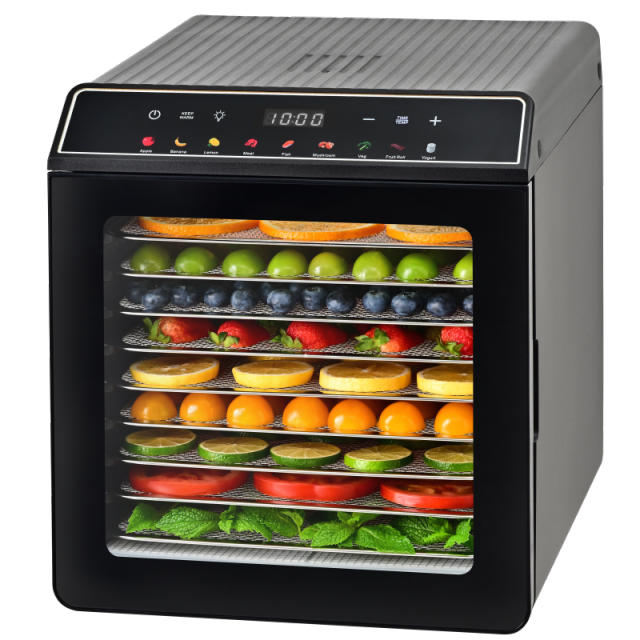
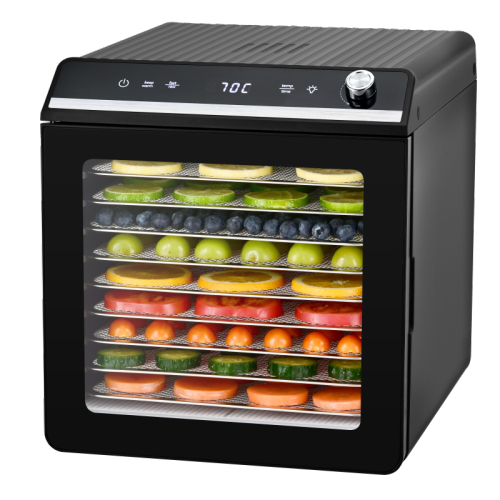
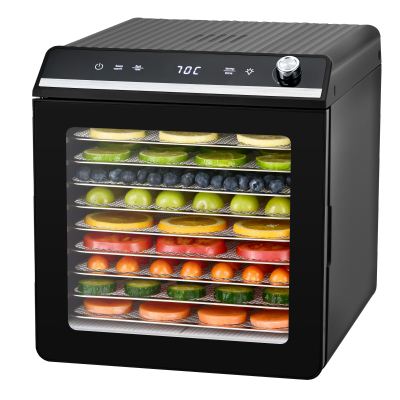
The 10-tray KYS-315 cabinet uses rear heating with horizontal airflow across each stainless steel tray — a configuration that dries large jerky and fruit batches without constant tray rotation. View KYS-315 details
Temperature Range and Control Precision: Match the Range to Your Foods
Every serious dehydrator needs an adjustable thermostat because different foods need different air temperatures — and the range you need is defined by the lowest and highest temperature foods you intend to dry. Extension-service guidance is consistent here:
Herbs and flowers: 95–115°F (35–46°C) — high heat destroys the volatile oils that give herbs their flavor.
Fruit: roughly 135°F (57°C), and vegetables about 125–135°F (52–57°C); the NCHFP and Kansas State Research and Extension describe about 140°F (60°C) as the practical optimum for many produce items, above which "case hardening" — a dried crust that traps moisture inside — becomes a real risk.
Meat and jerky: 160°F (71°C) for meat and 165°F (74°C) for poultry must be reached as an internal-temperature lethality step before or during drying, per USDA FSIS — most home dehydrators cannot do this alone, so pre-heating the meat is the standard safe method. After that lethality step, drying continues in the 130–140°F range.
A dehydrator with a narrow range such as 35–75°C (95–167°F) covers herbs at the low end and most fruit, vegetable and jerky drying at the top end, which is exactly the span Kangye's digital dehydrators use. If raw-meat jerky is a core use, do not expect the dehydrator alone to kill pathogens — follow the food-safety protocol in our pet food dehydrator guide, which follows USDA FSIS shelf-stable jerky guidance. For a deeper treatment of thermostats, timers and consistency, our article on food dehydrator temperature control explains why digital control is usually worth its premium.
Tray Material and Build: Stainless Steel vs Plastic vs Coated
Food-contact trays are where budget dehydrators cut corners, and where the difference shows up in durability, hygiene and flavor over years of use. Three material families dominate:
Material
Cost Position
Strengths
Honest Limitations
BPA-free food-grade plastic
Lowest
Light, inexpensive, common on entry-level stackables
Can warp, scratch and retain odors; heat resistance matters — check the food-contact claim carefully
Stainless steel (304 / SUS304)
Premium
Durable, dishwasher-safe, no odor retention, food-contact proven for meat and fish loads
Costs more; heavier trays; higher price point
Coated / mesh accessories
Add-on
Non-stick silicone or mesh sheets for fruit leathers, herbs and small pieces that fall through grids
Silicone fruit-roll sheets and mesh are add-ons, not tray replacements — budget for them
For anything that touches meat, fish or long high-fat loads, stainless steel trays are the defensible choice, and the grade matters: the widely used 304 stainless performs well for food contact, while 430 is sometimes used for housings and non-contact parts. Our 304 vs 430 comparison walks through migration limits and where each grade belongs. A stainless-steel tray does not mean a stainless-steel body — read the spec line by line, because the two decisions are separate.
Timers, Auto-Shutoff and Fan-Only Mode
Dehydration cycles run for hours — herbs in as little as 2–4 hours, but fruits and vegetables commonly 6–24 hours and dense or large batches longer. A few control features make the difference between a set-and-forget appliance and one you have to babysit:
An extended timer (24–48 hours) with auto-shutoff so overnight and multi-day runs end automatically rather than holding heat indefinitely. Kangye's digital models run 0.5–48 hours with auto shutoff.
A fan-only mode that circulates air without heat — useful for airing chambers, finishing some leathers and cooling loads.
Clear temperature readout, and where possible a verified chamber temperature rather than only a dial position.
Timer precision and control strategy connect to the temperature-control article we linked above, and to the broader question of PID vs on/off temperature control, which quantifies how tightly a unit holds its set point — the difference between a consistent batch and one that drifts into case-hardening or under-drying territory.
Buying for Resale or Private Label: Voltage, Certifications and Configurations
If you are a brand, importer or retailer choosing a food dehydrator to source rather than to use, the specification process adds three layers that home buyers never see. First, voltage and plug must match the destination market — 120 V / 60 Hz for North America and Japan, 220–240 V / 50 Hz for Europe, Australia and most of Asia — and a dual-voltage platform lets one design serve several markets with a single safety certification strategy. Second, safety and food-contact compliance must be documented per market: IEC 60335 series electrical safety with national certifications such as CE/GS (Europe), UL/ETL (North America) and others, plus food-contact rules (EU 1935/2004 and national rules such as LFGB; US FDA 21 CFR) for anything touching food. Third, configurability matters for your margin: tray material options, color, control panel branding, packaging and manual localization are exactly the kind of OEM/ODM decisions a manufacturer with in-house tooling and testing can execute.
Kangye, an OEM/ODM manufacturer in Guangdong, China with more than 35 years of manufacturing experience and exports to 100+ countries, builds dehydrators on exactly this dual-market logic — the same KYS-315 cabinet, for example, is available in both voltage families with digital control, 48-hour timers and BPA-free stainless-steel trays. For the broader process of qualifying a factory, our guides to sourcing OEM kitchen appliances from China and the OEM appliance manufacturing process walk through the full journey from first inquiry to container loading.
Three Kangye Dehydrators Compared: Tray Count × Wattage × Heating Type in Practice
To make the decision framework concrete, here are three real Kangye models that illustrate how the three specifications combine for different jobs. Note how wattage and heating type track the workload, not just tray count.
Model
Tray Count
Heating Type / Airflow
Power
Control & Key Specs
Best For
KYS-322 Series
5 trays
Bottom heating (vertical)
320–380 W (220–240 V); 350 W (120 V)
Digital, 0.5–48 h timer, 35–75°C / 95–167°F, fan-only; compact 320 × 265 × 205 mm
Compact kitchens; herbs, fruit snacks and light regular batches on a budget
KYS-308 Series
4 trays
Rear heating (horizontal flow)
320–380 W (220–240 V)
24 h timer, stainless-steel trays, 300 × 255 × 210 mm
Small households that want stainless trays and even drying in a tiny footprint
Families and serious home users doing jerky, fruit leathers and bulk produce; the mainstream "choose once, buy once" tier
The pattern is the point: the two rear-heated models need no tray rotation and use stainless steel trays for food contact, while the compact bottom-heated unit keeps entry cost and footprint low. None of the three is "better" in the abstract — each is correctly specified for a different volume, food type and market price point. If your goal is single-product family cooking, the consumer-oriented companion guide how to choose the perfect home food dehydrator looks at the same decision from a household-buyer perspective.
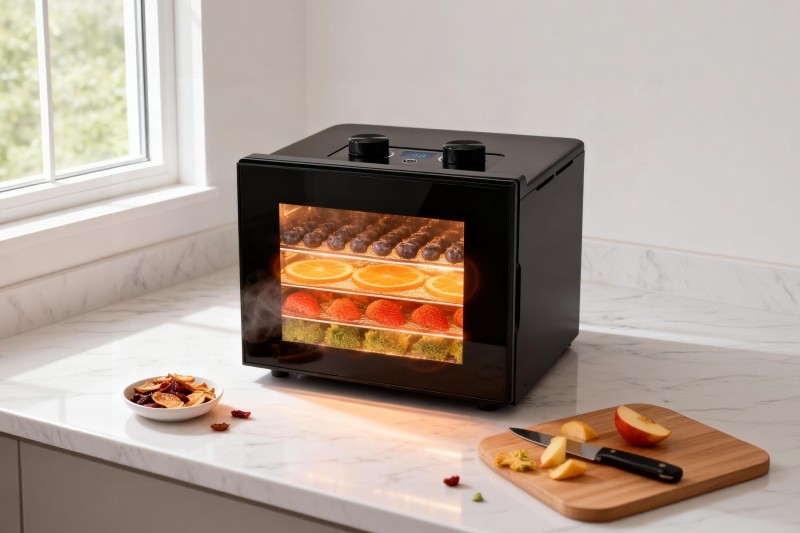
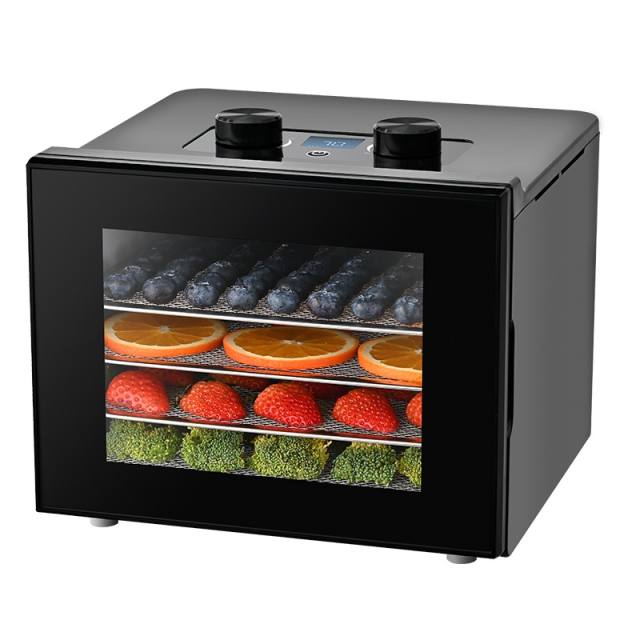
The KYS-308 brings rear-heated horizontal airflow and stainless-steel trays into a 4-tray compact body — even, hands-off drying for small households. View KYS-308 details
Featured Product: Kangye KYS-315 Series 10-Tray Food Dehydrator
Featured Product: KYS-315 Series 10-Tray Rear-Heated Food Dehydrator
The KYS-315 Series is a 10-tray rear-heated food dehydrator designed for the workload where most "how to choose a food dehydrator" decisions actually land: regular family batches of jerky, fruit leathers and seasonal produce. Rear-mounted heating pushes warm air horizontally across each of the ten stainless-steel trays for even drying without rotation, and the digital control with a 0.5–48-hour timer and a 35–75°C (95–167°F) range covers everything from herbs to fruit and jerky drying. The glass door lets you check progress without opening the chamber, and the included fruit-roll tray extends the machine to leathers and purees.
How many trays does a food dehydrator need for a family?
For occasional herbs and snacks, 4–5 trays are enough. For regular family use — jerky, fruit leathers and garden produce — 6–10 trays is the practical range, with 10-tray rear-heated cabinets the mainstream "serious home" tier. Compare usable tray area rather than tray count alone: total width × depth × number of trays is what determines batch size.
Is higher wattage always better in a food dehydrator?
No. Wattage determines whether the element can hold your set temperature under a full, wet load — an under-powered element slows the cycle, while an over-powered element is unnecessary if airflow is weak. Small 4–6 tray units run 250–500 W; mainstream 6–10 tray units 500–800 W; commercial cabinets 1,000–2,000 W. Match wattage to tray count and load, and verify actual chamber temperature rather than trusting the dial.
Which heating type dries food most evenly — bottom, top or rear?
Rear heating with horizontal airflow is generally the most uniform, because each tray receives comparable temperature and air velocity and trays do not need rotating. Bottom-heated vertical stacks are cheaper and compact but create a temperature gradient between trays, so they need periodic rotation and careful batch separation to avoid flavor transfer.
What temperature range should a food dehydrator cover?
Look for roughly 35–75°C (95–167°F) so the low end can dry herbs without destroying volatile oils and the top end can dry fruit, vegetables and jerky. Remember that raw-meat jerky needs a lethality step to 160°F (meat) / 165°F (poultry) before or during drying, per USDA FSIS — a home dehydrator is not a substitute for that.
Are stainless steel trays worth the higher price?
For anything touching meat, fish or frequent high-fat loads, yes: 304 stainless steel is durable, dishwasher-safe and does not retain odors, and it passes food-contact migration requirements. BPA-free plastic trays are acceptable for light fruit and herb use but can warp, scratch and hold smells over time. Read the spec carefully — stainless trays do not mean a stainless body.
When sourcing dehydrators for resale, what specifications matter most?
Beyond tray count, wattage and heating type, confirm the voltage/plug family for your target market (120 V vs 220–240 V), the safety and food-contact certification package (IEC 60335-series / CE / UL / LFGB / FDA as applicable), and the OEM options — tray material, color, branding, packaging and manual localization. A dual-voltage platform with documented thermal testing reduces certification cost and compliance risk across markets.
Summary: A Simple Sequence for Choosing a Food Dehydrator
Summary: choosing a food dehydrator is a workload-first decision, not a spec-sheet contest. Define what and how much you dry weekly, then size tray count and usable area to that volume; select wattage so the element can hold your target temperature under a full load; choose the heating type that matches your need for uniformity (rear-heat horizontal for large or jerky batches, bottom-heat vertical for compact budget use); and confirm the temperature range, timer, tray material and compliance package fit both your foods and your target market.
Size by workload: 4–5 trays for light use, 6–10 for regular families, 10+ for bulk or commercial throughput — and compare usable tray area, not tray count alone.
Treat wattage as heat-recovery capacity, not speed: 250–500 W (4–6 trays), 500–800 W (6–10 trays), 1,000–2,000 W (commercial).
Prefer rear-heated horizontal airflow for even, rotation-free drying; accept vertical stacks for budget with planned tray rotation.
Verify the temperature range (ideally 35–75°C / 95–167°F) and, for jerky, follow the USDA 160°F / 165°F lethality step.
For resale, lock down voltage family, certification package and OEM configuration before sampling.
Choosing a food dehydrator to source, private-label or manufacture? Kangye is an OEM/ODM manufacturer based in Guangdong, China, with 35+ years of manufacturing experience and exports to 100+ countries. Our food dehydrator line spans compact 4–5 tray models and 10-tray rear-heated cabinets in both bottom- and rear-heating families, with stainless-steel tray options, dual-voltage platforms, 48-hour digital timers, certification packages (CE, GS, ETL, CB, RoHS, REACH, LFGB, FDA) and full private-label support. Contact our team to discuss your target volumes and markets, or browse the full product range .
Since its establishment in 1989, Kangye Electric Appliances has always focused on the research and development and manufacturing of kitchen appliances and outdoor cooking utensils.