How to Choose the Perfect Home Food Dehydrator: Tray Count, Heating Type & Power Explained
Introduction: Why a Home Food Dehydrator Belongs in Every Kitchen
Food dehydration is one of the oldest and healthiest methods of food preservation. By removing moisture from fruits, vegetables, meats, and herbs, a food dehydrator extends shelf life while preserving essential nutrients and flavor. In 2026, home food dehydrators have become a staple appliance for health-conscious families, outdoor enthusiasts, and home cooks looking to reduce food waste. But with so many models on the market — from compact 5-tray units to commercial-grade 20-tray machines — how do you choose the right one? This guide walks through every key factor: tray count, heating technology, power rating, materials, and special features, so you can make an informed purchasing decision.
Understanding Heating Technologies: Back vs Bottom vs Top Mounted Fans
The placement of the fan and heating element is the single most important factor that determines drying performance. Three main configurations exist: back-mounted (rear), top-mounted, and bottom-mounted dehydrators. Back-mounted dehydrators, also called horizontal airflow models, use a rear fan to push warm air evenly across all trays simultaneously. This design ensures consistent drying across every tray with no need for rotation, and it prevents flavor cross-contamination between different foods. Top-mounted dehydrators blow air downward through the stack — they are more affordable and generally perform better than bottom-mounted units, but may still require periodic tray rotation. Bottom-mounted dehydrators are the most budget-friendly option, but they suffer from uneven heat distribution, and food crumbs easily fall onto the heating element, creating a cleaning challenge. For serious dehydrating, a back-mounted horizontal airflow system is the gold standard.
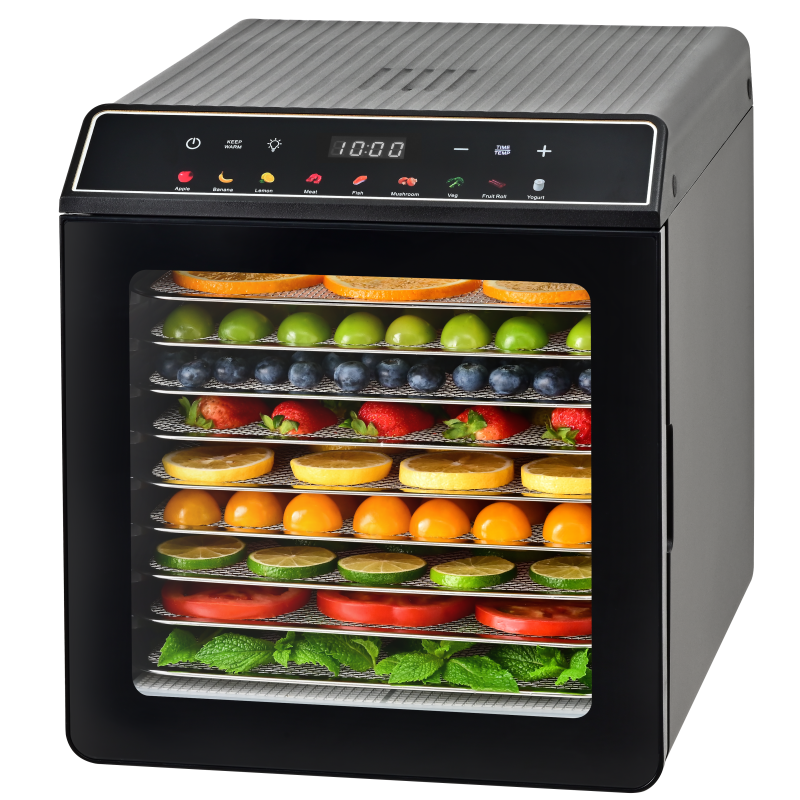
10-Tray Home Food Dehydrator — KYS-315 Series
600-700W · 10 stainless steel trays · 48H timer · rear-mounted horizontal airflow
The gold-standard configuration for even drying across all trays — no rotation needed, no flavor cross-contamination.
View ProductChoosing the Right Tray Count: 5, 7, 10, or More?
Tray count directly affects how much food you can dehydrate in a single batch. A 5-tray dehydrator is ideal for small households or occasional use — it handles herbs, a few pounds of jerky, or a small harvest of fruit. A 7 to 10-tray machine suits regular weekly batches and families who enjoy dried snacks. Commercial or heavy-duty home units with 10 to 20 trays are designed for bulk processing, large garden harvests, or small business operations. Kangye offers a range of models: the 5-tray KYS-322 series for compact kitchens, and the 10-tray KYS-315 series for serious home preservationists. Consider your typical batch size and kitchen counter space before deciding. More trays also require higher wattage to maintain consistent heat across all levels.
Power and Wattage: 300W vs 600W vs 1000W
Wattage determines how quickly your dehydrator can heat up and maintain drying temperature. For most home users, 600 watts is the practical sweet spot — it provides fast drying times without excessive electricity consumption. A 300-400W dehydrator works fine for herbs and thin vegetable slices, but extends drying time for dense foods like meat jerky. Higher wattage models (700-1000W) are better for bulk processing and thick-cut items, reducing drying time by several hours. The KYS-315 series from Kangye delivers 600-700W of power, perfectly balancing speed with energy efficiency. When comparing models, always check the wattage rating alongside the number of trays — a 10-tray dehydrator with only 400W will struggle to maintain temperature across all levels.
Temperature Range: What Temperatures Should a Dehydrator Cover?
A wide temperature range is essential for versatility. For herbs and spices, you need 95-115°F (35-46°C) to preserve volatile oils. Fruits and vegetables dry best at 125-135°F (52-57°C). Meat and jerky require 155-165°F (68-74°C) — the USDA recommends reaching at least 160°F for safe beef jerky production. Many budget dehydrators max out at 145°F, which is insufficient for meat safety. Kangye dehydrators offer an adjustable range from 95°F to 167°F (35-75°C), covering everything from delicate herbs to dense meat jerky. Digital temperature control with precise 5-degree increments is preferred over simple on/off switches.
Stainless Steel vs Plastic Trays: Which Material Is Better?
Tray material affects durability, hygiene, and drying performance. Stainless steel trays conduct heat more evenly than plastic, resist warping over years of use, and are easier to clean. They do not absorb odors from onions or garlic, and they are dishwasher-safe. Plastic trays are lighter and cheaper but tend to crack after repeated heating cycles and may stain over time. BPA-free plastic is the standard for entry-level models, but stainless steel is the premium choice for health-conscious buyers. Kangye uses BPA-free stainless steel trays across its entire home dehydrator lineup, ensuring food safety and long-term durability.
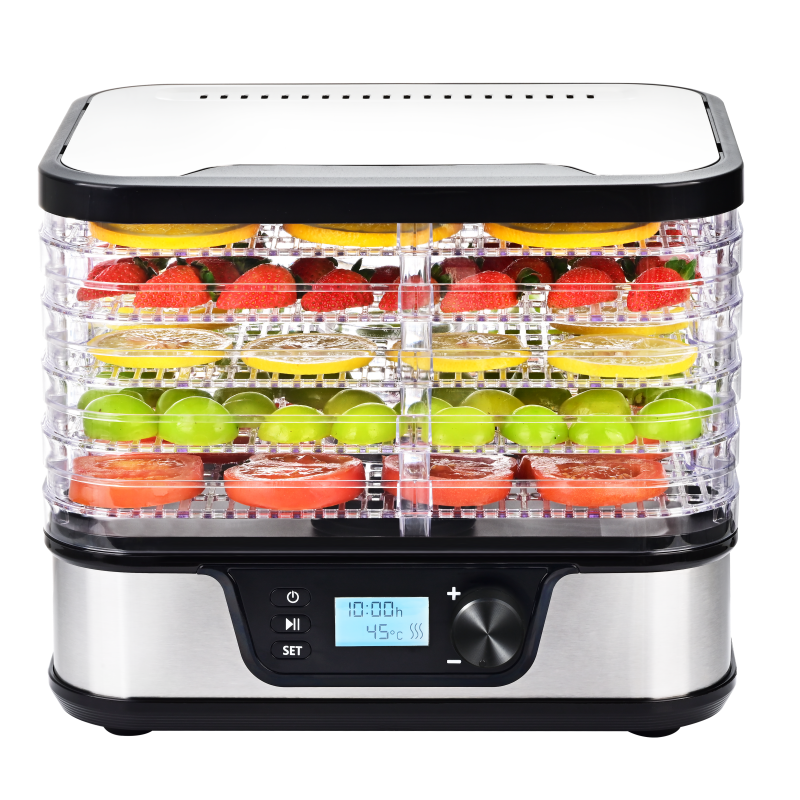
5-Tray Home Food Dehydrator — KYS-322 Series
Compact design · digital control · 48H timer · BPA-free stainless steel trays
The space-saving choice for small households — handles herbs, jerky, and small fruit harvests with ease.
View ProductTimer Features: 24H vs 48H and Auto Shut-Off
Most dehydration cycles run for 8 to 24 hours, depending on the food type and thickness. A built-in timer with auto shut-off is essential for overnight drying sessions. A 24-hour timer covers most use cases, while a 48-hour timer gives you flexibility for denser foods like large cuts of meat or whole fruits. Kangye food dehydrators feature a 48-hour timer with auto shut-off, ranging from 30 minutes to 48 hours. Some models also include a fan-only function (without heating) for air-drying herbs at room temperature. These features allow true set-it-and-forget-it operation, saving time and preventing over-drying.
Noise Level: What to Expect from a Home Dehydrator
Food dehydrators produce noise from the internal fan, and noise levels vary significantly between models. Rear-mounted fan dehydrators generally operate more quietly than bottom-mounted units because the fan is housed away from the trays. Look for models that advertise low-noise technology — typically around 40-50 dB, comparable to a quiet conversation. If you plan to run your dehydrator overnight or in a living area, noise level becomes an important consideration. Kangye home dehydrators are engineered with whisper-quiet operation, making them suitable for continuous use in any room.
Special Features Worth Considering
Modern food dehydrators come with additional features that enhance convenience. A transparent door or window allows visual checks without opening the unit and losing heat. Interior LED lighting helps you monitor food at night. Digital displays with touch controls are easier to use than analog dials. Some models include a keep-warm function that holds food at safe temperature after the cycle ends. Expandable tray designs let you increase capacity as your needs grow. When comparing models, prioritize features that match your actual usage patterns rather than paying for unnecessary extras.
Why Kangye Food Dehydrators Stand Out
Kangye Electric Appliance, based in Shunde, China, is a professional OEM/ODM manufacturer of home food dehydrators. Our KYS-315 series (10-tray) and KYS-322 series (5-tray) feature BPA-free stainless steel trays, rear-mounted horizontal airflow for even drying, digital temperature control from 95-167°F, and 48-hour timers with auto shut-off. Every unit is backed by ISO-certified production lines, rigorous quality control, and CE/RoHS compliance for global markets. Whether you are a brand looking for private-label solutions or a distributor sourcing wholesale dehydrators, Kangye delivers factory-direct pricing with full OEM/ODM customization.
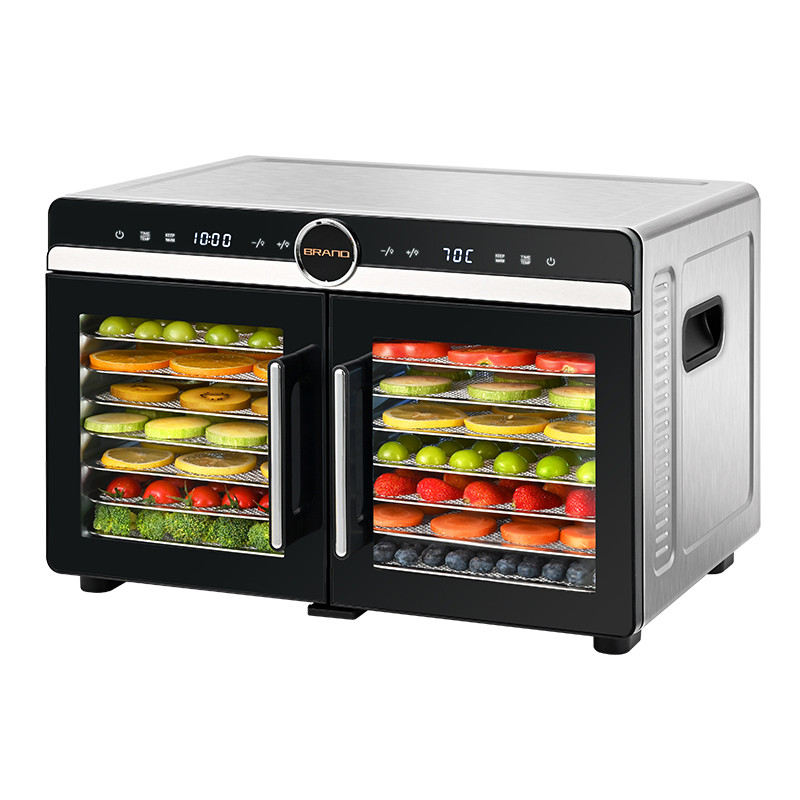
16-Tray Food Dehydrator — KYS-601A/B/D
1200-1400W · 16 stainless steel trays · 48H timer · back heating
Large-capacity drying for bulk batches, big garden harvests, and small business operations.
View ProductFinal Thoughts: Making Your Decision
Choosing the right food dehydrator comes down to three key factors: the heating technology (prioritize back-mounted horizontal airflow), the tray count (match to your batch size), and the temperature range (ensure it covers 95-165°F for full versatility). Stainless steel trays, a 48-hour timer, and digital controls are worth the investment for regular users. For OEM buyers and wholesale distributors, Kangye offers custom branding, packaging, and specification options with flexible MOQ. Contact our sales team for wholesale pricing and sample requests.