Pet Feeder & Water Fountain Buying Guide: How to Choose the Right Products for Your Market
The pet care appliance category is one of the fastest-growing segments in small household appliances. Automatic pet feeders and pet water fountains are no longer niche accessories — they have become mainstream products stocked by retailers, e-commerce sellers, and subscription-box brands across North America, Europe, and Asia-Pacific. For B2B buyers, the challenge is no longer whether to enter the category, but how to select the right feeder and fountain models that will actually sell, perform reliably, and survive the regulatory checks at destination.
This buying guide walks through the decision framework we use at Kangye — a kitchen and pet care appliance OEM/ODM manufacturer based in Guangdong, China — when helping importers, distributors, and private-label brands shortlist pet feeder and water fountain products. It covers market size, technical specifications, material choices, filtration systems, power strategies, certification requirements, and the sourcing pitfalls that cost buyers money.
The Market Opportunity: Size, Growth, and Demand Drivers
Before evaluating individual products, it is worth understanding the size of the opportunity you are buying into. The data points below help frame realistic sales expectations and product positioning.
Market Snapshot 2026
- Global smart pet feeder and drinker market: valued at roughly USD 1.2 billion in 2024, projected to reach about USD 3.2 billion by 2033 — a CAGR of approximately 10.8%.
- Automatic & smart pet feeder market: forecast to grow from about USD 973 million in 2025 to USD 1.85 billion by 2032, at a CAGR of 9.64%.
- Pet water feeder market: projected to rise from roughly USD 160 million in 2026 to over USD 390 million by 2035, a CAGR of about 10.5%; the US accounts for roughly 32% of global demand.
- Pet humanization: 72% of pet owners now consider smart feeders and fountains essential for peace of mind, and 68% prioritize health and wellness features over basic functionality.
- Convenience driver: roughly 65% of urban pet owners cite time constraints as the main reason for adopting automated feeding and watering products.
The growth is being driven by three structural forces: rising pet ownership and "pet humanization," busier urban lifestyles that demand automation, and the spread of smart-home connectivity expectations. Importantly for buyers, these forces are pushing demand beyond simple gravity feeders toward connected, app-controlled, portion-controlled products with meaningful technical complexity — which is exactly where manufacturing quality separates good products from returns and refunds.
Step 1: Choose Your Feeder Architecture — Gravity, Timer, or Smart
Automatic pet feeders fall into three broad architectures. Each serves a different price point, use case, and consumer profile. Matching your market positioning to the right architecture is the first sourcing decision.
Gravity Feeders
Simplest architecture: food flows down by gravity as the pet eats. No power required, very low failure rate, and the cheapest to produce.
- Entry price point, high volume potential
- No portion control, no scheduling
- Risk of overfeeding
Timer Feeders
Mid-tier: a rotating mechanism dispenses preset portions at scheduled times. Runs on AC power or batteries, with simple controls.
- Portion control, weight management
- Works for scheduled feeding routines
- Limited remote control or feedback
Smart / Connected Feeders
Premium tier: app control, scheduling from a phone, feeding logs, voice-assistant compatibility, and sometimes camera or weight sensors.
- Remote feeding and monitoring
- Higher margin and repeat-app engagement
- Requires reliable connectivity and app quality
For most importers entering the category today, the sweet spot is a well-executed timer or smart feeder with anti-jam dispensing, decent capacity, and battery backup — products that solve real problems (portion control, missed meals during power cuts) without requiring a complex software stack that increases cost and support burden.
Step 2: Capacity — Matching Tank Size to Pet Size and Household
Feeder capacity is one of the first specifications buyers check, and it maps directly to the target customer. The market segments capacity into three rough bands, and choosing the wrong band for your channel is a common sourcing mistake.
| Capacity Band |
Typical Tank Size |
Best Fit |
| Compact |
Below 3 liters |
Cats and small dogs; single-pet homes; apartment dwellers who refill weekly |
| Mid-range |
3–5 liters |
Medium dogs; multi-day trips; the mainstream e-commerce volume band |
| Large |
Above 5 liters |
Large-breed dogs, multiple pets, shelters, and commercial users |
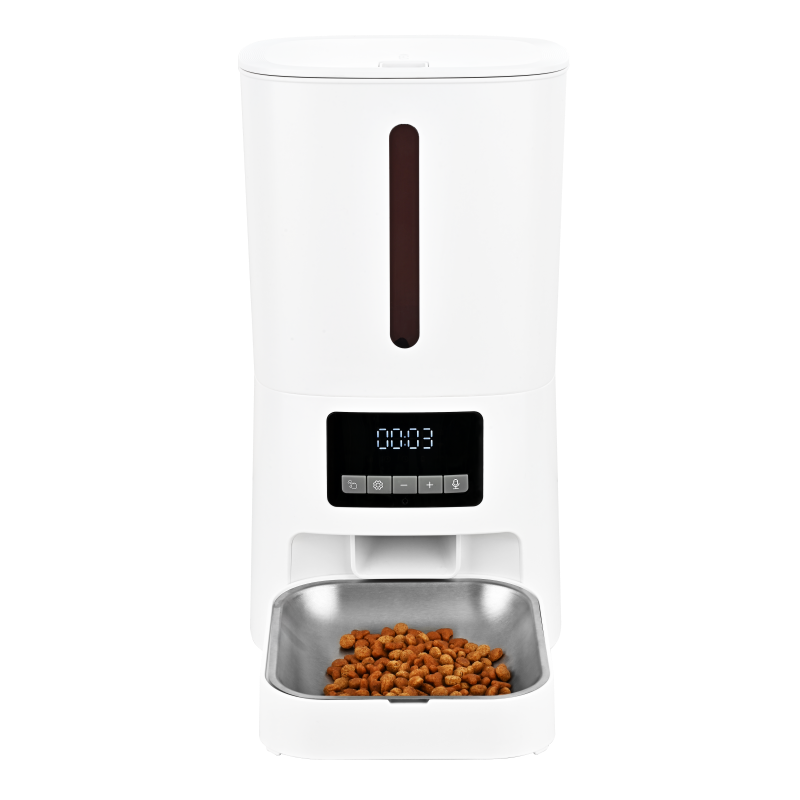
As a practical rule, a 3-liter feeder holds roughly 1.0–1.2 kg of kibble — enough for a medium dog for about a week, or a cat for well over a week. Before finalizing a model, ask the factory for the usable capacity (the volume that actually dispenses without jamming), not just the nominal tank volume. Kangye's KYS-13B Automatic Cat Dog Feeder, for example, pairs a 3-liter tank with portion sizes of roughly 10 g per serving and up to 9 scheduled meals per day — a configuration we validated against typical cat and small-dog feeding routines before bringing it to market.
Step 3: Portion Control and Anti-Jam Dispensing
Two engineering details determine whether a feeder delights users or generates returns: portion accuracy and jam resistance. Both are directly tied to the design of the dispensing mechanism, and both are areas where low-cost manufacturing shortcuts become visible.
- Portion accuracy: Look for feeders where the portion size per serving is adjustable (typically 1–5 portions per meal) and where the mechanism delivers consistent serving weights across the life of the tank. Inconsistent portions lead to overfeeding and owner frustration.
- Anti-jam design: Kibble varies in size (3–14 mm is common, and freeze-dried or puffed foods are larger and lighter). A good feeder is tested against multiple kibble sizes and shapes. Features like auger-style dispensing, wider chutes, and desiccant-sealed hoppers reduce jam frequency.
- Food type compatibility: Clarify with the manufacturer whether the feeder handles dry kibble only, or also semi-moist and freeze-dried foods. Most budget feeders are dry-kibble only; if your market feeds freeze-dried, the mechanism must be designed accordingly.
- Moisture protection: A sealed hopper with a desiccant pack keeps kibble fresh and prevents clumping that causes jams. This matters more in humid markets.
Ask the factory for their test protocol: how many dispensing cycles the mechanism is rated for, and what kibble size ranges were tested. Kangye runs anti-jam testing across kibble diameters and humidity conditions during development, because jam complaints are the #1 driver of feeder returns in the market.
Step 4: Power Strategy — AC, Battery, or Dual Power
Power design is a decisive buying factor for pet products, because pets are fed on schedules that do not pause for power outages. The three common strategies are:
- AC-powered (corded): Reliable for continuous operation, but placement is limited by the outlet and the cord can be chewed by pets. Most mid-tier feeders still default to AC.
- Battery-powered: Flexible placement and no cord risk, but batteries need replacing or recharging. This is becoming the premium design choice, especially for water fountains.
- Dual power (AC + battery backup): The best safety net — the feeder keeps dispensing scheduled meals during outages. Kangye's KYS-13B feeder, for instance, runs on Type-C power with 4 x 1.5V D-cell battery backup, so feeding schedules survive a power cut.
For water fountains, battery life has become a headline specification. A 3-liter cordless fountain with a 2000–3600 mAh battery and sensor-based operation can run for weeks on a single charge — Kangye's KYS-15B Wireless Pet Water Fountain is rated for up to 27 days depending on mode and battery capacity. When evaluating battery claims, ask what conditions the number was measured under: continuous pump operation, sensor-triggered mode, or a mix. The difference can be 2–3x in real-world run time.
Step 5: Water Fountains — Filtration, Flow, and Materials
Pet water fountains address a real health problem: many cats and dogs drink too little, which contributes to urinary and kidney issues. Moving, filtered water encourages drinking. But a poorly designed fountain — noisy pump, hard-to-clean surfaces, weak filtration — quickly becomes an unused appliance.
Filtration Systems: What Actually Matters
The filtration system determines water freshness and owner satisfaction. Multi-layer filtration is the current standard:
- Non-woven pre-filter: catches hair, debris, and food particles before they reach the pump.
- Activated carbon layer: removes odors, chlorine taste, and organic impurities — the layer owners notice most.
- Ion-exchange resin: softens water and reduces dissolved minerals and hardness, which extends pump life in hard-water regions.
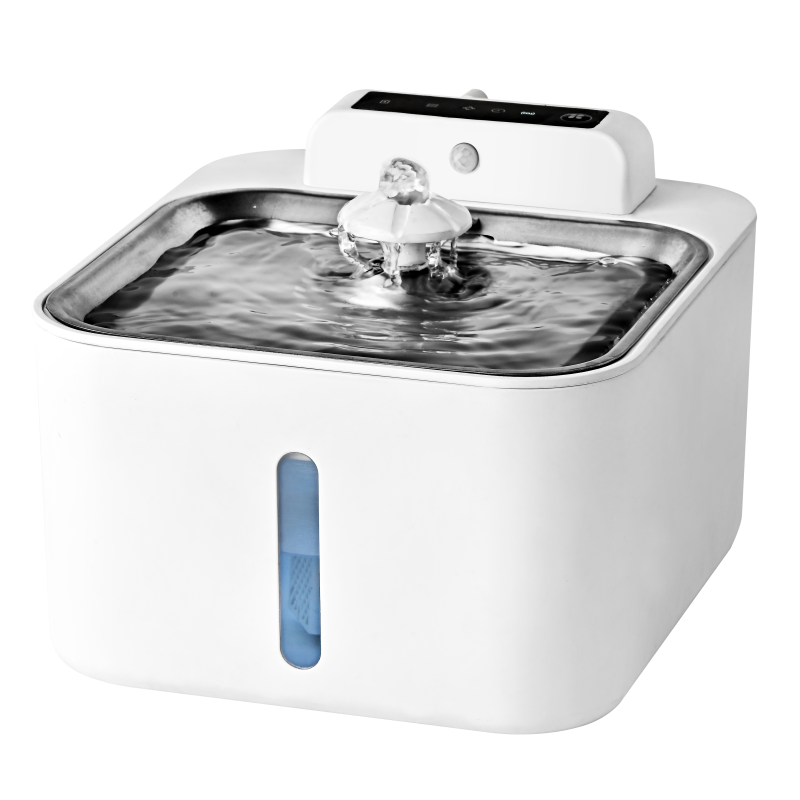
Kangye's KYS-15B fountain uses a dual-stage activated carbon + ion-exchange resin filtration system, which balances cleaning effectiveness with reasonable filter replacement cost — a trade-off we recommend buyers examine closely, since filter refills are a recurring-revenue opportunity for your brand.
Flow Types and Pump Noise
Fountains typically offer a bubbling stream, a gentle fall, or both. Cats in particular are sensitive to noise — a pump that vibrates or hums can deter drinking. Look for:
- Ultra-quiet pumps: aim for around 20–35 dB at operating distance; quiet operation is a top-three purchase criterion for fountain buyers.
- Pump isolation: rubber feet or a submerged pump compartment reduce vibration transfer to the tank.
- Adjustable flow: lets owners reduce splashing for shy pets and shallow drinking positions.
- Low-water protection: the pump should shut off or alert before running dry, protecting the pump from burn-out.
Materials: Stainless Steel, Ceramic, or BPA-Free Plastic
| Material |
Pros |
Cons |
| Stainless steel |
Resists scratches and bacteria; dishwasher-safe; keeps water cooler; premium perception |
Higher cost; slightly heavier |
| Ceramic |
Inert, odor-resistant, aesthetic appeal, stable |
Fragile in shipping and daily use; heavier |
| BPA-free plastic |
Light, affordable, easy to mold into complex designs |
Micro-scratches can trap bacteria; needs more diligent cleaning |
Stainless steel is the default premium choice for fountains in 2026 — it ranks first in most buyer guides because it is easier to keep clean and safer for pets prone to chin acne and allergies. For the feeder hopper itself, food-grade, BPA-free materials with a clear material declaration are the minimum requirement for any destination market.
Step 6: Ease of Cleaning and Maintenance
Cleaning is where pet appliances live or die. A fountain or feeder that is hard to disassemble and scrub will develop biofilm, smell, and end up in a closet. When evaluating a sample, count the disassembly steps:
- Few parts, no hidden corners: the fewer components that touch water or food, the easier the weekly clean. Fountains with three main parts or fewer are dramatically easier to maintain than complex multi-chamber designs.
- Dishwasher-safe components: mark which parts are dishwasher-safe on the product; owners value this highly.
- Accessible pump: a pump that lifts out without tools makes the difference between a maintained fountain and a slimy one.
- Filter availability: confirm the filter is a standard, replaceable cartridge with a sensible replacement cycle (typically every 2–4 weeks for carbon filters).
This is also a packaging and documentation point: the user manual should include a clear cleaning schedule and filter-replacement indicator. Importers who ignore maintenance design end up with high return rates that no marketing spend can fix.
Step 7: Smart Features — What Justifies the Premium
Not all smart features are worth the engineering cost. Based on what sells in the US and EU markets, the features that justify a premium are:
- App scheduling and portion control: remote feeding and per-meal portion adjustment — the core smart value.
- Feeding notifications: push alerts when a meal is dispensed, the hopper is low, or a jam is detected.
- Water-level and filter alerts (fountains): low-water alerts and filter replacement reminders reduce owner anxiety and support recurring filter sales.
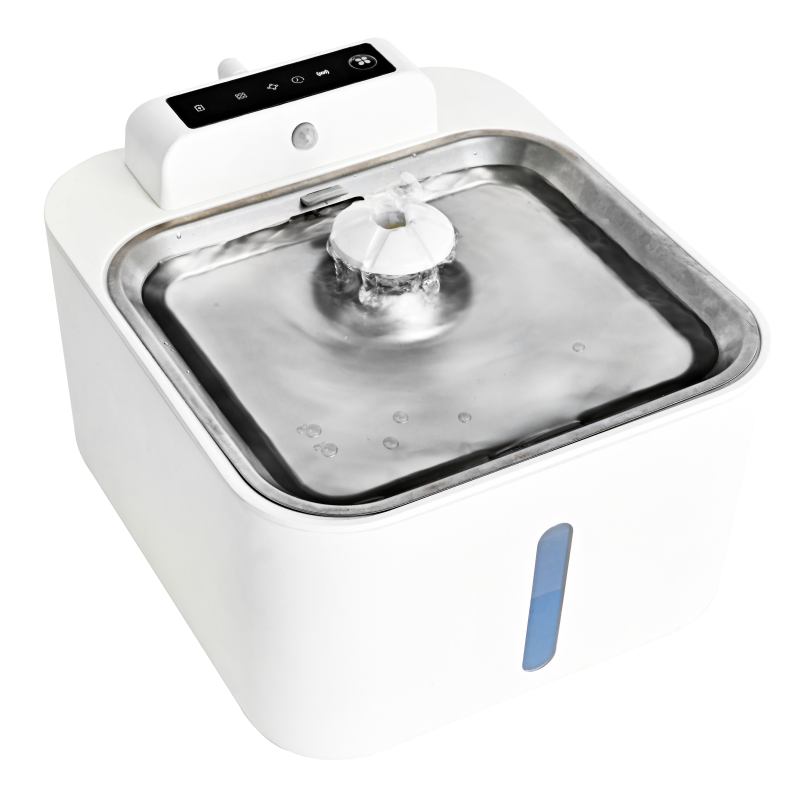
- Motion-activated operation: sensor-triggered flow extends battery life and reduces noise — a key selling point for cordless fountains.
- Voice-assistant compatibility: integration with Alexa and Google Home is now a checklist item on premium listings.
A caution for buyers: connectivity quality depends on the module and app the factory ships with. Ask which IoT platform the feeder uses (common options include Tuya), whether the app supports your target regions' app stores, and whether firmware updates are supported over the air. A feeder with a dead app is a refund waiting to happen.
Step 8: Certifications, Materials Safety, and Export Compliance
Pet products sit at the intersection of food-contact, electrical, and consumer-safety regulation. Before committing to a model, verify the compliance package for your destination market:
- Electrical safety: UL/ETL for North America; CE (LVD + EMC), UKCA for the UK; PSE for Japan. Confirm the exact voltage/frequency versions you need (e.g., 120V 60Hz vs 220–240V 50/60Hz).
- Food-contact materials: BPA-free declarations, FDA-compliant food-grade materials for the US, and EU food-contact (LFGB or EU 10/2011) documentation where required.
- Battery compliance: for rechargeable models — UN38.3 transport testing, CE battery directives, and, for the EU, the new Battery Regulation requirements. Battery cells should come from reputable manufacturers with full documentation.
- RF/wireless compliance: Wi-Fi or Bluetooth modules need FCC (US) and RED (EU) certification. Ask the factory for module-level certificates, not just device-level claims.
- Chemical restrictions: RoHS and REACH compliance for the EU; Prop 65 considerations for California. Get a component-level declaration, not just a blanket statement.
Kangye's product lines are certified to UL, ETL, CE, and other standards, with test reports and component-level documentation available to buyers — including the KYS-15B fountain and KYS-13B feeder. When comparing factories, treat "we can get it certified later" as a red flag; certification should be part of the product development, not an afterthought.
Step 9: Sample Evaluation Checklist Before You Commit
Once you have shortlisted two or three factories, run a structured sample evaluation. This is the stage where most sourcing mistakes are caught:
- Run a two-week daily-use test: fill the feeder with real kibble, set a schedule, and observe portion consistency and jam frequency.
- Measure fountain noise: run the pump for 24 hours and assess noise and vibration in a quiet room.
- Check cleaning ease: disassemble and reassemble the unit at least three times, and note sharp edges or hard-to-reach areas.
- Simulate a power cut: verify battery backup actually dispenses scheduled meals.
- Test the app: if smart features are included, install the app, test scheduling from a second location, and check for obvious localization gaps.
- Review the compliance file: certificates, material declarations, and test reports should arrive with the sample, not after a chase.
Kangye's Pet Care Line: Products Designed for Global Buyers
Kangye has applied its two decades of small-appliance OEM/ODM experience to a focused pet care line that covers the two core products in this guide — and the adjacent category that feeds into pet wellness trends.
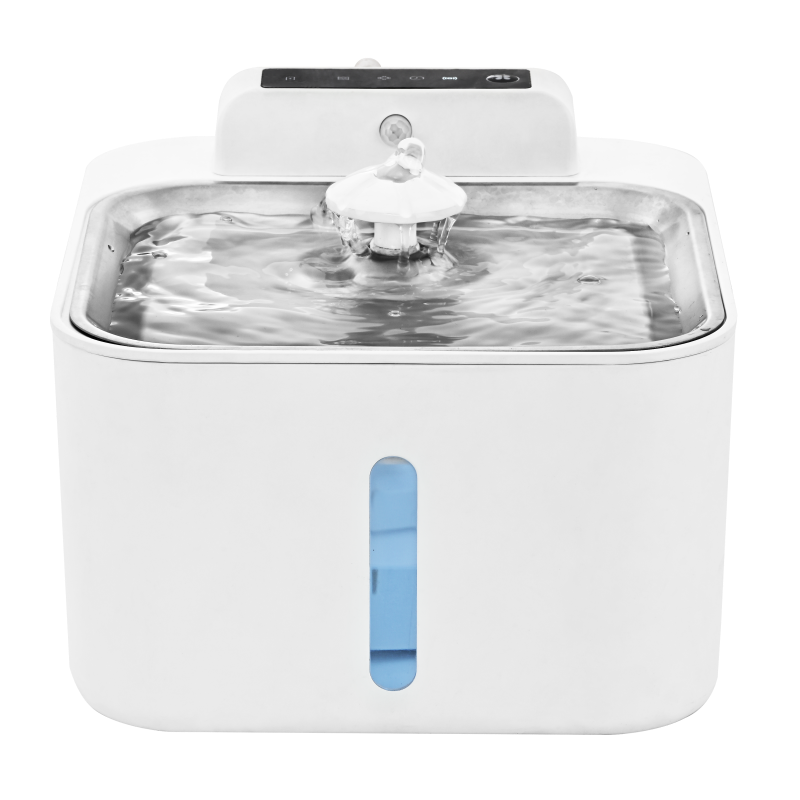
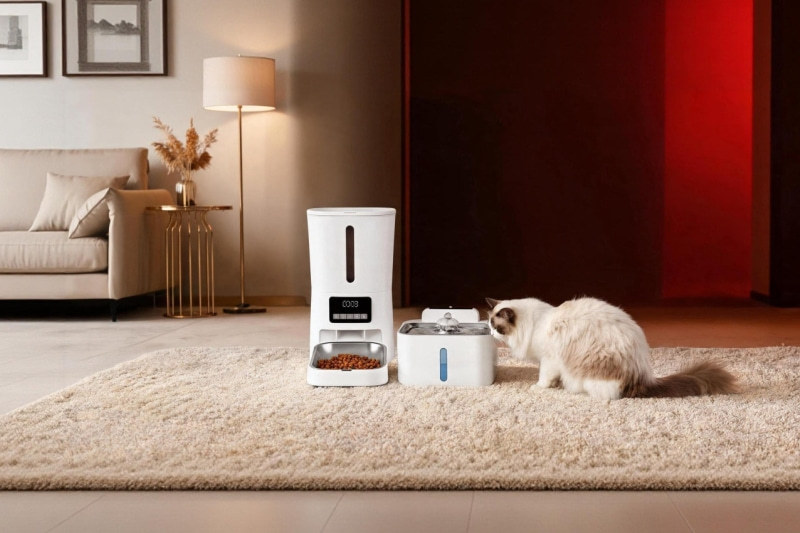
- KYS-15B Wireless Pet Water Fountain (3L): cordless Type-C operation, 2000/3000/3600 mAh battery options, up to 27 days of battery life in sensor mode, dual-stage activated carbon + ion-exchange filtration, and an ultra-quiet pump — designed for the premium cordless segment.
- KYS-13B Automatic Cat Dog Feeder (3L): Type-C power with D-cell battery backup, roughly 10 g adjustable portions (1–5 per meal), up to 9 meals per day, and anti-jam dispensing tested across kibble sizes — built for the mainstream timer/smart segment.
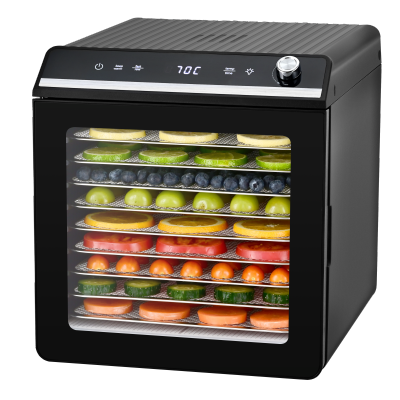
- KYS-315J/K 10-Layer Pet Treat Dehydrator: stainless steel shelves, 600–700 W, 48-hour timer and 35–75°C control — supports the fast-growing homemade pet treat trend and complements a full pet-care assortment.
Featured Product: Kangye Wireless Pet Water Fountain KYS-15B
The Kangye KYS-15B 3L Wireless Pet Water Fountain targets the fastest-growing segment of the hydration market: cordless, app-free, sensor-activated operation with genuinely long battery life. It is a strong candidate for importers and private-label brands looking to launch a premium pet care SKU with minimal software overhead.
- 3L tank with Type-C input (5V DC / 1A) and 2000–3600 mAh battery options
- Up to 27 days of run time with smart-sensor activation
- Dual-stage filtration: activated carbon + ion-exchange resin
- Ultra-quiet pump with low-water protection
- OEM/ODM customization: branding, packaging, colors, plug types
Explore Kangye's full product lineup
Both pet products share the same OEM/ODM flexibility as Kangye's kitchen line: private-label branding and packaging, voltage and plug configuration, feature and color adjustments, and complete export documentation. Kangye is also a partner to brands that want to bundle pet care products with their existing kitchen appliance programs — one factory, one quality system, one compliance framework.
Key Takeaways for Global Buyers
- Match architecture to market: gravity feeders serve entry price points; timer and smart feeders serve the growth segment with better margins.
- Capacity is a positioning decision: 3L covers cats and small dogs; 5L+ is required for large breeds and multi-pet households.
- Anti-jam and portion accuracy decide return rates: ask for the factory's testing protocol before ordering.
- Battery life claims need scrutiny: check the conditions behind every run-time figure.
- Filtration depth sells fountains: carbon + ion-exchange + pre-filter is the 2026 standard, with filter refills as recurring revenue.
- Compliance is a border filter: UL/ETL/CE, food-contact declarations, battery transport rules, and RF module certificates must be settled before you order, not after.
Frequently Asked Questions
What is the difference between a pet water fountain and a pet water dispenser?
A pet water dispenser (gravity dispenser) simply holds a reservoir and refills a bowl by gravity — no pump, no filter. A pet water fountain continuously circulates water through a pump and filter, keeping it moving, oxygenated, and filtered. Fountains encourage more drinking, which is why they are preferred for cats and for pets prone to urinary issues, but they require cleaning and filter replacement. Many brands now offer fountain models with gravity-feed options in one unit.
How often should a pet water fountain filter be replaced?
Typically every 2–4 weeks for activated carbon filters, depending on water hardness, pet hair load, and usage. Some premium fountains pair a washable sponge pre-filter with a longer-life cartridge to reduce recurring cost. The KYS-15B's dual-stage design is tuned so the carbon layer remains effective for a standard replacement cycle while the ion-exchange resin protects pump life in harder water.
Can automatic feeders handle wet food or only dry kibble?
Most automatic feeders are designed for dry kibble only. Semi-moist and freeze-dried foods require specialized dispensing mechanisms and refrigeration concerns that most budget feeders cannot support. If your market feeds freeze-dried or wet foods, specify this requirement to the factory during sourcing — it changes the hopper design, the dispensing mechanism, and often the price.
What capacity feeder do I need for a two-week vacation?
As a rule of thumb, plan about 50–60 g of kibble per day for a 5 kg cat and 150–300 g per day for a medium dog. For two weeks of automated feeding, you would need roughly 1 kg of kibble for a cat (a 3L tank usually suffices) and 2–4 kg for a medium dog (a 5L+ tank or a refill plan with a neighbor is safer). Always combine large-capacity feeders with a backup plan, since no feeder is failure-proof over long absences.
Are wireless pet fountains worth the premium over corded models?
For the right customer, yes. Cordless fountains remove cord-chewing risks, allow placement anywhere (kitchen island, bedroom, patio), and simplify cleaning since the pump assembly has no trailing cable. The trade-offs are battery management and a higher price point. Sensor-activated cordless fountains such as the KYS-15B, which run only when a pet approaches, address the battery-life objection while keeping noise to a minimum.
Why is stainless steel recommended over plastic for pet fountains?
Stainless steel does not develop micro-scratches that trap bacteria, is dishwasher-safe, resists odors, and keeps water cooler. Plastic is lighter and cheaper but requires more diligent cleaning and may show wear that concerns health-conscious owners. For brands targeting the premium segment, stainless steel construction is now an expected feature rather than a differentiator.
Thinking about adding pet care products to your assortment? Kangye supports OEM/ODM development of pet feeders, water fountains, and pet treat appliances with certification-ready compliance packages. Contact our team to discuss samples, MOQs, and customization options.