The 2026-2027 US Kitchen Appliance Market: Opportunities for Importers
Quick Answer: The US Kitchen Appliance Market in 2026-2027
The US kitchen appliance market is a $260+ billion opportunity in 2026, with small countertop appliances growing at 6-8% annually as the fastest-moving segment. For importers, the opening is concentrated in three areas: air fryers and multi-function ovens (the single fastest-growing countertop category), replacement and premiumization demand driven by a decade-old installed base, and e-commerce channel growth that lowers the cost of entering with a private label. The 2026-2027 window is particularly favorable because US retail inventory correction cycles have ended, consumer spending on home cooking remains elevated, and a new generation of direct-to-factory sourcing (OEM/ODM) lets importers compete on margin rather than volume alone.
Key takeaway for importers: the most defensible 2026-2027 strategy is not adding another me-too air fryer to the market — it is importing multi-function oven-style air fryers with verified compliance (UL/ETL/CE), real after-sales support, and a factory that can do OEM/ODM customization. That combination is what separates importers who survive the price war from those who win shelf space.
Market Size and Growth: Where the Money Is in 2026-2027
The US kitchen appliance market — large and small domestic appliances combined — is projected to grow from roughly $254 billion in 2025 to $268-275 billion by 2027, a compound annual growth rate of about 4-5%. Within that, small kitchen appliances (SKAs) represent $34-38 billion and are growing faster than the market as a whole. Industry trackers including the Association of Home Appliance Manufacturers (AHAM) and market research firms consistently show countertop categories compounding at 6-8% annually through the forecast period, driven by three durable forces:
- Home-cooking stickiness: post-2020 habits persist — more US households cook at home more often, and the air fryer has become a staple rather than a fad (household penetration now exceeds 40% in some consumer surveys and is still rising).
- Replacement cycle: the air fryer boom of 2019-2021 installed millions of first-generation units that are now 4-6 years old — entering the failure and upgrade window in 2026-2027. Upgraders want larger capacity, oven-style versatility, and better build quality, which plays directly into 16L-class air fryer ovens.
- Electricity and health economics: air fryer ovens cook faster and use less energy than full-size ovens, and the health narrative (up to 80% less oil) remains one of the strongest purchase triggers in kitchen retail.
| Segment | 2026 US Market Estimate | 2026-2027 Growth Outlook | Importer Opportunity |
|---|---|---|---|
| Air fryers (basket) | $3.2-3.6B | Moderate, 5-7% | Mature, price-competitive; margin pressure high |
| Air fryer ovens (oven-style) | $1.8-2.2B | Strong, 9-12% | Fastest growth; premium pricing holds |
| Countertop ovens / toaster ovens | $2.5-3.0B | Steady, 4-6% | Converging with air fryer ovens |
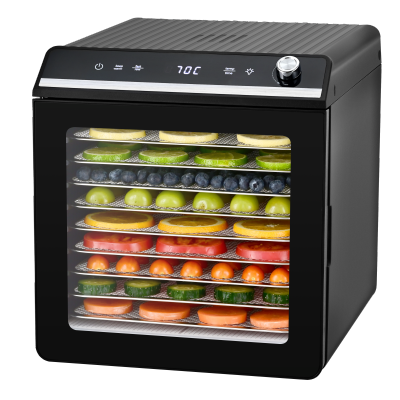
| Food dehydrators | $0.5-0.7B | Niche but growing, 7-9% | Under-served; healthy-lifestyle pull |
| Other SKAs (mixers, blenders, cookware-adjacent) | $25B+ | 3-5% | Category-specific, brand-led |
The practical read for importers: the air fryer oven segment is where volume growth, price stability, and differentiation overlap. It is the only major countertop category where importers can still command a meaningful margin premium — provided the product is genuinely multi-function (air fry + bake + toast + broil + roast + dehydrate) and backed by compliance.
Category Deep-Dive: Why Air Fryer Ovens Outperform Basket Units
Importers evaluating product mix for 2026-2027 should understand why the oven-style format is outperforming classic basket air fryers at retail. Basket units dominate unit volume, but the growth and margin are shifting to oven-style formats:
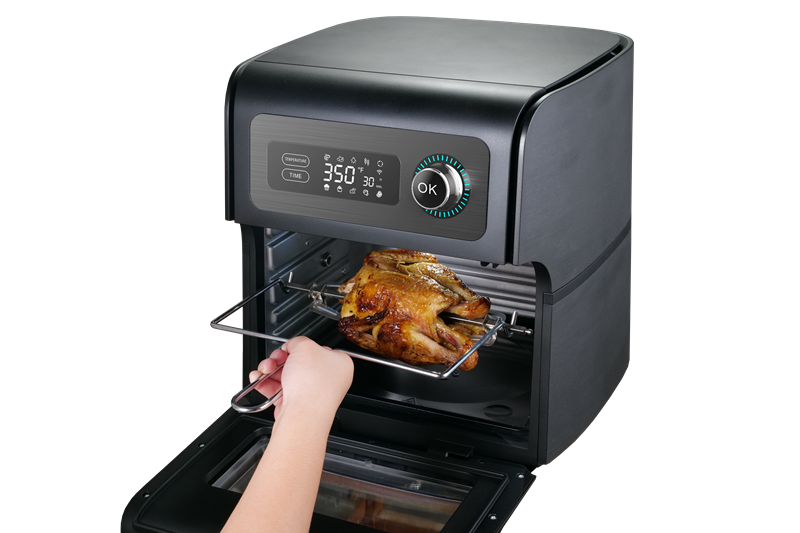
- Capacity advantage: a 16L oven-style unit fits a whole chicken, a 12-inch pizza, or two trays at once — a genuine family-sized batch that a 4-7L basket cannot match. Upgrading households trade up from basket to oven format.
- Versatility: one appliance replacing a toaster oven + air fryer + dehydrator + roaster is the strongest shelf story in the category, and it justifies a higher price point.
- Energy positioning: at 1,500-2,400W, a 16L air fryer oven cooks a family meal faster and with less energy than a 4,000W+ full-size oven — an increasingly marketable spec.
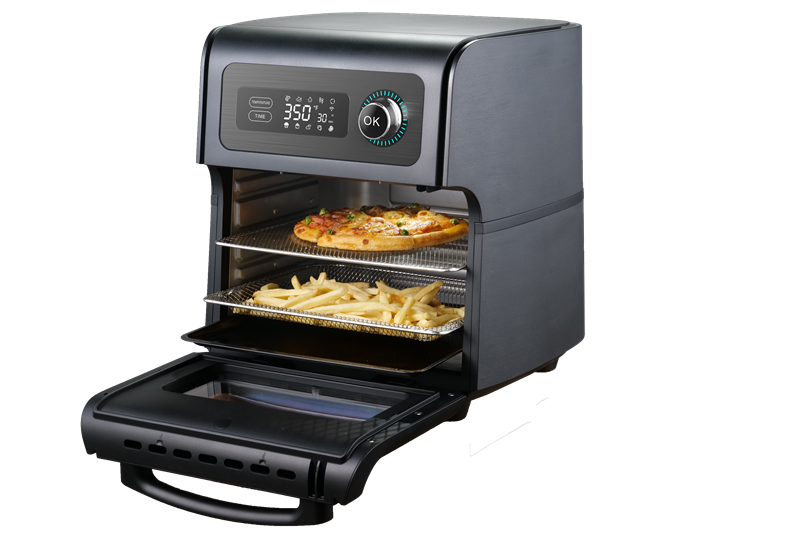
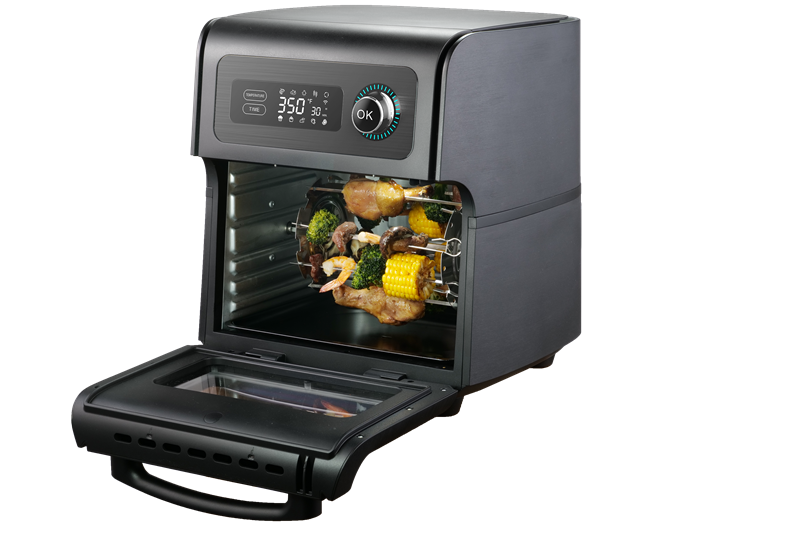
- Transparency: a glass door with interior light builds trust at retail and on unboxing videos, which is disproportionate marketing value.
For the 2026-2027 season, the sweet spot in import programs is the 16L, 1,800W oven-style air fryer with digital control, 8 preset functions, and a 35-200°C temperature range — a specification profile exemplified by the Kangye KYS-116AK, which also offers the 120V/60Hz variant required for the US market. Products at this spec hit the price point where US consumers trade up (typically $129-199 retail) while still leaving importers healthy margins.
Channel Trends: E-Commerce, Private Label, and Retail Shelves
The way US consumers buy kitchen appliances changed structurally, and 2026-2027 importers must plan for three channels at once:
1. E-commerce and marketplace first-party brands
Amazon and Walmart marketplace account for a fast-growing share of air fryer sales. Marketplace economics favor importers who can launch private-label brands quickly and iterate on listings. The winning playbook in 2026-2027: import a small, verified product range (not a huge catalog), invest in the listing (titles, images, A+ content), and use marketplace reviews to prove quality. Importers with a factory that offers OEM branding (logo, packaging, multi-language manuals) can do this with a smaller MOQ than legacy retail requires.
2. Big-box and specialty retail
Traditional retail still carries the category volume, but buyers are more selective after the 2022-2023 inventory correction. Retailers now prefer suppliers who can demonstrate compliance documentation, UL/ETL listing readiness, and supply-chain reliability (consistent lead times, container economics). This raises the barrier to entry — and favors importers working with manufacturing partners that already hold the certifications.
3. Direct-to-consumer and social commerce
Short-video platforms and social commerce continue to move kitchen appliances, particularly for demonstration-heavy products like air fryer ovens. A glass-door unit that shows food cooking is tailor-made for this channel. Importers targeting DTC should plan for demo-friendly packaging and content assets from day one.
Channel strategy note: the importers who perform best in 2026-2027 treat channels as a portfolio, not a single bet — a private-label marketplace launch for cash flow, retail/wholesale for volume, and DTC content for margin. The product spec (multi-function, verified compliance) is the common foundation across all three.
Tariffs, Compliance, and Import Costs: The 2026-2027 Reality
No importer plan is complete without the compliance and cost picture. Three factors define the 2026-2027 importing environment for kitchen appliances:
Tariff exposure and supply chain diversification
US tariffs on Chinese-manufactured consumer goods continue to shape sourcing decisions. While small kitchen appliances are rarely the primary target of the highest duty tiers, tariff policy remains the single biggest planning variable. The practical responses for importers: work with factories that can provide full commercial documentation (commercial invoice, packing list, CO, HS classification support), consider mixed sourcing strategies, and use container-level pricing to protect margin. Importers should ask every potential factory partner for a clear landed-cost breakdown — a manufacturer like Kangye that quotes 20GP/40GP/40HQ container loads (KYS-116: 315/645/780 pcs respectively) makes this planning straightforward.
Electrical safety and market-entry certification
For the US market, the non-negotiable certifications are UL or ETL (product safety) and FCC (where electronic control boards are involved — which is every digital air fryer). Supporting documentation for retail buyers typically includes RoHS, REACH, and food-contact material compliance (LFGB/FDA). Importers should never rely on the factory's word alone — ask for certificate copies and, for larger programs, arrange third-party lab verification. A factory that lists compliance credentials openly (CE, CB, GS, ERP, ETL, RoHS, REACH, LFGB, FDA) is the safer starting point.
Logistics and lead time
Standard sea freight from South China ports to US West Coast runs 20-30 days, plus production lead time (typically 25-45 days for OEM programs). For 2026-2027 planning, importers should place holiday-season orders (for Q4 retail) no later than mid-year, and reserve buffer for port congestion. Factories with stable raw-material suppliers and consistent lead times — a stated 10-15 day delivery on standard models, longer for OEM customization — reduce the planning risk that sinks smaller importers.
Sourcing Strategy: What to Verify Before Signing an Import Program
Importers succeed or fail on the factory relationship. For a 2026-2027 kitchen appliance program, the verification checklist should include:
| Checklist Item | Why It Matters | What to Ask / Verify |
|---|---|---|
| Certification package | Market access is binary — no UL/ETL, no retail | Request copies; confirm US-market (120V) models carry UL/ETL |
| OEM/ODM capability | Private-label margin depends on branding flexibility | Logo engraving/printing, custom packaging, multi-language manuals |
| Container economics | Freight is a fixed cost — optimize load | 20GP/40GP/40HQ quantities; ask for landed-cost model |
| Production capacity & lead time | Missed seasons are fatal in this category | Current MOQ, production days, raw-material inventory policy |
| Quality control process | Returns destroy marketplace economics | In-line QC, aging/burn-in tests, pre-shipment inspection policy |
| After-sales support | Replacement parts and technical support protect brand | Spare parts availability, warranty terms, English support |
Direct factory sourcing removes a layer of cost compared to trading-company intermediaries. For a 16L air fryer oven, the factory-direct advantage typically translates into 20-40% better landed cost at comparable quality — the difference between a viable private label and a me-too product fighting on price.
Product Selection for 2026-2027: The Specification Profile That Wins
Based on market data and retail performance, the product profile importers should be building for the 2026-2027 season looks like this:
- 16L capacity — large enough to justify the upgrade story, compact enough for standard countertops (the KYS-116AK footprint is 370×429×400mm).
- 1,800W power, available in both 220-240V/50-60Hz and 120V/60Hz — the 120V variant is non-negotiable for the US.
- Digital control with 8 preset functions — air fry, bake, toast, broil, roast, dehydrate, reheat; presets reduce support load and drive first-purchase confidence.
- Wide temperature range (35-200°C) — the 35°C low end unlocks dehydration, a genuine differentiator that also cross-sells the food dehydrator category.
- Long timer (up to 24 hours) — supports low-and-slow functions like yogurt, proofing, and dehydration.
- Glass door + interior light — the visual demonstration asset that drives conversion on every channel.
- Non-stick interior + included trays/drip pan — addresses the #1 negative-review theme (cleanup) at the product level.
A product hitting this profile, with the compliance package above and an OEM-capable factory behind it, is the strongest import program available in the category for 2026-2027.
FAQ: Importers' Most Common 2026 Questions, Answered
Is the air fryer market saturated in 2026?
The basket segment is saturated at the low end, but the oven-style segment is not. 16L-class air fryer ovens are the fastest-growing format in the category, and importers who lead with multi-function, verified-compliance products still have clear room. Differentiation in 2026-2027 comes from product quality and function range, not from being another low-cost basket.
What certifications do I need to import air fryers to the US?
For safety: UL or ETL. For the digital control board: FCC. Supporting documentation for retail buyers typically includes RoHS, REACH, and food-contact material compliance (LFGB/FDA). Always request certificate copies from the factory and verify US-market (120V) model coverage.
Should I source basket air fryers or oven-style air fryers?
Basket units win on unit volume and entry price; oven-style units win on growth, margin, and upgrade demand. For a 2026-2027 import program, the evidence favors leading with a 16L oven-style unit and adding a basket model as a volume complement if your channel demands it.
What is a realistic MOQ for an OEM air fryer program?
MOQs vary by factory. Direct manufacturers like Kangye offer flexible MOQs designed for both container-level wholesale (20GP/40GP/40HQ) and private-label launches. Ask for the MOQ at the exact spec you want — customization (branding, presets, packaging) usually adjusts the minimum.
How do tariffs affect kitchen appliance imports in 2026-2027?
Tariff policy remains the main planning variable. Mitigation strategies: work with factories providing full commercial documentation, use container-level pricing to protect margin, and maintain buffer in landed-cost models. A factory that quotes transparent container quantities and FOB terms simplifies this planning.
What is the best retail price point for a 16L air fryer oven?
The $129-199 retail band is where US consumers trade up from basket units while importers keep healthy margins. At $179-199 with strong accessories (trays, drip pan) and a glass door, the value story is strong enough to defend against private-label price pressure.
Can I customize presets and branding for my private label?
Yes — OEM/ODM factories offer logo engraving or silk-screen printing, custom packaging, multi-language manuals, and in some cases preset customization. Confirm customization capability and its MOQ impact before committing, and request samples of the final branded configuration.
Summary: The 2026-2027 Importer Playbook
Summary: the US kitchen appliance market in 2026-2027 offers importers a clear window — demand is growing 6-8% in the countertop segment, the replacement cycle favors upgradeable multi-function products, and e-commerce lowers the barrier to private-label entry. The winning playbook has five steps:
- Lead with a 16L, 1,800W, 8-preset oven-style air fryer (120V for the US) rather than a me-too basket unit.
- Verify the full compliance package — UL/ETL, FCC, RoHS, REACH, food-contact materials — before sampling.
- Choose a direct manufacturer with OEM/ODM capability to protect margin through branding.
- Build a channel portfolio — marketplace private label, retail/wholesale, and demo-friendly DTC content.
- Use container-level planning and transparent landed-cost models to survive tariff and freight volatility.
Importers who execute this playbook — with a factory partner that provides the compliance, customization, and supply-chain reliability the category demands — are positioned to win in the 2026-2027 US kitchen appliance market.