The Ultimate Guide to Buying a Commercial Food Dehydrator for Your Business
Introduction: Why Your Business Needs a Commercial Food Dehydrator
The global food dehydrator market is projected at approximately $2.7-3.7 billion in 2026, with the commercial segment growing faster than residential at 6.8% CAGR. For small food businesses, butcher shops, pet treat manufacturers, and specialty snack producers, investing in a commercial food dehydrator is a strategic decision that affects production capacity, product quality, and bottom-line profitability. Unlike home dehydrators designed for occasional use, commercial-grade units are built for continuous operation, higher throughput, and food safety compliance. This guide walks through every critical factor you need to evaluate — capacity, airflow technology, build materials, certifications, warranty, and OEM partnership considerations — to ensure you select the right machine for your business.
Capacity: Matching Tray Count and Drying Area to Your Production Volume
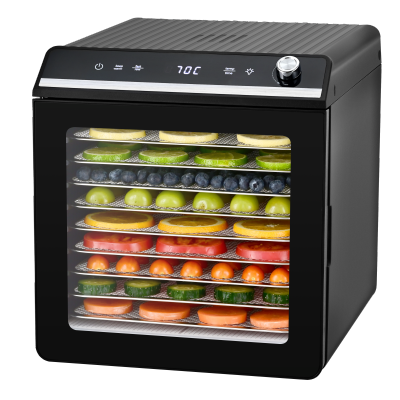
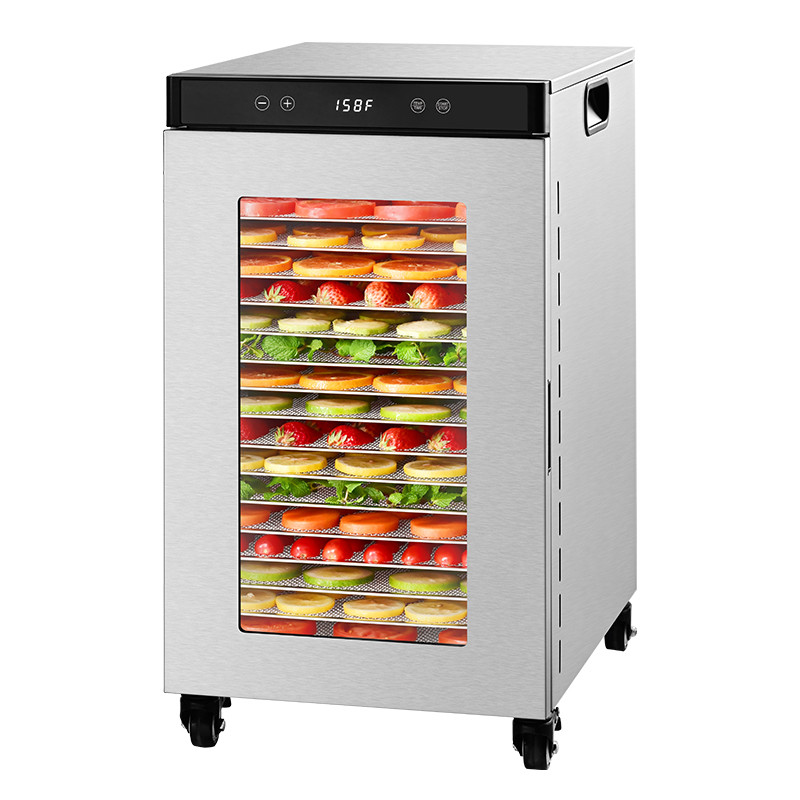
Commercial food dehydrators typically range from 10 to 30+ trays, with drying areas from 10 to 37+ square feet. The right capacity depends on your daily production volume. A small jerky business producing 50-100 lbs per week can manage with a 16-tray unit offering approximately 11 square feet. A medium-scale operation processing 200-500 lbs per week needs 20-22 trays with 16+ square feet. For industrial-scale production, 30+ tray units or multiple machines are necessary. Consider not just current volume but projected growth over 12-24 months. Kangye's KYS-500A/R offers 16/17 stainless steel trays at 850-1010W — ideal for entry-level commercial use. The KYS-510A/R with 20/22 trays at 1450-1730W handles higher volumes with the same horizontal airflow reliability.
Airflow Technology: Horizontal vs Vertical — Why It Matters for Commercial Use
In commercial environments where consistency and throughput are paramount, airflow technology is the most critical specification. Horizontal airflow (rear-mounted fan) systems push warm air across all trays simultaneously, eliminating the need for tray rotation and ensuring every batch is uniformly dried. This is essential for food safety — uneven drying can leave moisture in some pieces while others are over-dried, creating food safety risks. Vertical flow dehydrators (bottom or top-mounted fans) create thermal gradients that require manual tray rotation, which is impractical for high-volume commercial operations. Horizontal airflow also prevents flavor cross-contamination between different food types running simultaneously. Every Kangye commercial dehydrator uses rear-mounted horizontal airflow technology for consistent, reliable results.
Build Materials: Stainless Steel Grades for Commercial Durability
Commercial food dehydrators must withstand continuous operation, frequent cleaning, and exposure to food acids and moisture. The material standard for commercial equipment is 304 stainless steel — containing 18% chromium and 8% nickel — which offers excellent corrosion resistance, is non-magnetic, and meets food-grade hygiene requirements. Budget equipment may use 430 stainless steel (no nickel content, magnetic, lower corrosion resistance) or 201 stainless steel. For food-contact surfaces in commercial settings, 304 stainless steel is the minimum acceptable standard. Kangye commercial dehydrators feature food-grade 304 stainless steel construction throughout — trays, interior housing, and door frames — ensuring compliance with food safety regulations in North American and European markets.
Temperature Range and Control Precision
Commercial dehydrators need a wider temperature range than home units. For herbs and flowers, you need 95-115°F (35-46°C). Fruits and vegetables dry at 125-135°F (52-57°C). Meat jerky requires 155-165°F (68-74°C) — the USDA mandates reaching at least 160°F internally for beef jerky safety. Digital PID temperature control with ±2°F accuracy is preferred over analog thermostats for commercial applications. Kangye commercial dehydrators offer an adjustable range from 95-167°F with digital controls and a 48-hour timer. The precise temperature regulation ensures consistent product quality across every batch, which is essential for branded food products sold to retailers.
Power Requirements and Energy Efficiency
Commercial dehydrators require significantly more power than home units. Entry-level commercial models like the KYS-500A/R run on 850-1010W, which can typically plug into a standard 15A outlet. Larger units like the KYS-510A/R at 1450-1730W may need a dedicated 20A circuit. Industrial-scale dehydrators at 10kW+ require three-phase power. Energy efficiency directly impacts operating costs — horizontal airflow systems are 15-25% more efficient than vertical designs because heat is circulated in a closed loop rather than vented upward. When calculating total cost of ownership, include electricity costs over the expected 5-10 year service life.
Food Safety Certifications: NSF, CE, RoHS, and FDA Compliance
If you plan to sell dehydrated food products commercially, equipment certifications are not optional. NSF (National Sanitation Foundation) certification is required by many health departments in the United States. CE marking is mandatory for the European market. RoHS compliance ensures materials are free from hazardous substances. FDA compliance is required for food-contact materials in the US. Kangye commercial dehydrators are manufactured in ISO-certified facilities with CE, RoHS, and FDA-compliant materials. For wholesale buyers and OEM partners, we provide full certification documentation to support your market entry in North America, Europe, and Asia Pacific.
Warranty and After-Sales Support
A commercial dehydrator is a significant investment, and warranty terms directly reflect manufacturer confidence. Consumer dehydrators typically carry 1-year warranties. Entry-level commercial units often offer 2-3 years. Premium brands like Excalibur offer up to 10 years on select models. Beyond warranty length, evaluate the manufacturer's spare parts availability, technical support responsiveness, and service network. Kangye provides comprehensive after-sales support for all commercial dehydrators, including spare parts supply, technical documentation, and remote troubleshooting. For OEM partners, we offer extended warranty options and dedicated account management.
Noise Levels and Facility Requirements
Commercial dehydrators generate more noise than home units due to larger fans and motors. Typical noise levels range from 50-65 dB, comparable to a dishwasher or background music. If your dehydrator will operate in a customer-facing retail space, noise should be a consideration. Kangye commercial dehydrators are engineered for quiet operation relative to their power class. Also consider ventilation — dehydrators release warm, moist air that should be vented or managed with adequate room ventilation to prevent humidity buildup affecting other equipment or building materials.
OEM vs Buying Off-the-Shelf: What Commercial Buyers Need to Know
For brands entering the dehydrated food category, OEM manufacturing offers significant advantages over buying retail equipment. Direct factory pricing from Kangye eliminates distributor margins, typically saving 30-50%. Custom branding, packaging, and specification modifications allow differentiation in the market. Flexible MOQ (minimum order quantities) — Kangye's MOQ is one 40HQ container — makes OEM accessible for growing businesses. Full certification support ensures your products meet target market requirements. Whether you need a private-label commercial dehydrator for your brand or white-label units for distribution, Kangye provides end-to-end manufacturing support from design through logistics.
Conclusion: Making the Right Commercial Investment
Choosing a commercial food dehydrator requires careful evaluation of capacity, airflow technology, materials, certifications, and total cost of ownership. The right machine will pay for itself through reliable production, consistent quality, and long service life. Kangye Electric Appliance, based in Shunde, China, manufactures commercial food dehydrators trusted by brands worldwide. Contact our sales team to discuss your requirements, request samples, and explore OEM partnership opportunities.