Understanding Food Dehydrator Heating Technologies: Bottom, Back & Top Heating Compared
Introduction: The Science of Dehydration
Food dehydration is fundamentally the process of removing moisture from food through controlled warm air circulation. While the concept is simple — heat plus airflow equals evaporation — the engineering behind different dehydrator designs varies significantly. The placement of the fan and heating element is the single most critical design decision that determines drying evenness, energy efficiency, cleaning difficulty, and overall food quality. This technical article examines three primary heating configurations found in modern food dehydrators: bottom-mounted, top-mounted, and back-mounted (horizontal airflow) systems.
Bottom-Mounted Heating: The Budget-Friendly Design
Bottom-mounted heating systems position the fan and heating element at the base of the unit. Air is drawn from below and pushed upward through the stack of trays. This design is the most affordable to manufacture, making it common in entry-level dehydrators priced between $20 and $60. However, the engineering compromises are significant. Heat naturally rises, so the bottom trays receive the most intense heat while top trays receive significantly cooler air. This creates a thermal gradient that can be 15-25°F between the bottom and top trays. More critically, food crumbs and drippings fall directly onto the fan and heating element, creating a fire hazard and a sticky mess. Over time, residue buildup reduces fan efficiency and can cause the heating element to burn food particles.
Top-Mounted Heating: A Step Up in Performance
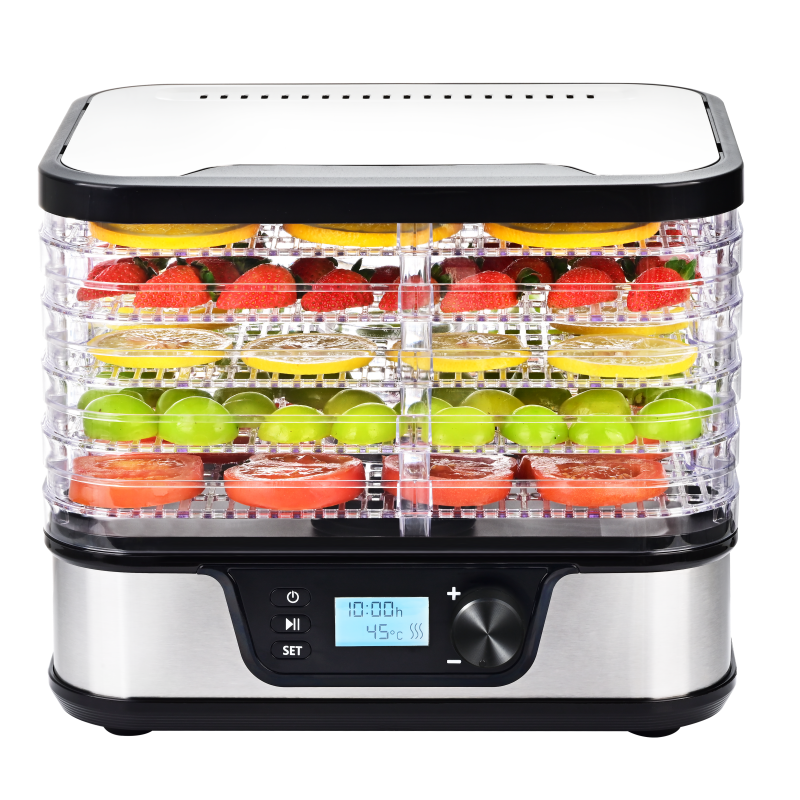
Top-mounted dehydrators move the fan and heating element to the top of the unit, solving several problems inherent in bottom-mounted designs. Crumbs and drippings no longer fall onto the fan, reducing cleaning difficulty and eliminating the fire risk from residue buildup. Air is pushed downward through the tray stack. While more even than bottom-mounted systems, top-mounted designs still create a vertical temperature gradient. The trays closest to the fan dry fastest, and users must rotate the stack periodically for consistent results. Most top-mounted dehydrators include adjustable temperature controls and basic timers.
Back-Mounted (Horizontal) Heating: The Professional Standard
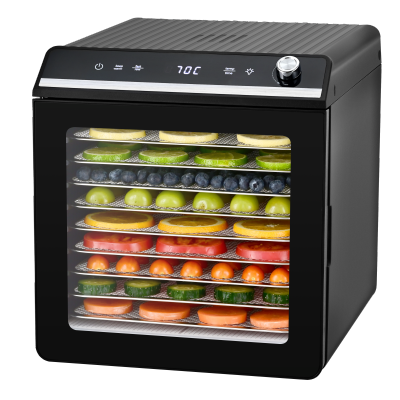
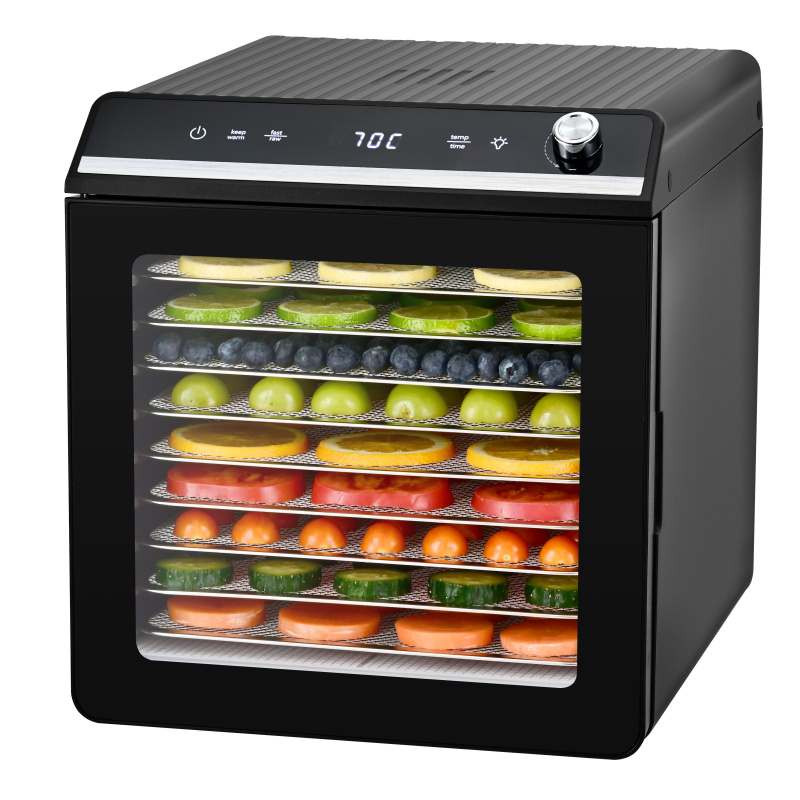
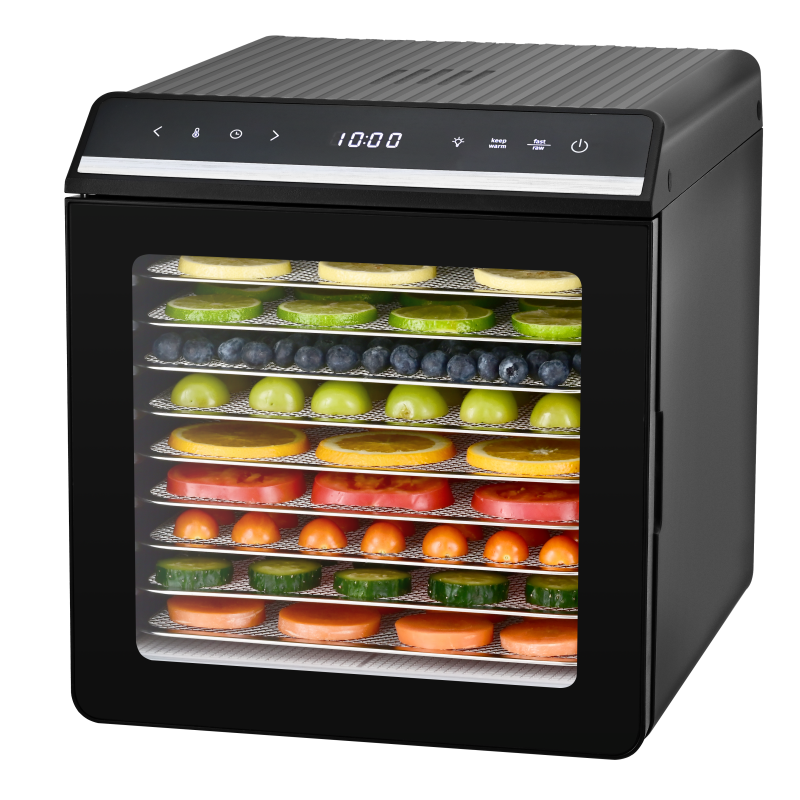
Back-mounted dehydrators place the fan and heating element at the rear of a rectangular cabinet. Air moves horizontally across every tray simultaneously, eliminating the thermal gradient problem entirely. Every tray receives the same temperature air at the same velocity, resulting in perfectly uniform drying with no need for tray rotation. Horizontal airflow also prevents flavor cross-contamination because air passes each tray independently. The rear-mounted fan stays clean since no drippings can reach it. Kangye KYS-315 series uses this advanced design with 10 BPA-free stainless steel trays and 600-700W motor.
Airflow Dynamics: Laminar vs Turbulent Flow
Horizontal flow dehydrators produce near-laminar airflow — smooth, parallel air streams that maintain consistent velocity and temperature across the entire drying surface. Vertical flow dehydrators produce turbulent air patterns as the rising air interacts with tray surfaces, center holes, and food pieces. The center-hole design of round stackable trays further complicates airflow — hot air preferentially rises through the center opening rather than passing through the food. Measurements show that horizontal flow dehydrators can reduce drying time by 20-30% compared to vertical flow designs for the same food load.
Heat Distribution and Energy Efficiency
Horizontal flow dehydrators are the most energy-efficient because the confined rear-mounted system directs all heated air across the food trays in a closed loop. The heat is reused as it circulates, maintaining consistent temperature with less power consumption. Kangye horizontal-flow dehydrators achieve their 600-700W drying performance with energy efficiency that translates to lower operating costs. For wholesale buyers evaluating total cost of ownership, a horizontal-flow dehydrators higher upfront cost is offset by lower electricity bills and faster batch times.
Tray Design and Material Considerations
Vertical stackable units use round trays with a center hole that reduces usable drying space by approximately 15-20%. Horizontal units use rectangular drawer-style trays that provide full access to any tray without disturbing others. Material quality is another differentiator: plastic trays are common in entry-level units, while premium horizontal dehydrators use BPA-free stainless steel that conducts heat more efficiently, resists warping, and is dishwasher-safe.
Temperature Control Systems: Analog vs Digital vs PID
Basic dehydrators use analog bimetal thermostats that maintain temperature within ±10-15°F. Digital thermostats improve accuracy to ±5°F. PID controllers maintain temperature within ±1-2°F, critical for applications like yogurt fermentation or raw-food dehydration. Kangye dehydrators incorporate digital temperature control with a 48-hour timer and fan-only mode, covering the full 95-167°F range.
Cleaning and Maintenance: Engineering for Serviceability
Horizontal flow dehydrators offer the best cleaning experience: the rear fan is completely protected from drips, and the stainless steel trays are individually removable and dishwasher-safe. Bottom-mounted units require disassembling and manual cleaning of the fan blades. For commercial users processing large volumes, reduced cleaning time translates to higher throughput.
Selecting the Right Technology for Your Application
For occasional home users, a top-mounted stackable dehydrator offers good value. For regular users processing weekly batches, horizontal-flow with stainless steel trays is the better investment. For commercial users, horizontal-flow technology is non-negotiable. Kangye specializes in horizontal-flow food dehydrators with rear-mounted fan systems, offering full OEM/ODM services.
Conclusion: Engineering Excellence Defines Performance
Horizontal airflow with rear-mounted fans consistently outperforms vertical designs in drying evenness, energy efficiency, and food quality. For OEM buyers and distributors partnering with Kangye, this means products that meet the highest standards of performance and reliability.