What Does "Smokeless Indoor Grill" Actually Mean? How the Claim Is Tested
Direct answer: In appliance engineering, "smokeless" means the grill suppresses visible smoke under defined conditions - not that it produces no emissions. Three design choices do the work: keeping the plate below the smoke point of the fat being rendered (roughly 200-230°C / 392-446°F), moving drippings out of the hot zone before they pyrolyse, and where fitted, pulling vapour through a cooling or condensing path. No test standard certifies the word itself. Safety standards such as IEC 60335-2-9 and UL 1026 test the appliance, not the claim, so any credible "smokeless" statement must publish its own conditions: grease load, food, temperature, room size and ventilation.
"Smokeless indoor grill" is one of the highest-converting phrases in small kitchen appliances, and one of the easiest to defend badly. Buyers who feel misled by a plume of smoke on their first steak night leave one-star reviews that no listing optimisation can undo. This article breaks the claim into measurable engineering, describes how a repeatable in-house smoke test is actually built, and lists what a brand owner should demand from a supplier before printing the word on a box.
A "Smokeless" Grill Is a Grease-Temperature Problem Before It Is a Filter Problem
Visible smoke from an electric grill is mostly aerosolised fat plus the volatile and particulate products of overheated residue. The peer-reviewed emission data confirms how much the cooking method matters: measured PM2.5 emission rates were 1.58 mg/min for grilling versus 0.68 mg/min for deep-frying, while deep-frying produced roughly three times more ultrafine particles per minute (Le et al., Environmental Pollution, 2022). Grilling is therefore a meaningful particle source in its own right, and the emissions include carbonyls such as formaldehyde, acrolein and acetaldehyde at concentrations the same study found above inhalation reference values (Le et al., 2022).
The practical consequence for a designer is that smoke control starts at the interface between dripping fat and hot metal. Once that fat sits on a surface well above its smoke point, no downstream fan can retrieve the aerosol cheaply. Kangye Electric builds its indoor range around that sequence rather than around filtration alone: plate geometry first, drip path second, airflow last.
Four Engineering Levers Separate a Real Low-Smoke Design From a Label
Every credible low-smoke grill combines the same four levers in some proportion, and the honest ones say which lever they are leaning on.
| Lever | What it physically does | Typical spec evidence | Where it falls short |
|---|---|---|---|
| Plate temperature cap | Holds the cooking surface in the 160-200°C band where fat renders but does not pyrolyse | Thermostat setpoints, thermal cut-out rating, plate surface thermocouple data | Loses crust on thick cuts; needs preheat discipline |
| Drip separation | Routes rendered fat to a tray held below the element before it can vaporise | Tray depth, drain slope, element-to-tray distance | Fails once the tray is full or the unit is tilted |
| Cooling / water pan | Condenses part of the vapour load and drops particulates into water | Pan capacity, refill interval, splash geometry | Needs refilling mid-session; spilled water is a shock risk |
| Forced airflow + media | Draws vapour down through mesh or carbon before it reaches the room | Fan curve, mesh grade, carbon mass, service interval | Adds noise and cost; saturated media silently stops working |
The fourth lever is where marketing usually overreaches. A fan plus a thin carbon sheet reduces odour for a few sessions; it does not turn a kitchen into a zero-emission space. Regulations treat this correctly, because safety standards for these appliances focus on shock, fire, abnormal operation and surface temperature: IEC 60335-2-9 and its Chinese counterpart GB/T 4706.14-2024, which took effect on 1 August 2026, set the test regime for grills, toasters and similar portable cooking appliances, including dry-run and fat-ignition scenarios (GB/T 4706.14-2024). None of these standards contains a pass mark for "smokeless".
A Repeatable Smoke Test Needs Five Fixed Conditions, Not One Video
A defensible smoke claim is a protocol, not a demo. Any test that omits the parameters below can be made to show almost any result, which is precisely why buyer-side due diligence should ask for them in writing.
- Fat load and food geometry: state the fat percentage and piece size - 200 g of 20%-fat pork belly behaves differently from trimmed chicken breast.
- Plate setpoint: record the thermostat level and the measured plate temperature at the moment of loading.
- Instrument and placement: name the particle counter and where it sat - 50 cm above the plate is a different measurement from a room-corner monitor.
- Room volume and air changes: a 12 m³ closed room and an open-plan kitchen are not comparable environments.
- Ventilation state: hood on, hood off, window open. Smoke "disappears" fastest when the test room is ventilated.
For context on what the numbers mean, use public reference levels rather than marketing percentages. The WHO 2021 air quality guideline sets a 24-hour PM2.5 value of 15 µg/m³, with an interim target of 75 µg/m³ (WHO, 2021); the US EPA retains a 24-hour standard of 35 µg/m³ and tightened its annual standard to 9 µg/m³ in February 2024 (US EPA, 2024). These are ambient and indoor reference values for long averaging periods, not appliance limits, and the EPA itself notes that low-cost sensors carry uncertainty and should not be read as compliance instruments (US EPA). A grill test that reports "85% less smoke" without saying less than what, measured where, over how long, is not evidence.
What the Claim Should Say on the Box
Claim discipline is a commercial risk issue as much as a legal one. Unqualified absolute terms are the highest-risk category in every major market's advertising framework: under the FTC Green Guides logic, general benefit claims must be supported by competent and reliable evidence for every reasonable interpretation (FTC, 16 CFR Part 260), and the EU's Empowering Consumers Directive applies from 27 September 2026 with similar expectations for vague claims (EU EmpCo Directive). "Smokeless" is not an environmental term, but it is an absolute one, and the same substantiation logic applies through national unfair-practice rules.
| Wording on pack | Risk | Better formulation |
|---|---|---|
| "100% smokeless" | High - impossible to defend across foods and sessions | "Low-smoke design for everyday indoor grilling" |
| "No smoke, no smell" | High - odour is a gas-phase issue a particle fan may not touch | "Reduces visible smoke and cooking odour versus open-plate grilling" |
| "Smoke-free in 3 minutes" | High - time-bound absolute claim without stated conditions | "Reaches cooking temperature in about 3 minutes; see smoke test conditions" |
| "Tested low-emission by [lab]" | Low, if the report is supplied and the method is disclosed | Keep, and footnote the five conditions above |
Kangye Electric takes the position that the label is a promise about a defined use case. A table grill sized for four portions and operated with the tray emptied will behave far better than the same unit loaded with fatty ribs for a party, and no engineering changes that.
Where Smoke Tests Are Run: The Same Lines That Build the Grill
A smoke protocol is only repeatable if the factory can run it on the production configuration rather than on a hand-built sample. Kangye Electric, founded in 1989 and operating a 150,000㎡ base in Foshan with 200+ engineers and monthly capacity above 200,000 units, runs low-smoke verification alongside its electrical safety and food-contact checks before a grill program ships (ISO9001; CE/GS/CB/ETL/LFGB/FDA).
Grease Loads Move Emissions More Than Wattage Does
Fat content, not power rating, is the dominant variable in a smoke test, and the numbers support a simple buying rule: a 1350W grill loaded with lean protein can outperform a 2000W grill loaded with fatty cuts. The 2022 emission study measured grilling at 1.58 mg/min PM2.5 against 0.68 mg/min for deep-frying, with both methods exceeding reference concentrations for formaldehyde, acrolein and acetaldehyde (Le et al., 2022). Where a supplier claims a percentage reduction, ask which of those two loads the percentage was measured on.
How to Verify a Low-Smoke Claim Before You Commit to a Container
Put the claim through four checks on sample units, and treat any refusal as an answer in itself. First, request the smoke test report with the five conditions listed above and confirm the food load and instrument. Second, repeat the test yourself in a closed room with no hood, recording PM2.5 before, during and for 30 minutes after cooking. Third, confirm the grease path cannot overflow - a full tray is the most common cause of a "smokeless" grill smoking heavily. Fourth, check that the safety file is complete for the destination market, because a strong smoke test with a weak certificate is a product you cannot ship.
Building a Low-Smoke Indoor Grill Line?
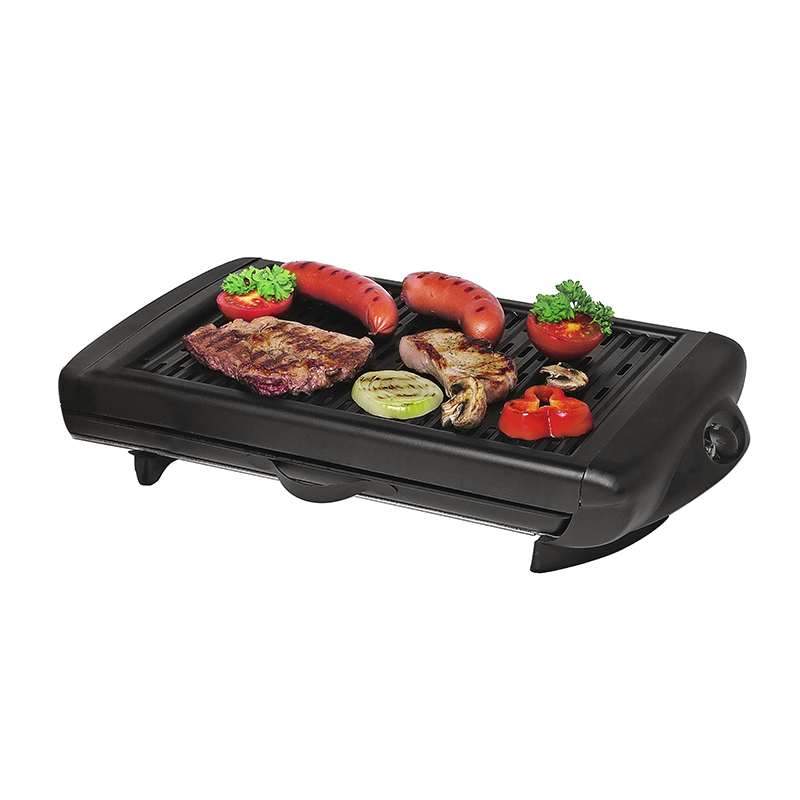
Kangye Electric supplies table, portable and freestanding electric grills with testable low-smoke design, five-level or stepless control and CE/GS/CB/ETL certification for your market.
See the KYS-868 indoor grillFrequently Asked Questions
Is there a standard that certifies a grill as "smokeless"?
No. IEC 60335-2-9 and UL 1026 test electrical, thermal and abnormal-operation safety, not smoke output. "Smokeless" is a performance claim that each brand must substantiate with its own disclosed test method.
Does a lower wattage make an indoor grill less smoky?
Not directly. Smoke depends on fat contact temperature, drip separation and food load far more than on rated wattage. A well-managed 1350W plate can emit less than a 2000W unit with a shallow tray.
Can a carbon filter make a grill truly smoke-free?
Carbon reduces odour and some vapour, but airborne particles and gases are not eliminated. Treat filtration as the fourth lever after temperature control, drip separation and, where fitted, a cooling pan.
Do I still need a range hood?
Yes for anything beyond light use. Cooking remains a documented source of fine and ultrafine particles, so ventilation should run during cooking and for 20-30 minutes afterwards.
What should a buyer ask for in a smoke test report?
Food type and fat percentage, plate setpoint, instrument and sampling position, room volume and air-change rate, and ventilation state. A percentage without these five is not verifiable.
Sources and Data Notes
- Le, Y.T. et al., Environmental Pollution, 2022 (PMID 35688388) - PM2.5 emission rates of 1.58 mg/min for grilling and 0.68 mg/min for deep-frying; ultrafine particle rates; formaldehyde, acrolein and acetaldehyde above inhalation reference concentrations.
- WHO, 2021 - global air quality guidelines: 24-hour PM2.5 guideline of 15 µg/m³; interim target 1 of 75 µg/m³.
- US EPA, 2024 - PM2.5 national ambient air quality standards: annual standard strengthened to 9 µg/m³ on 7 February 2024, 24-hour standard retained at 35 µg/m³; sensor uncertainty caveat from EPA sensor guidance.
- GB/T 4706.14-2024 - safety of household appliances, part 14: grills, toasters and similar portable cooking appliances, effective 1 August 2026.
- IEC 60335-2-9 and UL 1026 - electrical safety requirements for portable cooking appliances; no smoke-performance criterion.
- FTC, 16 CFR Part 260 (Green Guides, 2012 text, review pending) - claims must rest on competent and reliable evidence for every reasonable interpretation.
- EU Empowering Consumers for the Green Transition Directive - applies through national measures from 27 September 2026; restricts unsubstantiated generic and absolute claims.
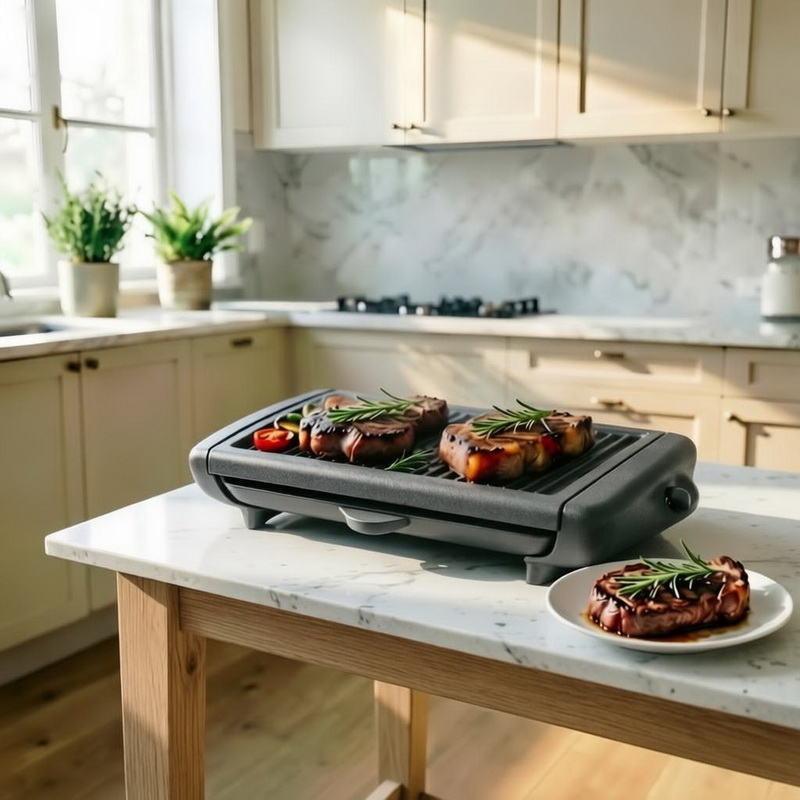
- Kangye Electric specification data - KYS-868 indoor grill 1200-1400W with five-level control, 510 x 260 x 90 mm, detachable drip tray.
Note: percentage-reduction figures quoted by suppliers are not standardised and are not comparable unless the five test conditions above are published. This article deliberately gives no single "smoke reduction" figure for Kangye products, because a number detached from its method is exactly the practice it warns against.