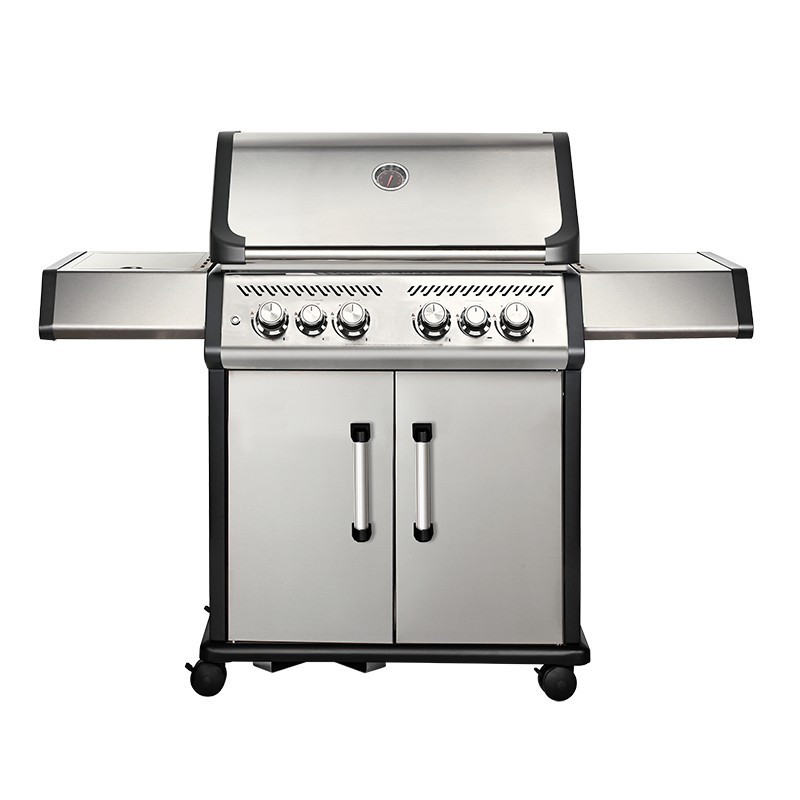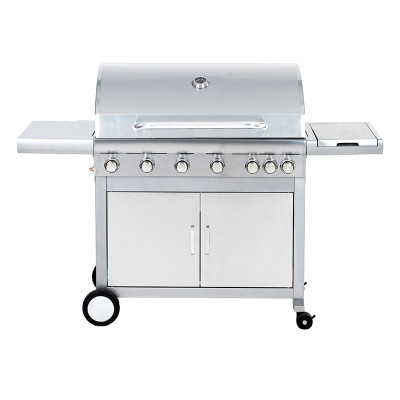
What Is a Low-Pressure Propane Grill? Regulator and Gas Type Standards by Region
Direct answer
A low-pressure propane grill runs on gas reduced by a regulator to a fixed, low outlet pressure - not on the 100-200 PSI inside the cylinder. North America and Australia land near 11 inches of water column (2.74-2.75 kPa, about 27 mbar); Europe splits by country, with 30 mbar, 37 mbar and 50 mbar all still in force and Great Britain on 37 mbar propane. "Low pressure" is the appliance-side gas class, and it is the first thing an OEM order has to fix: the regulator, injector, hose and data plate all change with it.
1. What "low pressure" means, and what it does not
Propane is stored in a cylinder as a liquid in equilibrium with its vapour, and that vapour pressure sits between roughly 100 and 200 PSI depending on ambient temperature. No grill burner is built to see that. A low-pressure appliance receives gas at around 0.4 PSI, and the regulator makes that step-down once, consistently, for the life of the unit.
Two consequences cause real field failures. A low-pressure grill must never be connected to an unregulated source, which is why the regulator supplied with the unit is the only approved one. And high-pressure appliances are a separate family, not a stronger version of it: fryers and jet burners run on 1-60 PSI, and that hardware puts far too much gas into a grill manifold.
The third complication is units: inches of water column in the United States, millibar in Europe, kilopascals in Australia - the same pressure in three languages, so a spec sheet is useless until buyer and factory agree which one is in use.
| Market / gas category | Outlet pressure | Inch w.c. | kPa | mbar |
|---|---|---|---|---|
| North America (LP grill) | 11 in w.c. | 11 | 2.74 | 27.4 |
| Australia / New Zealand | 2.75 kPa | 11.0 | 2.75 | 27.5 |
| Europe I3+ (propane) | 37 mbar | 14.9 | 3.7 | 37 |
| Europe I3B/P(30) | 30 mbar | 12.0 | 3.0 | 30 |
| Europe I3B/P(50) | 50 mbar | 20.1 | 5.0 | 50 |
2. Regulator types, and the sizing rule that decides performance
The regulator on a typical outdoor grill is a single-stage, low-pressure unit: compact, inexpensive, matched to one flow range. Two-stage regulators do the same job in two steps and suit one tank feeding several appliances; integral regulators are built into cooktops and built-in grills; adjustable high-pressure units belong to a different family.
Sizing matters more than buyers expect. Regulator makers advise flow capacity at least 20% above the appliance's demand. A standard replacement regulator handles roughly 50,000-60,000 BTU/hr - enough for most residential grills, short of the multi-burner models that pass 100,000 BTU/hr. Undersized regulators do not fail loudly: they starve the burners, and the weak, surging flame is misdiagnosed as a burner fault.
| Regulator type | Typical outlet | Where it is used | Notes |
|---|---|---|---|
| Single-stage, low pressure | 11 in w.c. (North America) | Most consumer grills | Compact; matched to one flow range |
| Two-stage | 11 in w.c. at the second stage | RV, bulk tank, multi-appliance | Higher, steadier flow under load |
| Integral appliance regulator | 11 in w.c. | Built-in grills, cooktops, ranges | Mounted inside the appliance |
| High-pressure | 1-60 PSI | Turkey fryers, jet burners | Not interchangeable with LP grills |
3. North America: one pressure, one connector
In the United States and Canada the appliance-side answer is fixed at 11 inches of water column, and so is the connection. Modern grills use the Type 1 (QCC1) cylinder fitting: right-hand thread, hand-tight with no sealant, a thermal element that shuts off flow near 115 degC (240 degF), and a flow limiter capped at roughly 0.28 m3/h (10 ft3/h). The older left-hand POL fitting survives on old tanks, and manuals warn against connecting a Type 1 grill to it.
The cylinder is regulated too: North American cylinders need an overfill prevention device (OPD) and must be built to DOT rules in the US or CAN/CSA-B339 in Canada. ANSI Z21.58 / CSA 1.6 governs the appliance - a 10 mph wind test with burners required to stay lit, a rain test, carbon monoxide under 0.08%, rated input within plus or minus 5%, and six eight-hour operating cycles. The 2022 sixth edition added smart-appliance provisions, with updated requirements taking effect on 1 September 2026. LP hoses fall under ANSI/UL 569, and cylinder size tracks input: 20 lb below 80,000 BTU/hr, 30 lb at and above.
| Item | North American requirement |
|---|---|
| Regulator outlet pressure | 11 in w.c. (2.74 kPa / 27.4 mbar) |
| Cylinder connection | Type 1 / QCC1, right-hand, hand-tight, no tape |
| Cylinder and hose | OPD mandatory, DOT or CAN/CSA-B339; hose to ANSI/UL 569 |
| Appliance standard | ANSI Z21.58 / CSA 1.6; 20 lb below 80,000 BTU/hr, 30 lb at and above |

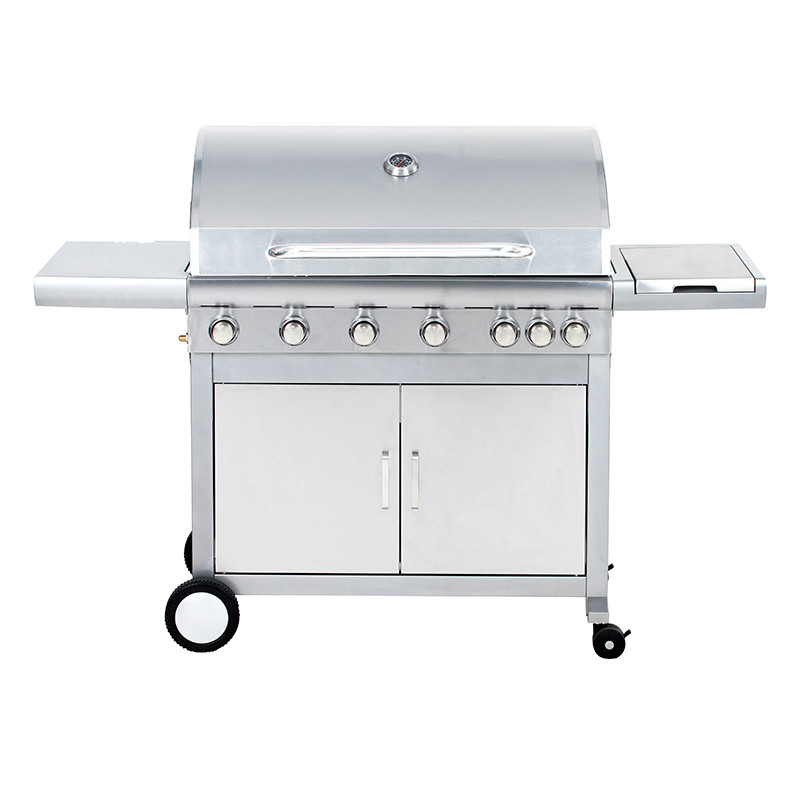
4. Europe: the pressure depends on the country, not the continent
Europe harmonised safety requirements but not gas pressures. A gas grill sold in the EU must conform to Regulation (EU) 2016/426 (the Gas Appliance Regulation, GAR) and carry CE marking, tested to EN 498 with test gases defined by EN 437. What the GAR does not do is give the continent one working pressure: appliances are declared to a gas category, and each category maps to a set of countries.
| Gas category | Regulator outlet | Countries in this category |
|---|---|---|
| I3+ | Butane 28-30 mbar / propane 37 mbar | BE, CH, CY, CZ, ES, FR, GB, GR, IE, IT, LT, LU, LV, PT, SK, SI |
| I3B/P(30) | Butane/propane 30 mbar | BE, BG, CY, DK, EE, FI, HR, HU, IS, IT, LT, LU, MT, NL, NO, RO, SE, SI, SK, TR |
| I3B/P(37) | Butane/propane 37 mbar | PL |
| I3B/P(50) | Butane/propane 50 mbar | AT, CH, CZ, DE, SK |
The clearest proof that these are separate products sits in the burner table of any European grill manual: the same 12 kW grill takes a 0.86 mm injector at 37 mbar but only 0.75 mm at 50 mbar, because higher supply pressure pushes more gas through the same hole. Germany's 50 mbar is the most common surprise for buyers who treat Europe as one market.
Components are specific too: the regulator to EN 16129, the hose to EN 16436, kept to 1.5 m and rated above 80 degC. Great Britain left the EU conformity system on 1 January 2021 and now uses UKCA marking with UK Approved Bodies, while the technical requirements still point at the same EN standards.
5. Great Britain, Australia and New Zealand
Great Britain keeps 37 mbar propane and 28-30 mbar butane, so a GB order is technically close to a French one but carries a different conformity mark. Australia and New Zealand match North America on pressure - a 2.75 kPa outlet - with a different hardware ecosystem: propane or ULPG cylinders certified to AS 2469, a 1/4 inch BSP hose inlet rather than a QCC1 nut, installation under AS/NZS 5601, and a regulator and hose assembly that must be the parts specified by the appliance manufacturer.
Certification splits the same way. Australia and New Zealand require certification against AS 3645:2017 through a body such as the Australian Gas Association, and compliant products carry the AGA Mark with an annual verification audit - a different paperwork chain from a CE declaration, even when the grill is mechanically similar.
| Market | Outlet pressure | Connector / hose | Appliance standard | Conformity mark |
|---|---|---|---|---|
| US / Canada | 11 in w.c. (27.4 mbar) | Type 1 QCC1; hose to ANSI/UL 569 | ANSI Z21.58 / CSA 1.6 | UL or CSA listing |
| European Union | 30 / 37 / 50 mbar by country | EN 16129 regulator; EN 16436 hose, max 1.5 m | EN 498 under GAR (EU) 2016/426 | CE |
| Great Britain | 37 mbar propane / 28-30 mbar butane | EN 16129 regulator; EN 16436 hose | EN 498 | UKCA |
| Australia / New Zealand | 2.75 kPa (27.5 mbar) | 1/4 inch BSP hose inlet; AS 2469 cylinders | AS/NZS 5601 and AS 3645:2017 | AGA Mark |
6. What the regional split means for an OEM order
A gas grill is not export ready as a generic object; it is configured per market, and an order that omits the gas class forces the factory to guess. Six variables move together before tooling and certification are committed, because changing an injector afterwards invalidates the report the certificate was issued against.
| Specification item | US / Canada | EU | Great Britain | Australia / NZ |
|---|---|---|---|---|
| Regulator outlet pressure | 11 in w.c. | 30 / 37 / 50 mbar | 37 mbar | 2.75 kPa |
| Tank connection | Type 1 QCC1 | Local valve, EN 16129 regulator | Local cylinder valve | 1/4 inch BSP hose |
| Injector orifice | Sized for 11 in w.c. | Sized per country mbar | Sized for 37 mbar | Sized for 2.75 kPa |
| Data plate heat input unit | BTU/hr | kW | kW | MJ/h |
| Certification | UL or CSA listing | CE (GAR 2016/426) | UKCA | AGA Mark |
| Hose standard | ANSI/UL 569 | EN 16436 | EN 16436 | Manufacturer-specified |
The unit spread is a useful sanity check. One 18.9 kW six-burner grill is about 64,500 BTU/hr on an American document and about 68 MJ/h on an Australian one. The same grill is a 27.4 mbar appliance in the US and a 37 mbar appliance in France - roughly a third more supply pressure, which is why one injector cannot serve both.
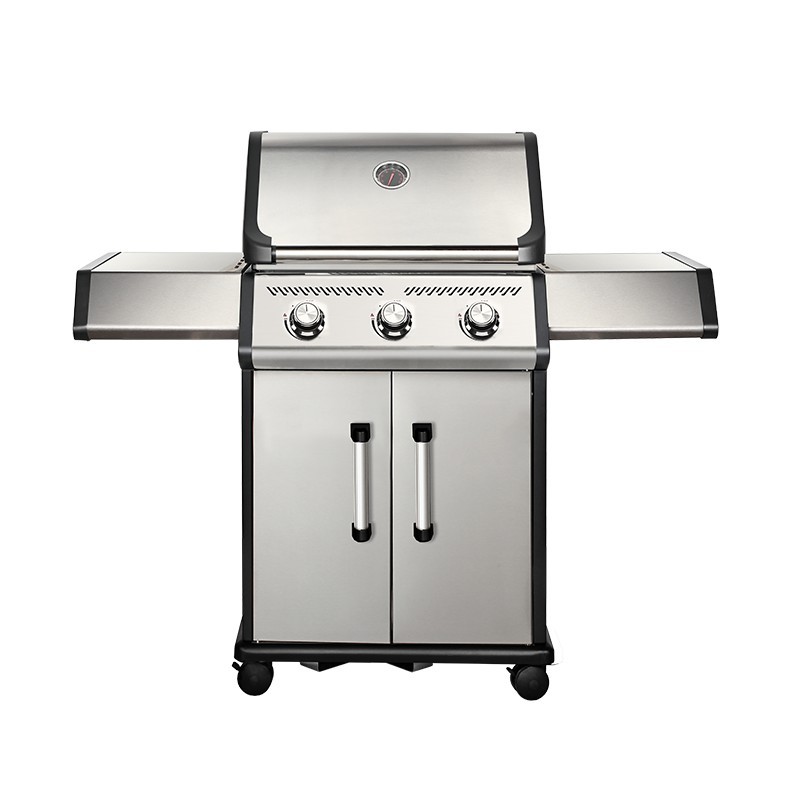
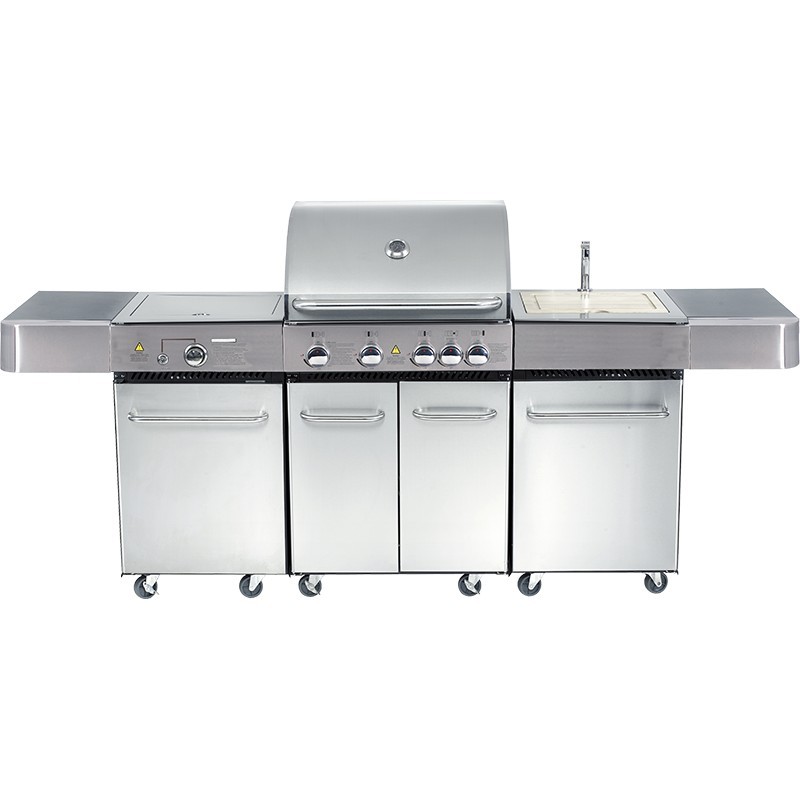
The practical answer is to put the gas class on the inquiry instead of assuming it. Kangye Electric builds its gas grill range with market-specific regulator and orifice kits, with factory gas variants covered under CE, GS, CB, ETL, AGA and CSA certification streams, so the configuration is set before the model goes into production.
7. Frequently asked questions
Is a low-pressure grill the same as an LPG grill?
LPG (ULPG in Australia and New Zealand) is the fuel; low pressure is the delivery class on the appliance side. Most consumer LPG grills are low pressure, but portable jet burners and fryers are not, so the class must be read off the label.
Why does Europe still use three different outlet pressures?
Because the GAR harmonised safety without harmonising gas infrastructure. Appliances are declared to a category such as I3+ or I3B/P(30), and the country list attached to each category decides the correct regulator.
What does an undersized regulator look like in the field?
A weak or yellow flame that never reaches full heat, surging at the burners, and complaints about uneven cooking. Size flow capacity to the grill's total rated input plus at least a 20% margin before looking for a burner fault.
What must appear on the data plate?
The outlet pressure in the local unit, the gas family and category, total rated heat input in the local unit (BTU/hr, kW or MJ/h), and a certificate number that matches the exact model being shipped.
8. Sources and data notes
- Gas grill owner's manual, LP cylinder and regulator section (2026): 11 in w.c. outlet; QCC Type 1 thermal shut-off near 115 degC and 0.28 m3/h flow limiter; DOT / CAN/CSA-B339 cylinders with OPD.
- MB Sturgis low-pressure regulator datasheet (2026): single-stage, Type 1 (QCC1) inlet, 3/8 inch NPT outlet, 11 in w.c., 65,000 BTU/hr; cylinder pressure 100-200 PSI.
- Noursun regulator notes (2026): regulator families by application; capacity should exceed appliance demand by at least 20%.
- EngineerFix regulator guide (2026): QCC1 against POL; the three compatibility factors; typical draw 30,000-50,000 BTU/hr, larger grills above 100,000 BTU/hr.
- Adexa and Nexgrill European grill instructions (2026): categories I3+, I3B/P(30), I3B/P(37), I3B/P(50) with country lists; EN 16129 regulators; EN 16436 hoses, 1.5 m limit; 0.86 mm injector at 37 mbar versus 0.75 mm at 50 mbar for 12 kW.
- Gasmate barbecue manuals (2026): 2.75 kPa outlet, 1/4 inch BSP hose inlet, AS 2469 cylinders, AS/NZS 5601 and NZS 5601.
- Australian Gas Association gas product certification (2026): AS 3645:2017 scope, AGA Mark, annual verification audit.
- UL and GMA gas appliance compliance guide (2026): ANSI Z21.58/CSA 1.6 highlights (10 mph wind test, rain test, 0.08% CO, plus or minus 5% input, six eight-hour cycles); GAR (EU) 2016/426 modules; EN 484, EN 497 and EN 498; UKCA from 1 January 2021.
- Kangye Electric gas grill specification sheets (2026): rated inputs for the models referenced above.
Conversions used throughout: 1 in w.c. = 0.249 kPa; 1 mbar = 0.1 kPa; 1 kW = 3,412 BTU/hr = 3.6 MJ/h. Categories and country lists change - confirm the destination's current category before releasing an order.
Featured machine
KYQ-A480RB 4-burner gas BBQ grill with 4.5kW infrared side burner
Full cast aluminum chamber with a stainless steel door and a 4.0kW rear burner, supplied with market-specific regulator and orifice kits for LPG programmes - OEM/ODM supported by Kangye Electric's 150,000 sqm base.