How Long Does OEM Kitchen Appliance Development Take? A Stage-by-Stage Timeline
If you are planning a product launch around a factory's production calendar, the single most useful number is not one figure but a timeline that changes with how deep your customization goes. Buying a finished model with your logo is a factory-scheduling exercise; commissioning a brand-new product is a project with design, tooling, certification and pilot-production gates, each with its own clock. This guide breaks both down with 2026 benchmarks, and links the process detail to our longer OEM appliance manufacturing process walkthrough.
How Long Does Each Level of OEM Customization Take?
The customization depth sets your baseline: the more of the product you change, the longer every downstream stage takes. Industry FAQs in 2026 converge on three tiers, and the spread between them is roughly fourfold.
| Customization tier | What changes | Typical timeline (2026) |
|---|---|---|
| Recolor and logo (private label) | Existing platform; color, logo, packaging, manual | 5–8 weeks (Goodfriends Kettle, 2026) |
| Semi-custom | New appearance or function on an existing platform | 90–120 days (Qana Holdings, 2026) |
| All-new development | New molds, new electronics, certification from scratch | 120–180 days; 3–5 months brief to first container (Qana Holdings, 2026; Kangye Electric project data, 2026) |
The top row is what most importers actually buy. A factory that already holds tooling, certification and BOM for a running model only needs to apply your branding, so the calendar is dominated by production slots and shipping. If that faster path fits your plan, our private label kitchen appliances guide covers how the commercial terms differ.
What Happens at Each Stage of a Brand-New OEM Appliance Program?
A brand-new molded kitchen appliance passes through seven gates, and each gate has a duration you can hold your supplier to. The stage table below reflects Kangye Electric program milestones published in 2026, cross-checked against independent 2026 tooling benchmarks from OkTool, GMMoldTech and Shun Hing.
| Stage | Typical duration | Your role as buyer |
|---|---|---|
| 1. Brief lock and DFM review | 1–3 days | Approve spec, voltage, target certifications |
| 2. Engineering and prototypes | 2–6 weeks | Approve form, fit, function (Zetwerk, 2026: 2–6 wks; China 2 West, 2026: 4–6 wks design + 6–8 wks functional prototypes) |
| 3. Production tooling | 4–8 weeks | Approve T0/T1 samples and dimensional report |
| 4. Sampling and certification testing | 2–4 weeks | Book test lab, prepare technical file |
| 5. Trial run (pilot production) | 1–2 weeks | Audit pilot line, approve pilot units |
| 6. Mass production | 4–8 weeks | Schedule PSI, monitor production reports |
| 7. Packing, inspection and loading | 1–2 weeks | Confirm AQL results, arrange logistics |
Two cross-checks keep stage 3 honest. OkTool's 2026 benchmark for home-appliance molds is 7–11 weeks from RFQ approval to the start of mass production, including design, fabrication and first samples. Shun Hing's 2026 tooling FAQ quotes 4–8 weeks depending on complexity, and GMMoldTech's 2026 guide puts a production-grade appliance mold at 8–14 weeks with prototype molds in 3–5 weeks. If a supplier quotes far below these ranges, ask what was excluded.
How Much Time Does Certification Add to an OEM Project?
Certification testing adds 3–16 weeks depending on which marks your target market requires, and it is the stage buyers most often schedule too late. The 2026 benchmarks below are for small kitchen appliances under IEC 60335-family standards.
| Mark | Typical lead time (2026) | Source |
|---|---|---|
| CB (IEC 60335-1/-2-9) | 3–5 weeks | APEXDURA, 2026 |
| CE (LVD + EMC + RoHS) | 4–6 weeks | APEXDURA, 2026 |
| ETL for US and Canada | 4–8 weeks | APEXDURA, 2026 |
| LFGB food contact | 3–4 weeks | APEXDURA, 2026 |
| GS (Germany) | 8–10 weeks best case; 10–16 weeks typical | Huayu Test, 2026 |
The CB route is the multi-market shortcut: one IEC 60335 test report converts into national marks with reduced re-testing, and APEXDURA's 2026 analysis estimates 30–40% total certification savings versus certifying each market independently. Factories that already hold category certificates — Kangye Electric's product lines carry CE, GS, CB, ETL, AGA, CSA, LFGB and FDA coverage under its ISO9001 system — can often run your model through as a family extension rather than a from-zero approval, which shortens stage 4 materially.
What Actually Delays an OEM Timeline — and How Do You Compress It?
Three delay patterns account for most slipped launch dates, and all three are controllable at the brief stage. Budget the buffers where they are proven to occur rather than padding every line.
Design changes after the first tooling sample
OkTool's 2026 internal project data shows 40% of home-appliance mold projects need at least one design change after the first sample, adding 1–2 weeks for minor fixes — and 20–30% of original mold cost if a cavity must be reworked. Locking materials and wall thicknesses at design freeze, not at certification, is the countermeasure China 2 West recommends after seeing projects fail UL flammability requirements at the end of development (China 2 West, 2026).
Certification scheduled after tooling instead of beside it
Stages 3 and 4 can overlap: submit certification samples while the mold is being corrected and a failed re-test costs 2–4 weeks instead of collapsing your launch window (APEXDURA, 2026). GS is the longest pole at a typical 10–16 weeks (Huayu Test, 2026), so if Germany is a target market, start its factory audit booking before tooling completes.
Vague briefs that reset stage 1
Every restart of the DFM review moves all seven gates. A brief that specifies wattage, materials, certification targets and packaging at day one — the same discipline our MOQ guide applies to order sizing — is the cheapest schedule protection available. For buyers who want to verify a factory can actually hold these gates, the factory audit checklist lists the records to request.
Planning a New OEM Program?
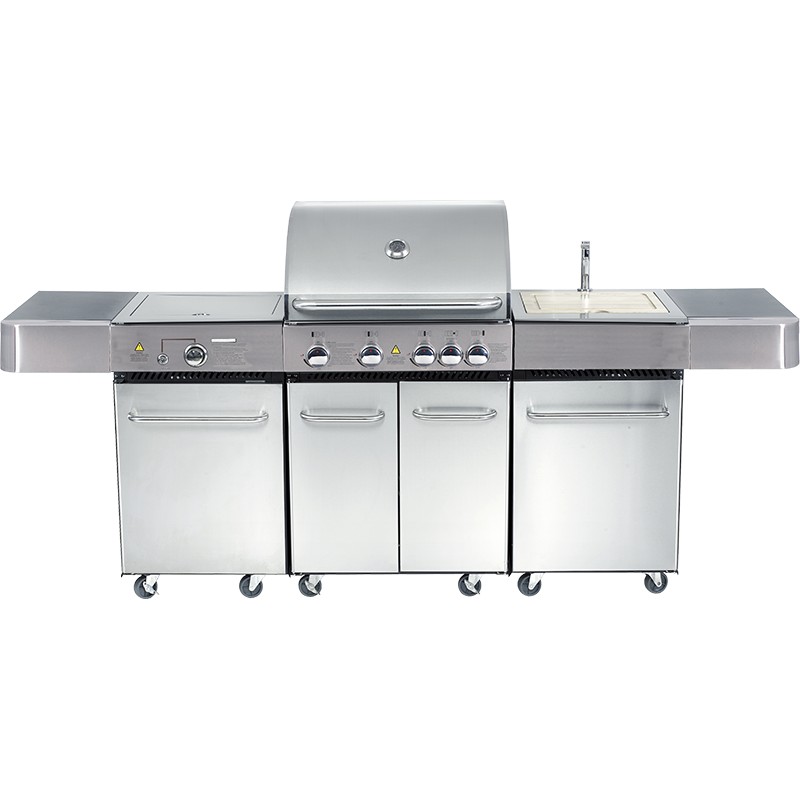
Kangye Electric has run OEM and ODM kitchen appliance programs since 1989 from a 150,000㎡ manufacturing base with 200+ engineers and monthly capacity above 200,000 units. Send a brief and receive a stage-by-stage schedule for your model.
View OEM Grill PlatformFAQ: OEM Kitchen Appliance Development Timelines
How long does OEM production take if I only change the color and logo?
Plan on 5–8 weeks from order confirmation to shipment readiness for a private-label run on an existing certified model (Goodfriends Kettle, 2026). The clock is driven mainly by production scheduling and transit, not development.
Can tooling and certification run in parallel?
Yes, and they should. Submit pre-production samples to the lab while the mold is in its correction cycle; a re-test then adds 2–4 weeks on paper instead of serializing two stages (APEXDURA, 2026). Starting from a CB certificate shortens every downstream national approval.
Why do OEM timelines range from 3 months to nearly a year?
Because the range mixes tiers. Recolor programs run in weeks, semi-custom at 90–120 days, all-new molded programs at 3–5 months (Qana Holdings, 2026), and projects that begin from industrial design average 8–11 months (China 2 West, 2026). Always confirm which tier a supplier's quote describes.
What is the fastest legitimate way to compress the schedule?
Freeze the specification at DFM review, choose a factory that already holds certificates for your target markets, book the test lab before tooling finishes, and approve samples against a written dimensional report. Each step removes a known restart risk documented in 2026 industry data.
Sources and Data Notes
- Kangye Electric program milestones (DFM 1–3 days; tooling 4–8 weeks; certification sampling 2–4 weeks; mass production 4–8 weeks; 3–5 months brief to first container), company project data published 2026, ikangye.com.
- China 2 West, appliance product development schedules (8–11 months ground-up; stage durations), 2026, china2west.com.
- Goodfriends Kettle B2B sourcing guide (private-label OEM 5–8 weeks; new ODM 10–18 weeks), 2026.
- Qana Holdings ODM FAQ (60–90 days modification; 90–120 days semi-custom; 120–180 days all-new), 2026, qana.net.cn.
- OkTool, OEM injection mold lead-time benchmarks (7–11 weeks RFQ to production; 40% post-sample change rate), 2026, ok-tool.com.
- GMMoldTech, home appliance injection molding guide (production mold 8–14 weeks; prototype mold 3–5 weeks), 2026.
- Shun Hing Manufacturing tooling FAQ (4–8 weeks by complexity), 2026, made-in-china.com.
- APEXDURA certification guide (CE 4–6; ETL 4–8; CB 3–5; LFGB 3–4 weeks; re-test +2–4 weeks; CB scheme saves 30–40%), 2026, apexdura.com.
- Huayu Test, GS certification timeline (8–10 weeks best case; 10–16 weeks typical), 2026, huayutest.com.
- Zetwerk, consumer product manufacturing timeline (prototyping 2–6 weeks; tooling 4–12 weeks), 2026, zetwerk.com.
Benchmarks describe typical 2026 industry ranges, not guaranteed delivery dates. Figures marked as company data come from Kangye Electric's own program records.