How Air Fryer Ovens Work: Convection, Heating Elements and Airflow
How Air Fryer Ovens Work: Convection, Heating Elements and Airflow
An air fryer oven is a compact, high-speed convection oven. A powerful heating element near the top of the chamber generates intense heat — up to 400°F (200°C) — while a high-speed fan drives that hot air across the food at up to 40 mph, roughly twice the airflow of a conventional convection oven. The result is the Maillard reaction on the surface of the food: fast moisture evaporation, deep browning, and a crispy crust with little or no added oil. For buyers sourcing air fryers for retail, private label, or an OEM program, understanding how convection, heating elements, and airflow are engineered is what separates a product that browns evenly every batch from one that steams the food and returns it pale and soggy.
This guide explains the physics and engineering inside an air fryer oven — the components, the cooking sequence, why airflow design decides crispiness, and the specifications you should put in an RFQ — then maps it to a concrete example from an OEM factory floor.
What Exactly Is an Air Fryer Oven?
Despite the name, an air fryer does not fry. It is a small, powerful convection oven that cooks by circulating rapidly moving hot air around the food. The heat is generated by an electric heating element — usually a metal-sheathed tubular element — positioned at the top of the cooking chamber. A high-speed fan, mounted directly above or behind the element, blows that heated air down and around the food in a continuous loop.
The chamber is deliberately small. A compact space concentrates heat, so the air reaches cooking temperature in a fraction of the time a full-size oven needs, and the fan is much larger and faster than the one in a standard convection oven. Perforated baskets or mesh trays let the air pass through the bottom and sides of the food, not just across the top, so every surface is exposed to moving hot air. That combination — concentrated heat, high-velocity airflow, and all-around exposure — is the entire trick.
The concept has a longer history than most buyers expect. Convection heating for ovens was introduced in 1945, but the technology did not take off until 2005, when high-speed air circulation was patented. The first home air fryer arrived in 2007, simplified operation and efficient heating systems drove mass adoption around 2010, and post-2020 home cooking demand pushed the category into one of the fastest-growing appliance segments in the market. If you are sourcing today, you are buying a mature, proven technology — which means the differentiators are in the details of engineering, not in the concept itself.
The Core Components Inside the Cooking Chamber
Every air fryer oven is built from the same six subsystems. How well they are engineered — not whether they exist — determines cooking quality. The table below maps each component to its function and its practical importance for a sourcing decision.
| Component | Function | Why It Matters When Sourcing |
|---|---|---|
| Heating element | Radiates intense heat, typically up to 400°F (200°C) | Element type and wattage define heat-up speed and peak temperature; 1600–1800W is the working range for 12–16L oven-style units |
| High-speed fan | Moves air across food at up to 40 mph | Fan blade design and motor quality drive airflow uniformity — the single biggest crispiness factor |
| Perforated basket / mesh tray | Allows hot air under and around each piece of food | Hole pattern and tray geometry prevent steaming and allow fat to drain |
| Drip / catch tray | Collects drippings and melted fat | Keeps the chamber clean and reduces smoke; removable, dishwasher-safe trays are a retail selling point |
| Temperature control | Adjustable thermostat, typically 80–200°C | Precision and stability over the cycle decide browning consistency; digital PID-style control beats bimetallic thermostats |
| Timer | Cycle control, typically 5–60 minutes | Digital timers with presets reduce operator error and expand usable recipes |
When a machine cannot hold a steady temperature band or push air through every tray, no amount of wattage fixes it. That is why the engineering choices inside the chamber — element placement, fan position, tray geometry — are more important than the headline power figure on the box.
Step by Step: How an Air Fryer Oven Cooks
Understanding the sequence inside the chamber makes it easier to specify the right product. There are five stages in a typical cycle:
- Preheating. The heating element brings the chamber to the set temperature — usually 160–200°C (320–390°F) for frying-style results — in roughly two to four minutes thanks to the small chamber volume.
- Air circulation. The fan forces the heated air around the basket in a high-speed loop. Air moving at tens of miles per hour strips heat into the food surface far faster than the still air in a conventional oven.
- Surface drying. The moving hot air evaporates surface moisture rapidly. This is critical: wet surfaces steam instead of browning, so the airflow is what converts "moist and pale" into "dry and crisp."
- Maillard reaction. Once the surface dries, amino acids and reducing sugars react at roughly 140–165°C (285–330°F), producing the golden-brown crust and complex flavor compounds associated with frying.
- Moist interior retention. Because the crust forms quickly, the interior stays sealed and juicy — the reason air-fried chicken wings come out crisp outside and tender inside rather than dried out.
One practical benchmark worth remembering: for breaded or starchy foods to actually brown, the air needs to reach at least 320°F (160°C). Below that temperature, frozen snacks and fries will cook but stay pale and soft. A unit that cannot hold 160°C across a full batch is a unit your customers will return.
The Science Behind the Crunch: Convection and the Maillard Reaction
Two scientific mechanisms explain everything an air fryer oven does. The first is convection heat transfer. A traditional oven heats the air and lets it sit; heat reaches the food slowly and unevenly. An air fryer forces that air across the food at high velocity, which sharply increases the rate of heat transfer — the moving air delivers more heat per second and carries moisture away at the same time. This is why an air fryer oven cooks roughly 25–30% faster than a conventional oven for comparable loads.
The second mechanism is the Maillard reaction — the same chemistry that browns a seared steak and colors toast. It begins when the surface of the food reaches around 140–165°C (285–330°F) and amino acids react with reducing sugars. Deep frying triggers this reaction by surrounding food with oil at frying temperature. Air frying triggers it by drying the surface with high-velocity hot air. The reaction does the work of flavor and color; the appliance just has to deliver the right surface temperature and keep moisture away long enough for it to proceed.
The practical difference versus deep frying is measurable: air-fried food typically uses up to 90% less oil, and portion-level comparisons show roughly 30–40% fewer calories for equivalent servings of french fries and similar foods. Texture is lighter and less greasy than oil-saturated frying — a characteristic that matters to health-conscious consumers and therefore to buyers planning private-label positioning.
Why Airflow Design Matters More Than Wattage
Airflow engineering is the quiet differentiator in air fryer performance. The same 1800W element can produce completely different results depending on how the air moves through the chamber. Leading designs share three airflow principles:
- Curved or baffled chambers steer the hot air into a circular path so it reaches food from multiple directions instead of blasting one side.
- Perforated baskets with open-mesh or patterned bases allow air to pass underneath the food. Without bottom airflow, food sits in its own moisture and steams — the most common cause of soggy results.
- Rear or side vent systems create a uniform pressure field across the tray, reducing hot spots and "dead zones" where air cannot reach.
Some manufacturers use a star-shaped base or guide vanes under the basket to direct airflow and reduce the need to shake or turn the food mid-cycle. For OEM buyers, airflow geometry is exactly the kind of design detail you cannot see in a product photo — but it is the detail that determines whether a private-label product earns repeat purchases. When you audit a factory, ask for airflow distribution test data, not just a power rating.
Air Fryer Oven vs Conventional Convection Oven
Because both are convection appliances, buyers often ask whether an air fryer oven is simply a small convection oven. The honest answer: functionally yes, but the engineering priorities are different, and those differences produce very different results.
| Attribute | Air Fryer Oven | Conventional Convection Oven |
|---|---|---|
| Chamber size | Compact, 8–20L typical | Full-size, 50L+ |
| Airflow velocity | High, up to ~40 mph | Moderate, far lower |
| Preheat time | 2–4 minutes | 10–20 minutes |
| Cooking speed vs still-air oven | ~25–30% faster | ~20% faster than still air |
| Oil required | Little or none | Optional |
| Crispiness on frozen/breaded foods | High — rapid surface drying | Lower — moisture lingers |
| Energy use per small batch | Lower (small heated volume) | Higher (large heated volume) |
An air fryer oven is not a replacement for a full-size oven; it is a faster, more efficient tool for the cooking jobs that need crisp, browned surfaces in small batches. For a deeper comparison of the two form factors — oven-style versus basket — see our guide Air Fryer Oven vs Basket Air Fryer: Which One Should You Source? and the related deep dive on the science of air frying.
Key Specifications to Check When Sourcing an Air Fryer Oven
If you are sourcing an air fryer oven for retail or private label, these are the specifications to put on the RFQ:
- Wattage and heat-up time: 1600–1800W is the effective range for 12–16L oven-style units; verify actual preheat time in the factory test report.
- Temperature range and control type: a usable range of 80–200°C with digital, PID-style control delivers consistent browning; bimetallic thermostats drift and produce uneven results.
- Airflow documentation: ask for airflow distribution and temperature uniformity test data across the tray, not just a marketing airflow claim.
- Basket and tray materials: food-grade non-stick coating, dishwasher-safe removable parts, and BPA-free materials where applicable for the target market.
- Voltage variants and certifications: 120V for North America (UL/ETL), 220–240V for Europe and Australia (CE, GS, SAA), plus the relevant food-contact material compliance. See Understanding Electrical Ratings for the details.
- Safety features: overheat protection, auto shut-off on timer completion, cool-touch housing, and stable feet for countertop use.
Because an air fryer is fundamentally an oven with a strong fan, the manufacturing quality of the heating element, the motor, and the thermal control board matters more than cosmetic features. Those are the parts that determine whether a unit stays consistent after months of use — and they are the parts worth auditing in person. For the broader picture of how an appliance gets from mold design to container loading, see our step-by-step guide to the OEM appliance manufacturing process.
Product Spotlight: Kangye KYS-116AK 16L Air Fryer Oven
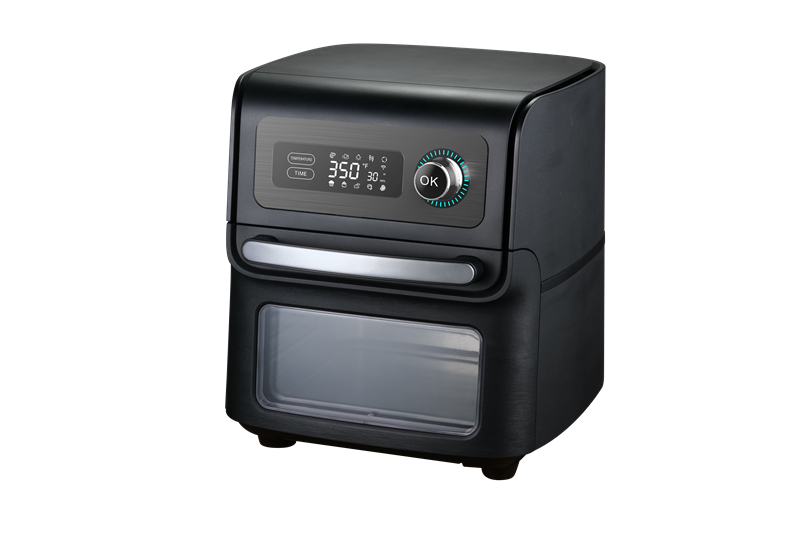
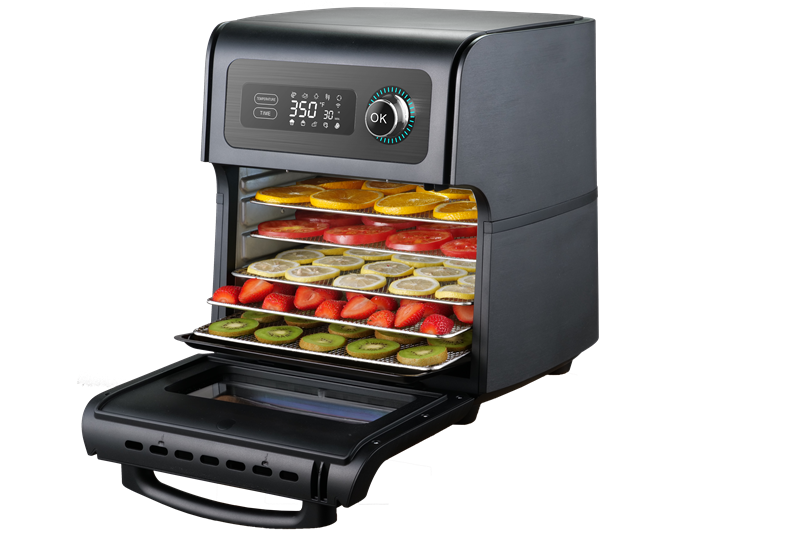
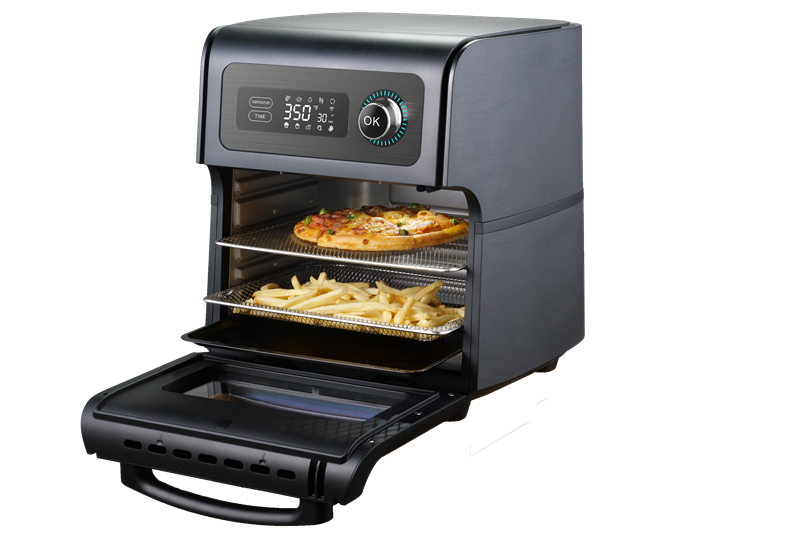
A concrete example helps anchor the theory. Kangye's KYS-116AK is a 16L oven-style air fryer with an 1800W heating system — squarely in the effective range for the category. It uses digital control with eight preset functions, so the temperature band and timer are managed electronically rather than by a drifting mechanical thermostat. The oven-style design adds a glass door, which lets users watch the browning process, and a non-stick interior simplifies cleanup — both practical selling points in retail.
For OEM and ODM buyers, the KYS-116 series is configurable — controls, presets, colors, branding, and packaging can be adapted to a private-label program. A 16L capacity hits the sweet spot between countertop footprint and batch size, and the 1800W element gives the headroom needed to hold temperature under load.
FEATURED PRODUCT
KYS-116AK 16L Digital Air Fryer Oven
16L digital air fryer oven, 1800W, 8 preset functions, oven-style design with glass door and non-stick interior — built for OEM/ODM private-label programs.
View ProductFrequently Asked Questions
Is an air fryer oven the same as a convection oven?
Functionally it is a compact convection oven, but the engineering is different: a larger and faster fan, a smaller chamber that concentrates heat, and a perforated basket that exposes food to airflow from all sides. Those differences produce the faster cooking time and crispier results the category is known for.
How much oil do you actually need in an air fryer oven?
Very little or none. A light mist of a high-smoke-point oil — about a tablespoon for a full batch — improves browning and flavor, but the circulating hot air does the crisping work. Compared with deep frying, air frying typically uses up to 90% less oil.
Why does my air-fried food come out soggy instead of crispy?
Almost always an airflow problem: the basket was overcrowded, the food surface was wet when it went in, or the unit cannot hold a high enough temperature. Pat food dry, leave space between pieces, and make sure the machine reaches at least 160°C (320°F) for breaded or starchy items.
Can I use the air fryer oven for baking and roasting, not just "frying"?
Yes. Oven-style air fryers are versatile: baking, roasting, reheating, and even dehydrating are within range for most units, especially 12L and larger models with multiple racks and preset programs.
What should I verify when sourcing air fryers from a Chinese factory?
Ask for the temperature-control accuracy (prefer digital PID-style control), airflow uniformity test data, food-contact material compliance for the target market, and the correct voltage variant and certification marks (UL/ETL for North America; CE/GS/SAA for Europe and Australia). Audit the element and motor quality in person where possible.
Planning to add air fryer ovens — oven-style, basket-style, or private-label — to your product portfolio? Kangye is an OEM/ODM manufacturer based in Guangdong, China, with 35+ years of manufacturing experience, exports to 100+ countries, and a product line covering air fryers, food dehydrators, grills, pizza ovens, steam cookers, vacuum sealers, and pet appliances. Contact our team to discuss samples, MOQs, certifications, heating-element and airflow options, and private-label programs.