Gas Grill Burner Design: From Tube Burners to Infrared Technology
Quick Answer: How to Choose Gas Grill Burner Types
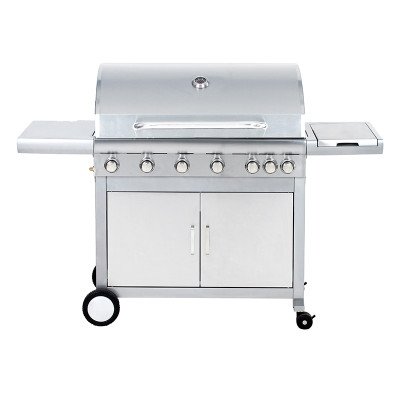
Choosing the right gas grill burner types is the single most important engineering decision in a gas grill — and for importers, it is the decision that separates a durable, even-cooking, certifiable product from a cheap unit that fails after one season. The four architectures that dominate the market — tube burners, cast iron and cast stainless steel burners, H-shaped and U-shaped burners, and infrared burners — each solve a different problem: affordable even heat, heat retention, flame geometry, and radiant searing. The modern premium grill is rarely a single type; it is a hybrid system, typically stainless steel tube burners for the main cooking zone plus an 800°C-class infrared side or rear burner for searing. That is exactly the architecture behind Kangye's KYQ-193RB and KYQ-A380 gas BBQ grills.
Key takeaway for importers: BTU numbers sell grills, but burner material, flame-port design, and certification sell repeat orders. When evaluating any gas grill supplier, verify the burner material grade (304 stainless vs 430 vs stamped), the ignition system's reliability and spare-part availability, the gas-type variants offered (natural gas vs LPG), and the target-market gas certification — ANSI Z21.58/CSA 1.6 in North America, EU Gas Appliance Regulation (2016/426) in Europe — before committing to samples.
Why Burner Design Matters More Than BTU
The burner is where gas becomes controlled heat, and it is the component that endures the harshest service life of any part in a grill: thousands of thermal cycles, dripping grease, rain, wind, and UV. A burner has three jobs — mix fuel and air correctly, distribute flame evenly across the cooking surface, and keep doing both for years without corroding or clogging.
Industry bodies and grill engineers consistently warn that total BTU output is a marketing number, not a performance number. The Hearth, Patio & Barbecue Association (HPBA), the trade association that represents the outdoor cooking industry, and every serious grill test lab agree on the same point: two grills with identical BTU ratings can cook completely differently depending on burner geometry, port size and spacing, the distance between burner and grate, and lid design. Roughly 82 million US households grill, and gas grills still hold about 48% of global outdoor cooking installations — on that kind of volume, a burner that produces hot spots or dies of corrosion in two seasons produces returns, not reorders. Our gas grill BTU ratings guide explains the math in detail, including why output per square inch of cooking area beats a headline BTU figure every time.
Gas Grill Burner Types: The Complete Landscape
Every gas grill burner on the market belongs to one of a handful of families. Understanding what each family does — and does not do — is the fastest way to read a spec sheet and spot the difference between a genuine design and a repackaged commodity:
- Tube burners — long cylindrical metal tubes with evenly spaced flame ports; the industry workhorse for affordable, even heat.
- Cast iron burners — heavy burners with excellent heat retention; prone to rust without maintenance, largely replaced by cast stainless steel.
- Cast stainless steel burners — thick-walled cast construction that resists corrosion and distributes heat evenly; the premium material play.
- H-shaped burners — two parallel tubes joined by a crossbar; even distribution with maximum fuel efficiency.
- U-shaped burners — a single continuous curved channel; exceptional heat retention, found in high-end and professional grills.
- Infrared burners — gas burns against a ceramic tile or perforated metal emitter that glows and radiates intense heat; the searing specialist.
- Hybrid systems — tube or cast burners for the main cooking zone combined with an infrared side or rear burner; the architecture of most premium grills in 2026.
The sections below walk through each family in the order an importer should evaluate them: workhorse first, premium materials second, geometry third, and radiant technology last — because that is also roughly the cost ladder from entry-level to flagship.
Tube Burners: The Industry Workhorse
Tube burners are the most common gas grill burner types on the market for a simple reason: they do the job at the lowest cost. A tube burner is a sealed metal tube with a Venturi section that draws in air to mix with gas, a row of drilled flame ports along its length, and a crossover tube that lets flame travel from an already-lit burner to light its neighbors.
The material tier decides how long that tube survives outdoors:
- 304-grade stainless steel — the benchmark for corrosion resistance; the grade to specify for coastal and humid markets.
- 430-grade stainless steel — a cost-effective alternative for non-critical zones; less corrosion resistance than 304 but far better than plain steel.
- Stamped stainless steel — two thin sheets stamped and welded together; lowest cost, thinnest walls, and the first to corrode or crack in aggressive environments.
- Aluminized or plated steel — entry-level economy; acceptable indoors or under cover, not for all-weather outdoor programs.
The honest assessment: tube burners excel at even flame distribution, easy maintenance, and replaceability, and they are the easiest burner to certify and to service in the field. Their weakness is that thin stamped versions fail fast — which is why a premium program should never accept a spec sheet that says "stainless steel burner" without naming the grade. If the grade is not stated, ask. The difference between 304 and stamped stainless is the difference between a five-year component and an eighteen-month replacement.
Cast Iron vs Cast Stainless Steel Burners: The Material Trade-off
Cast burners solve the problem tube burners cannot: heat retention. A cast iron burner is heavy and dense, so it absorbs heat, holds it, and radiates it back evenly — a real advantage in cold weather, windy patios, and low-and-slow cooking, where tube burners lose heat quickly. The trade-off is that cast iron rusts aggressively if it is not seasoned and maintained, which is why cast iron burners have largely been replaced in modern grills by cast stainless steel.
Cast stainless steel keeps the mass and even heat distribution of cast iron while adding real corrosion resistance. Because the casting is thicker than a stamped tube, it also resists warping and absorbs heat more evenly. The costs are a longer warm-up time and a higher price point — cast stainless burners sit in the premium tier of most grill lines.
One nuance importers should not miss: cast iron has not disappeared — it migrated to where it matters most, which is the cooking grid. Cast iron grids give superior sear marks and surface heat retention, which is why premium grills like Kangye's KYQ-193RB and KYQ-A380 ship with three cast iron cooking grids even when the burner system is stainless or infrared-based. When you see a grill advertised as "cast iron," check whether the marketing is talking about the burners or the grids — they are very different decisions.
H-Shaped and U-Shaped Burners: Geometry That Fixes Hot Spots
Burner geometry is the second lever after material. Straight tubes running front-to-back leave dead zones at the corners and center of a rectangular cooking surface; shaped burners cover more area with fewer gaps.
- H-shaped burners — two parallel tubes joined by a connecting bar, forming an "H." They distribute heat evenly across a wide surface, are fuel-efficient (the same gas covers more flame ports), and are easy to maintain. They are a strong all-rounder for mid-range and family grills.
- U-shaped burners — a single continuous channel bent into a "U." The continuous gas path produces exceptionally even heat retention and distribution, which is why U-shaped burners appear in high-end and professional lines, particularly for searing steaks and cooking delicate foods that punish hot spots.
Neither shape changes the fundamental material question — H and U burners are still made of stainless, cast stainless, or cast iron — but both reduce the number of zones where food burns while the rest of the grate undercooks. For a B2B program, H-shaped burners are an efficient mid-tier differentiator, and U-shaped burners belong in the flagship SKU.
Infrared Burners: Radiant Heat and the 800°C Searing Zone
Infrared is the technology that changed what a gas grill can do. Instead of burning gas in an open flame, an infrared burner directs gas against a ceramic tile or a perforated metal emitter. The emitter itself glows red-hot and transfers energy to food as infrared radiation — the same mechanism as the glowing elements in an electric grill, but driven by gas. Because radiation cooks the food surface directly rather than heating air first, an infrared burner reaches searing temperatures in minutes.
What infrared delivers, in measurable terms:
- Extreme surface temperature — premium infrared emitters operate at 700-800°C (1292-1472°F), hot enough for restaurant-style crust and deep Maillard browning on steaks.
- Reduced flare-ups — dripping fat vaporizes on the hot emitter instead of igniting in an open flame, so you get the sear without the fireball.
- Faster cook times and fuel efficiency — the same gas input produces more radiant energy delivered to the food, cutting preheat and cook times.
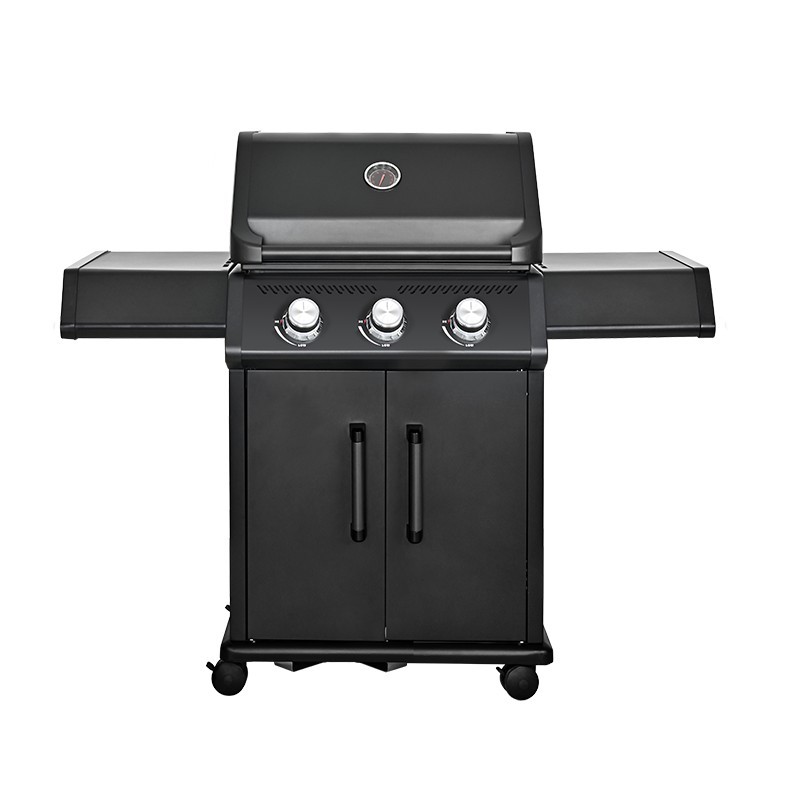
The honest assessment: infrared burners are more expensive, and they carry real maintenance responsibilities. Ceramic emitters can crack from thermal shock or heavy drippings, metal emitters can clog, and an infrared-only grill is a poor platform for low-and-slow cooking. That is why the industry consensus — and Kangye's own product architecture — is hybrid: standard tube or cast burners handle everyday grilling and indirect heat, while a dedicated infrared side or rear burner handles the searing story. The KYQ-193RB takes this further with a 4.5kW infrared side burner and a 4.0kW rear burner, so a single grill covers searing, rotisserie, and standard grilling.
Tube Burner vs Infrared Burner: Which Architecture Wins?
For most importers the real decision is not "which burner type" but "which mix of gas grill burner types." The comparison below is the framework buyers should use when evaluating a grill's burner package:
| Criterion | Tube Burner | Infrared Burner |
|---|---|---|
| Heat mechanism | Convection — open flame heats air above the burner | Radiation — glowing emitter transfers energy directly to food |
| Peak surface temperature | Zone-level, typically 500-650°F at the grate | Emitter surface 700-800°C (1292-1472°F) |
| Best for | Everyday grilling, indirect heat, low-and-slow, multi-zone cooking | Searing steaks, crust formation, fast high-heat cook |
| Flare-ups on fatty food | More frequent | Reduced — drippings vaporize on the emitter |
| Relative cost | Low to mid | High |
| Maintenance | Brush flame ports periodically | Clean or replace emitter; handle ceramic with care |
| Typical role in a grill | Main cooking burners | Side sear burner or rear rotisserie burner |
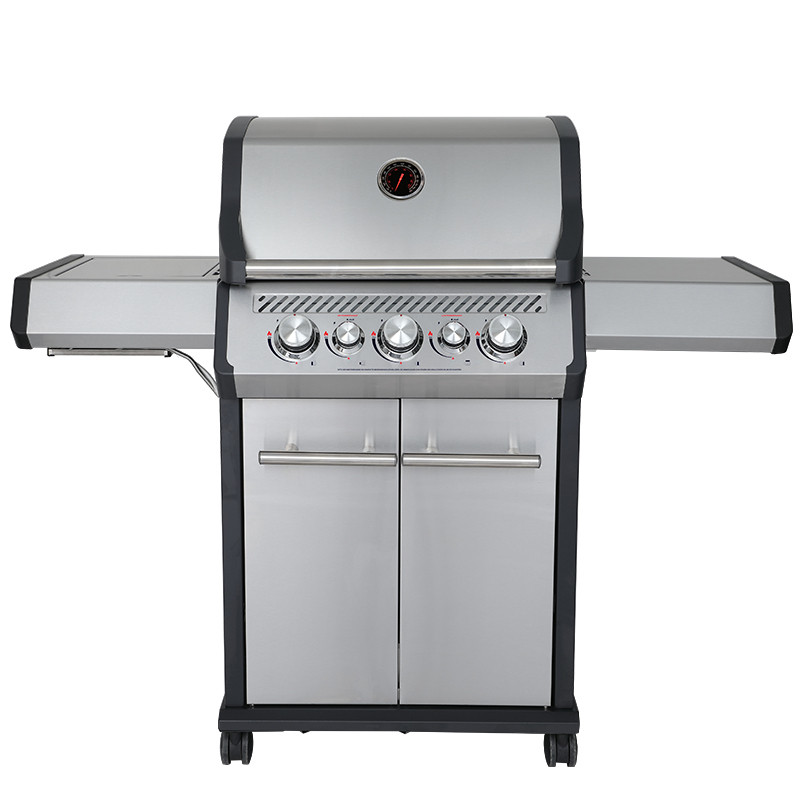
Verdict: don't pick one — specify a hybrid. A 3- to 4-burner main zone built on 304 stainless or cast stainless tubes, plus an infrared side or rear burner, is the configuration that wins premium shelf space in every major market. It is also the configuration Kangye manufactures: the KYQ-193RB combines three 3.5kW main burners with a 4.5kW infrared side burner and a 4.0kW rear burner, and the KYQ-A380 pairs three 3.0kW main burners with an 800°C infrared side burner.
Burner Materials Compared: A Spec Table
Material is the first filter on any burner spec sheet. This table compresses the trade-offs importers actually negotiate:
| Material | Heat Retention | Corrosion Resistance | Relative Cost | Typical Use |
|---|---|---|---|---|
| 304 stainless steel tube | Moderate | Excellent | $$ | Volume main burners, coastal markets |
| 430 stainless steel tube | Moderate | Good | $ | Budget and mid-tier mains |
| Stamped stainless steel | Low | Fair | $ | Entry-level grills |
| Cast stainless steel | High | Excellent | $$$ | Premium main burners |
| Cast iron | Excellent | Poor — needs seasoning | $$ | Retro burners; premium cooking grids |
| Ceramic emitter (infrared) | Very high | Fragile — thermal shock risk | $$$ | Infrared sear zones |
A practical note for outdoor programs: SUS 443 stainless steel — used for the KYQ-193RB hood — is a cost-effective alternative to 304 for panels and enclosures in marine and humid climates. Burner contact parts, however, should still be 304-grade or cast stainless for longevity, because the burner is the component that sees the highest temperatures and the most aggressive environment inside the grill.
BTU, Gas Pressure, and Ignition Systems: Reading the Spec Sheet
Once the burner family and material are settled, three numbers on the spec sheet deserve a second look: BTU output, gas-pressure ratings, and ignition type.
- BTU and kilowatts: one BTU is the energy needed to raise one pound of water by one degree Fahrenheit, and 1 kW equals about 3,412 BTU/hr. To sanity-check any gas grill spec: Kangye's KYQ-A380 delivers 9.0kW total — roughly 30,700 BTU/hr — with 3.0kW (≈10,240 BTU) per burner, and the KYQ-193RB delivers 19kW total — roughly 64,800 BTU/hr — split across three 3.5kW main burners, a 4.5kW infrared side burner, and a 4.0kW rear burner. Those are mid-to-high commercial-class figures; typical residential mains run 10,000-12,000 BTU per burner.
- Fuel energy and pressure: propane carries roughly 2,500 BTU per cubic foot (93.1 MJ/m³) versus about 1,040 for natural gas (40.1 MJ/m³), which is why LP grills reach high output with smaller orifices. Manifold setpoints are market-specific — commonly around 4 in WC for natural gas and 10-11 in WC for LP on outdoor grills — and must always be verified against the certified rating label and the regulator supplied with the unit.
- Ignition systems: piezo ignition generates a mechanical spark with no battery and no electronics; battery-powered electronic ignition delivers a consistent spark every time; and a crossover tube carries flame between burners so one ignition point lights the whole grill. For export programs, specify the ignition type explicitly and confirm spare igniter parts are available — ignition failure is the most common field complaint on low-cost grills.
The single most useful habit is converting everything to BTU per square inch of cooking area. A common residential reference band is 80-100 BTU/in²; very high total BTU with poor distribution just creates hot spots. Our BTU ratings deep dive walks through the conversion math, and the electrical ratings guide covers the voltage and frequency side for the ignition electronics and any powered rotisserie.
Safety Standards for Gas Grill Burners: ANSI Z21.58, CSA 1.6, and EU GAR
Burner design is regulated, and the certification gap between compliant and non-compliant burners is exactly where importers get burned. The two most important regimes:
- North America — ANSI Z21.58 / CSA 1.6, Outdoor Cooking Gas Appliances: the standard covers construction and performance of outdoor gas grills. Notable requirements include a wind test at 10 mph (4.47 m/s) — burners must stay lit — a rain test, carbon monoxide not exceeding 0.08%, rated input within ±5%, a cooking performance (hamburger) test, LP cylinder storage rules (a 20 lb cylinder for appliances under 80,000 BTU/hr and 30 lb for 80,000 BTU/hr and above), and new low-temperature operation requirements. The 2022 sixth edition adds smart-enabled appliance provisions, and updated requirements take effect September 1, 2026. Countertop specialty grills fall under ANSI Z21.89 / CSA 1.18.
- Europe — EU Gas Appliance Regulation (EU) 2016/426 (GAR): gas-fired grills sold in the EU must carry CE marking under the GAR, with appliances tested against the appropriate EN standards and gas families defined in EN 437. Great Britain requires UKCA marking. Certification bodies such as UL, CSA, and Intertek provide the testing and listing.
Beyond the gas standards, add IEC 60335-2-9 for electrical heating components, and food-contact compliance (LFGB or FDA) for the cast iron grids and any surface that touches food. The HPBA (Hearth, Patio & Barbecue Association) is the industry body that tracks these requirements and advocates for safe outdoor cooking — a useful reference point when checking how a supplier's claims line up with industry practice. For a step-by-step walk through the full compliance stack — certification bodies, gas variants, labeling, and documentation — our export compliance guide for kitchen appliances is the working reference.
Featured Product: Kangye KYQ-193RB & KYQ-A380 Hybrid Burner Grills
Kangye's gas BBQ grill line is built around the hybrid burner architecture this guide recommends. The KYQ-193RB is a 3-burner premium grill with 19kW total output — three 3.5kW main burners, a 4.5kW infrared side burner rated to 800°C, and a 4.0kW rear rotisserie burner — in a cast aluminum chamber with a SUS 443 stainless steel hood and three cast iron grids. The KYQ-A380 delivers 9.0kW from three 3.0kW burners with a full cast aluminum chamber and the same 800°C infrared side burner for a compact, value-positioned hybrid.
- KYQ-193RB: 19kW · 3 main + infrared side + rear burners · cast aluminum chamber · SUS 443 hood
- KYQ-A380: 9.0kW · 3 main burners · 800°C infrared side burner · full cast aluminum chamber
- Both: 3 cast iron cooking grids · mobile trolley · MOQ 40HQ/216PCS
- OEM/ODM: branding, gas standard variants (NG/LPG), regulator and orifice kits, retail packaging
- Factory-direct from Guangdong, China — 35+ years of appliance manufacturing, exports to 100+ countries
Sourcing Checklist: Verifying Burner Quality Before You Commit
| Checklist Item | Why It Matters | What to Ask / Verify |
|---|---|---|
| Burner material grade | Corrosion decides outdoor lifespan; stamped steel fails fast | Confirm 304 vs 430 vs stamped; request material certificates and sample corrosion tests |
| Port design and ignition | Even flame and reliable lighting = fewer returns and service calls | Port count and spacing, piezo vs electronic ignition, crossover tube, spare igniter parts |
| Gas certification package | Market access is binary — no ANSI Z21.58/CSA 1.6 or EU GAR, no sales | Certificate copies for the exact target market; regulator and orifice variants for NG and LPG |
| Infrared component quality | Ceramic emitters crack, metal emitters clog — the premium feature must not become the warranty claim | Emitter material, thermal-shock testing, replacement emitter availability and cost |
| Container economics | Freight is a fixed cost — optimize the load | 20GP/40GP/40HQ quantities and carton dimensions (e.g., KYQ-193RB and KYQ-A380: 40HQ/216PCS each) |
| MOQ and lead time | Seasonal retail windows are unforgiving | Current MOQ, production days, and burner/valve component lead times |
| After-sales spare parts | Burners and igniters wear out; parts availability protects your brand | Spare burner, valve, igniter, and grid availability; warranty terms; English technical support |
For the full journey — factory audits, samples, quality control — our step-by-step OEM sourcing guide from China covers it end to end, and the 2026 outdoor kitchen trends report frames the demand side of the same decision.
FAQ: Gas Grill Burner Questions, Answered
What are the main gas grill burner types?
The main gas grill burner types are tube burners (the industry workhorse), cast iron and cast stainless steel burners, H-shaped and U-shaped burners, and infrared burners. Most premium grills in 2026 are hybrid systems: stainless or cast tube burners for the main cooking zone plus an infrared side or rear burner for searing — the configuration Kangye builds into the KYQ-193RB and KYQ-A380.
Is stainless steel or cast iron better for gas grill burners?
For burners, 304-grade stainless steel or cast stainless steel is the better choice in almost every case — cast iron retains heat beautifully but rusts without constant maintenance, which is why manufacturers phased it out of burner systems. Cast iron has not disappeared; it migrated to cooking grids, where its heat retention and sear marks are a genuine advantage. A common premium combination is stainless burners plus cast iron grids.
How many BTUs do I need per burner?
Typical residential main burners run 10,000-12,000 BTU each; commercial-class grills push higher. Kangye's KYQ-A380 delivers 3.0kW (≈10,240 BTU) per burner, and the KYQ-193RB delivers 3.5kW (≈11,940 BTU) per main burner plus a 4.5kW infrared side burner and a 4.0kW rear burner for a total of 19kW (≈64,800 BTU). The more useful metric is BTU per square inch of cooking area — roughly 80-100 BTU/in² is a common residential reference — because total BTU says little about how evenly a grill cooks.
Are infrared burners worth the extra cost?
As a dedicated sear zone, yes. An infrared burner reaches 700-800°C, delivers restaurant-style crust in minutes, and reduces flare-ups because drippings vaporize on the emitter. As a grill's only heat source, no — infrared is not suited to low-and-slow cooking, and emitters need careful maintenance. The honest answer is hybrid: tube or cast burners for everyday cooking plus one infrared side or rear burner for the searing story.
What certifications do gas grill burners need for the US and EU?
North America: ANSI Z21.58 / CSA 1.6 for outdoor cooking gas appliances (wind test at 10 mph, rain test, CO ≤ 0.08%, input within ±5%, LP cylinder storage rules), with ANSI Z21.89 / CSA 1.18 for countertop units. Europe: the EU Gas Appliance Regulation (EU) 2016/426 with CE marking and EN 437 gas families; UKCA for Great Britain. Add IEC 60335-2-9 for electrical components and LFGB/FDA for food-contact grids. Always request certificate copies from the factory for the exact target-market gas standard.
Can Kangye OEM a gas grill with custom burner configurations?
Yes. Kangye is an OEM/ODM manufacturer based in Guangdong, China, with 35+ years of appliance manufacturing experience and exports to 100+ countries. For gas BBQ grills we support custom burner material and configuration options, NG/LPG gas variants with regulator and orifice kits, branding, packaging, and certification support for target markets — with container-level MOQs such as 40HQ/216PCS on the KYQ-193RB and KYQ-A380.
Summary: The Burner Design Playbook
Summary: gas grill burner design decides how a grill cooks, how long it survives outdoors, and whether it can be certified for export. The 2026 playbook for importers has five steps:
- Lead the main cooking zone with 304-grade stainless or cast stainless tube burners — corrosion resistance before headline BTU.
- Add an infrared side or rear burner (700-800°C class) for the searing story and flare-up control.
- Verify the gas certification stack — ANSI Z21.58/CSA 1.6 for North America, EU GAR/CE for Europe, LFGB/FDA for grids.
- Confirm ignition reliability and spare parts — the most common field failure on low-cost grills.
- Judge output by BTU per square inch, not total BTU, and lock container economics and MOQ early.
Importers who execute this playbook with a factory that controls burner material sourcing, port quality, ignition assembly, and certification are positioned to win the gas grill category — one burner at a time.
Planning to add gas grills to your product portfolio? Kangye is an OEM/ODM manufacturer based in Guangdong, China, with 35+ years of manufacturing experience and exports to 100+ countries. Our product line covers gas BBQ grills, pizza ovens, food dehydrators, air fryers, steam cookers, vacuum sealers, and pet appliances. Contact our team to discuss samples, MOQs, gas certifications, burner configurations, and private-label programs.