Home / All / Industry Insights / Outdoor Kitchen Trends 2026: Why Grills and Pizza Ovens Are Booming
Outdoor Kitchen Trends 2026: Why Grills and Pizza Ovens Are Booming
Aug 15,2026
Quick Answer: The Outdoor Kitchen Market in 2026
The global outdoor kitchen market is projected to reach $29.7 billion in 2026 — up from $27.2 billion in 2025 — and to grow at a compound annual rate of roughly 9.2% through 2034, according to Fortune Business Insights. Inside that wave, two product categories are outperforming the rest: gas grills (which hold about 48% of outdoor cooking installations worldwide) and outdoor pizza ovens (the fastest-growing segment in outdoor living, with gas-powered models taking a 43% share). For importers, brands, and distributors, the 2026 outdoor kitchen trend is not a single product play — it is a shift from selling standalone grills to supplying integrated outdoor cooking systems.
Key takeaway for importers: the winning 2026 strategy is not adding another entry-level gas grill to a crowded catalog — it is building a coordinated outdoor cooking range: a commercial-grade freestanding gas grill for the centerpiece, a gas pizza oven for the premium add-on, and verified compliance (CSA/AGA, EN 484 or equivalent, IEC 60335-2-9, LFGB/FDA food contact) behind every SKU. That combination is what separates importers capturing the outdoor kitchen build-out from those competing on grill price alone.
Market Overview: The Numbers Behind the Outdoor Kitchen Boom
Multiple independent trackers converge on the same conclusion: outdoor cooking has moved from seasonal hobby to permanent household infrastructure. The figures worth carrying into a 2026 sourcing plan:
Outdoor kitchen market: Fortune Business Insights projects $29.74 billion in 2026, up from $27.23 billion in 2025, reaching about $60.2 billion by 2034 — a 9.21% CAGR. Real-estate research from Zillow adds a structural tailwind: homes with a well-equipped outdoor kitchen sell for roughly 3.1% more than expected, turning the category into a home-value investment rather than pure leisure spend.
Outdoor cooking appliance penetration: about 64% of households in developed economies own at least one outdoor cooking appliance, and roughly 82 million US households grill outdoors, consuming nearly 39% of global outdoor cooking product volume. Around 71% of US consumers grill in summer — but 49% now use outdoor cooking products year-round, which is why "all-season" claims matter in 2026.
Fuel and format mix: gas grills account for 48% of global outdoor cooking installations (charcoal is second at 29%), and about 63% of suburban US households prefer gas. Among pizza oven buyers, gas-powered units hold the largest share at roughly 43%, followed by wood-fired at 37% — but hybrid/multi-fuel is the fastest-growing premium category.
Regional split: North America leads with about 41% of demand, Europe 28%, and Asia-Pacific 22% — with APAC growing fastest as Western-style outdoor living spreads in China, Australia, and Southeast Asia.
Metric
2026 Estimate
Trend
Importer Opportunity
Global outdoor kitchen market
$29.7B
+9.2% CAGR to 2034
System sales (grill + island + accessories), not single SKUs
Gas grill share of installations
~48%
Stable leader; premium segment growing
Commercial-grade, multi-burner gas grills
Outdoor pizza ovens
$563M (2026)
~12% CAGR; fastest outdoor category
Gas pizza ovens — the accessible premium add-on
US households grilling
~82M
49% grill year-round
All-season positioning, quality materials
Built-in / integrated demand
+15% YoY
Modular build-outs rising
Freestanding units that fit built-in frames
The practical read: the 2026 outdoor kitchen market rewards suppliers who can sell the whole cooking station — a high-output gas grill as the centerpiece, a pizza oven as the premium differentiator, and consistent design language across both. That is exactly the product architecture a single factory partner can deliver under one OEM/ODM program.
Trend #1: From Standalone Grill to Complete Outdoor Kitchen System
The biggest structural change in 2026 is the shift from a lonely freestanding grill to an integrated cooking zone. Industry watchers report that demand for built-in gas grills and modular stainless steel cabinetry grew about 15% year over year, driven by homeowners who treat the patio as an extension of the living room — with a grill, side burner, refrigerator, sink, and pizza oven arranged as one system.
For importers this changes the unit economics. Selling a standalone grill is a single transaction; selling into an outdoor kitchen build-out is a project sale with a much higher ticket. Distributors can capture that upside without designing cabinetry themselves by importing freestanding commercial-grade grills that drop into built-in frames and pairing them with complementary cooking appliances — exactly the model behind Kangye's outdoor cooking market analysis, which documented why BBQ and pizza oven demand is compounding.
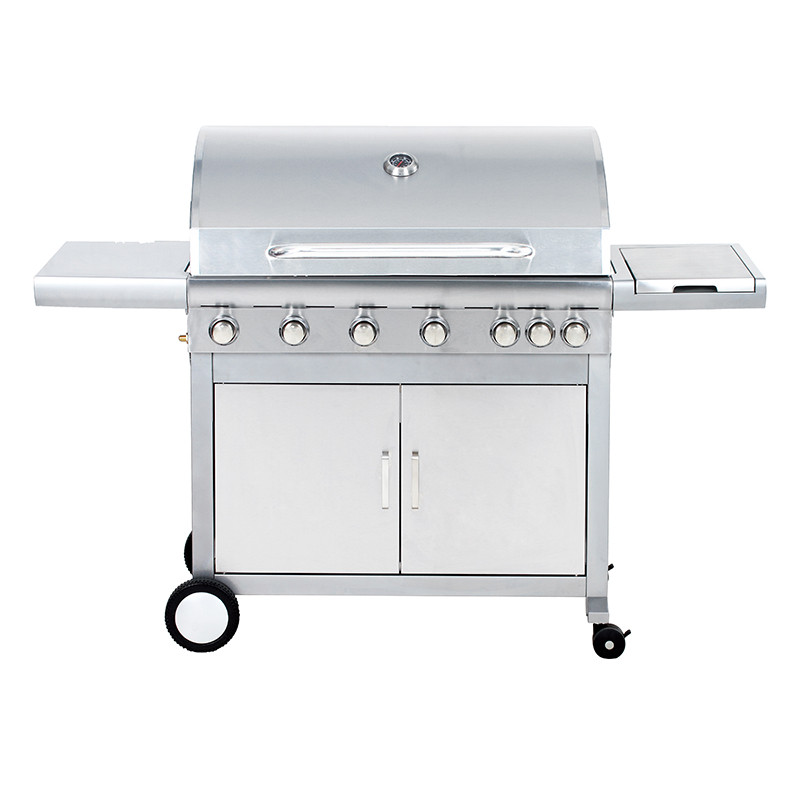
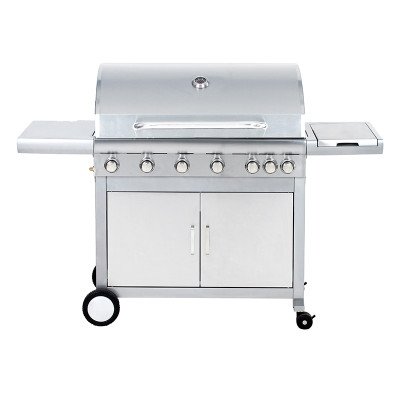
6-burner freestanding commercial gas grill — the centerpiece of an outdoor kitchen configuration. View product details →
Three configuration sub-trends define 2026 demand:
Built-in ready design: more buyers specify freestanding grills with flush-fit dimensions and removable trolleys so they can be set into masonry or modular steel frames. Our comparison of built-in vs freestanding vs portable grill configurations walks through the trade-offs.
Modular component sales: side burners, rotisseries, pizza oven inserts, and refrigerator units are being sold as system add-ons — higher margin, repeat purchases, and sticky ecosystems.
Weather-ready materials: 304 stainless steel, powder-coated exteriors, and enamel fireboxes dominate new builds because they survive rain, salt air, and UV without degrading.
Trend #2: The Outdoor Pizza Oven Goes Mainstream
The outdoor pizza oven is the fastest-growing category in outdoor living — and it is pulling gas models up with it. Market data from pmarketresearch shows global outdoor pizza oven revenue rising from $502 million in 2025 to $563 million in 2026, heading toward $1.07 billion by 2032; broader pizza oven market trackers put the US alone at roughly $800 million in 2026, growing at 6.1% CAGR — faster than the global average of 4.8-5%.
Two fuel facts matter for sourcing decisions:
Gas dominates adoption: gas-powered outdoor pizza ovens hold about 43% of the market (wood-fired is 37%), because gas offers the 400-500°C (750-930°F) heat needed for authentic Neapolitan-style pizza with turn-the-knob convenience and no firewood handling. That makes gas the volume play for importers entering the category.
Hybrid is the premium edge: official hybrid (gas + wood) share is small (~6-9%), but industry reporting indicates hybrid and multi-fuel models make up roughly 25-30% of new premium residential sales. If your brand targets the top of the market, a dual-fuel architecture is the 2026 differentiator; if you target volume, a clean, certified gas model wins.
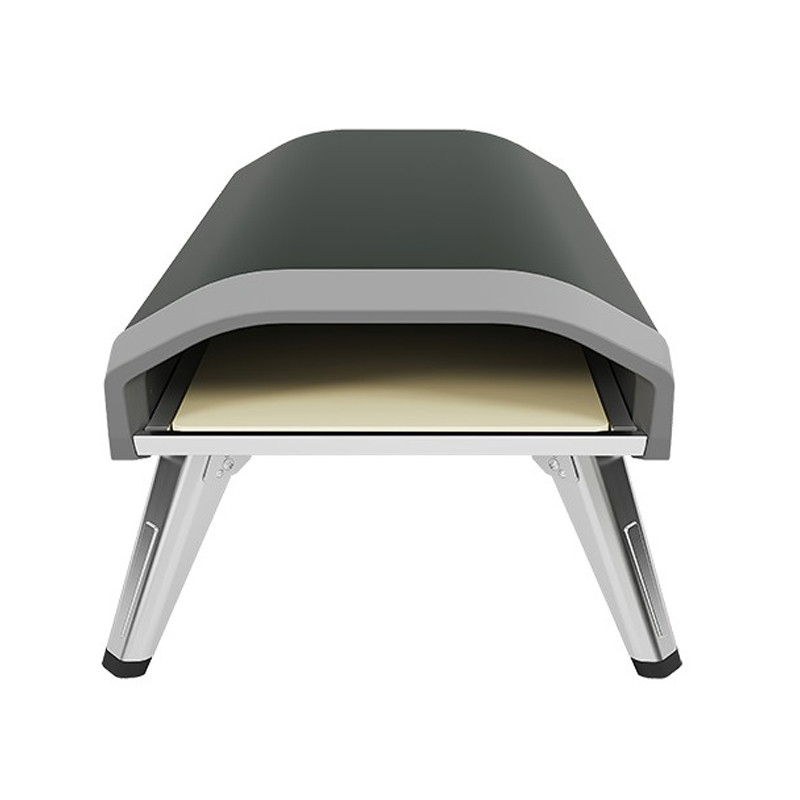
4kW gas pizza oven with 12-inch cordierite stone and thermometer — the premium add-on for outdoor kitchen programs. View product details →
For a deeper read on what separates a good gas pizza oven from a bad one — burner design, stone materials, heat distribution — our gas pizza oven design deep dive is the engineering reference, and our electric vs gas pizza oven guide covers the fuel decision for both home and commercial lines.
Trend #3: Smart, Connected, and Easier to Operate
Connectivity is no longer a novelty in outdoor cooking — it is a purchase driver. Research on the outdoor cooking market reports that roughly 58% of buyers now prefer smart grills, and about 28% of US consumers have already invested in connected grills with app-based monitoring. Temperature probes, Bluetooth/app control, and integrated thermometers are shifting from premium features to expected functionality.
Three ways this trend shows up in 2026 product lines:
Connected temperature management: app-linked meat probes and ambient control reduce the biggest failure mode in grilling — walking away and coming back to overcooked food.
Built-in instrumentation: built-in thermometer dials on pizza ovens and grills are the low-tech baseline; digital readouts and Bluetooth are the step-up tier that justifies a higher price point.
Recipe and guidance content: brands that ship QR-linked recipe content and setup videos reduce support load and drive repeat purchases of accessories.
The honest caveat: connected features add BOM cost and certification complexity (FCC/CE for radio modules, app liability, firmware support). For a first import program, an accurate built-in thermometer and a well-designed manual deliver 80% of the perceived value at a fraction of the complexity — treat full app connectivity as the second-generation upgrade unless your channel demands it today.
Trend #4: Materials, Durability, and Sustainability
Outdoor appliances fail outdoors — and in 2026, buyers know it. Approximately 43% of consumers cite maintenance concerns and 37% cite limited storage as reasons they delay purchases, per outdoor cooking market research. That makes material quality a decisive differentiator, and it favors three specifications:
Stainless steel where it counts: 304 stainless for lids, panels, and cooking surfaces resists corrosion in humid and coastal environments; 430 is a cost-effective alternative for non-food-contact parts. Enamel-coated fireboxes and cast iron grids offer durability plus heat retention at accessible price points.
Efficiency positioning: about 52% of outdoor cooking purchases are influenced by energy efficiency and portability. High-output burners with good heat distribution (fewer BTUs wasted) are both a selling point and a real operating-cost story for commercial users.
Eco materials and packaging: sustainable materials and reduced packaging are rising purchase factors (~46% of buyers seek eco-friendly pellet/energy systems in adjacent segments). Recyclable cartons and compliant coatings cost little to implement and win retail listing reviews.
When auditing a factory for material claims, our stainless steel grades comparison gives you the 304 vs 430 vs SUS443 decision framework, and our gas grill BTU guide explains why raw output numbers are less important than heat distribution.
Trend #5: All-Season Usage and Commercial Expansion
Two demand pools are expanding the market's seasonal ceiling:
Residential all-season cooking: with 49% of US consumers using outdoor cooking products year-round, weather resistance, wind shields, and low-temperature performance become real specifications rather than marketing phrases.
Commercial and hospitality adoption: research indicates about 31% of restaurants in hospitality/tourism have expanded outdoor dining facilities, and roughly 41% of upscale restaurants and cafés are adopting wood-fired or high-heat outdoor cooking concepts for experiential dining. Food trucks, catering, and outdoor event venues are buying commercial-grade grills and pizza ovens — a B2B channel with steadier order volumes than residential retail.
For importers, the commercial channel is attractive because it buys on specification and throughput rather than price alone: a 6-burner 18.9kW commercial gas grill with cast iron grids, side burner, and mobile trolley fits restaurants, catering, and resort kitchens, and it commands a materially higher price point than a residential 4-burner unit.
Channel strategy note: the strongest 2026 import portfolios pair a commercial-grade gas grill for hospitality/B2B with a gas pizza oven for the premium residential add-on — one factory, two complementary SKUs, and a system story that resists pure price competition.
What This Means for Importers: The 2026 Outdoor Kitchen Playbook
Pulling the trends together, the import program that captures the 2026 outdoor kitchen build-out looks like this:
Lead with a commercial-grade gas grill (5-6 burners, 15-19kW total output, cast iron grids, enamel or stainless firebox) that works freestanding and in built-in frames.
Add a gas pizza oven as the premium differentiator — 4kW class, cordierite stone, built-in thermometer — for the outdoor kitchen "complete cooking station" story.
Verify the compliance stack before sampling: gas certification (CSA/AGA in North America, EN 484 or EU gas requirements in Europe), IEC 60335-2-9 for household heating appliances, and food-contact compliance (LFGB/FDA) for surfaces touching food.
Demand container-level planning: confirm MOQs, carton dimensions, and 20GP/40GP/40HQ loading numbers early — they determine landed cost and retail pricing.
Build a system catalog, not a grill catalog: accessories (rain covers, pizza peels, rotisseries, replacement stones) drive repeat revenue and raise the average order value.
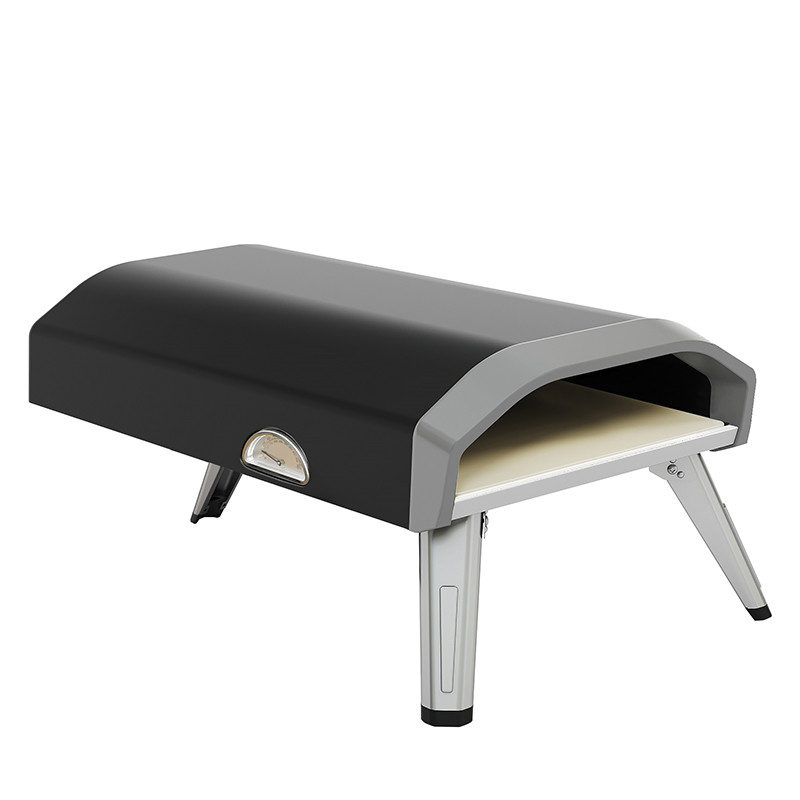
Compact 668×425×290mm footprint makes the KPS12A easy to integrate into outdoor kitchen islands and cart builds. View product details →
Featured Product: Kangye KYQ-61S & KYQ-KPS12A Outdoor Cooking Line
Kangye's outdoor cooking line is engineered around the 2026 trends this guide covers. The KYQ-61S is a 6-burner commercial gas BBQ grill with 18.9kW total output, two cast iron grids plus a cast iron plate, a dedicated side burner, enamel-coated firebox, and a mobile trolley — built for restaurants, catering, and premium residential patios. The KYQ-KPS12A is a 4kW gas pizza oven with a stainless steel inner housing, 12-inch (335×335mm) cordierite stone, and built-in thermometer, sized at 668×425×290mm for easy island integration.
KYQ-61S: 6 burners · 18.9kW · cast iron grids + plate · side burner · mobile trolley
KYQ-KPS12A: 4kW gas · 12" cordierite stone · built-in thermometer · stainless inner housing
OEM/ODM: branding, gas standard variants, accessories (rain covers, rotisseries, pizza peels), retail packaging
Factory-direct from Guangdong, China — 35+ years of appliance manufacturing, exports to 100+ countries
Current MOQ, production days, component (burner/valve) lead times
After-sales support
Replacement parts protect brand and channel
Spare parts availability (burners, valves, stones, grids), warranty terms, English support
For the full sourcing journey — factory audits, samples, quality control — our step-by-step OEM sourcing guide covers it end to end, and the 2026-2027 US kitchen appliance market analysis frames the broader demand context around countertop and outdoor categories.
FAQ: Outdoor Kitchen Sourcing Questions, Answered
Is the outdoor kitchen market still growing in 2026, or is it saturated?
It is growing. Fortune Business Insights projects the global outdoor kitchen market at $29.7 billion in 2026 with roughly 9.2% annual growth through 2034. Saturation exists only at the low end of residential gas grills — the growth is in commercial-grade grills, built-in/outdoor kitchen systems, and pizza ovens, where importers with verified compliance and OEM capability still have clear room.
Why are gas grills and gas pizza ovens booming specifically?
Gas offers the two things outdoor cooks actually want: high heat and convenience. Gas grills hold ~48% of installations because they are instant-on, controllable, and increasingly affordable at commercial output levels. Gas pizza ovens (~43% market share) deliver the 400-500°C heat needed for authentic pizza with a knob turn — no firewood, no waiting for coals — making the category the fastest-growing in outdoor living.
What certifications do gas grills and gas pizza ovens need for the US and EU?
For gas appliances: CSA or AGA certification in North America; EN 484 (or the applicable EU gas-appliance directive) in Europe, plus IEC 60335-2-9 for household heating appliances. Add UL/ETL or CE for electrical safety and FCC for any radio/connected modules. Food-contact materials must comply with LFGB/FDA. Always request certificate copies from the factory for the exact target-market gas standard.
Should I source a commercial-grade grill or a residential model for my first program?
It depends on your channel. Commercial-grade (5-6 burners, 15-19kW) sells into restaurants, catering, and premium residential projects at higher price points and steadier reorder volumes — but requires more rigorous gas certification and heavier packaging. Residential models win on unit volume and easier certification. Many 2026 importers lead with one commercial-grade SKU for the system story and add residential models for volume.
What is the realistic MOQ for OEM/ODM gas grills and pizza ovens?
Container-level MOQs are standard: for example, Kangye's KYQ-61S commercial grill packs 160 pcs per 40HQ, while the KYQ-KPS12A pizza oven loads 328 pcs per 20GP, 688 per 40GP, and 857 per 40HQ. Gas appliances with burner and valve subassemblies may carry longer component lead times, so confirm MOQ and production schedule before committing to seasonal retail programs.
Summary: The 2026 Outdoor Kitchen Importer Playbook
Summary: the 2026 outdoor kitchen market — projected at $29.7 billion, growing 9.2% annually — is being reshaped by five trends importers can build around: system sales over standalone grills, pizza ovens going mainstream on gas power, smart temperature management, weather-ready materials, and all-season/commercial expansion. The winning playbook has five steps:
Lead with a commercial-grade gas grill that works freestanding and in built-in frames.
Add a gas pizza oven as the premium, fastest-growing category add-on.
Verify the full gas + electrical + food-contact compliance stack before sampling.
Confirm container economics and MOQs early to protect landed-cost margin.
Build a system catalog with accessories to raise average order value.
Importers who execute this playbook with a factory partner that delivers the compliance, materials quality, and OEM flexibility the category demands are positioned to win the 2026 outdoor kitchen build-out.
Planning to add gas grills or pizza ovens to your product portfolio? Kangye is an OEM/ODM manufacturer based in Guangdong, China, with 35+ years of manufacturing experience and exports to 100+ countries. Our product line covers commercial gas grills, pizza ovens, food dehydrators, air fryers, steam cookers, vacuum sealers, and pet appliances. Contact our team to discuss samples, MOQs, gas certifications, material options, and private-label programs.
Since its establishment in 1989, Kangye Electric Appliances has always focused on the research and development and manufacturing of kitchen appliances and outdoor cooking utensils.