The Physics of Food Dehydration: Moisture Removal and Airflow Dynamics
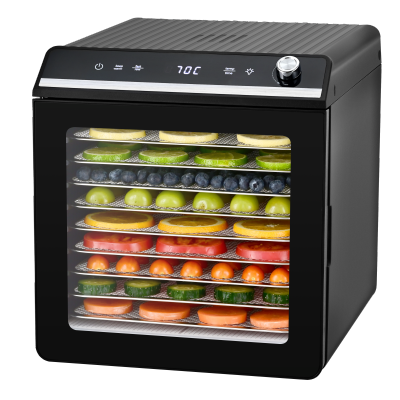
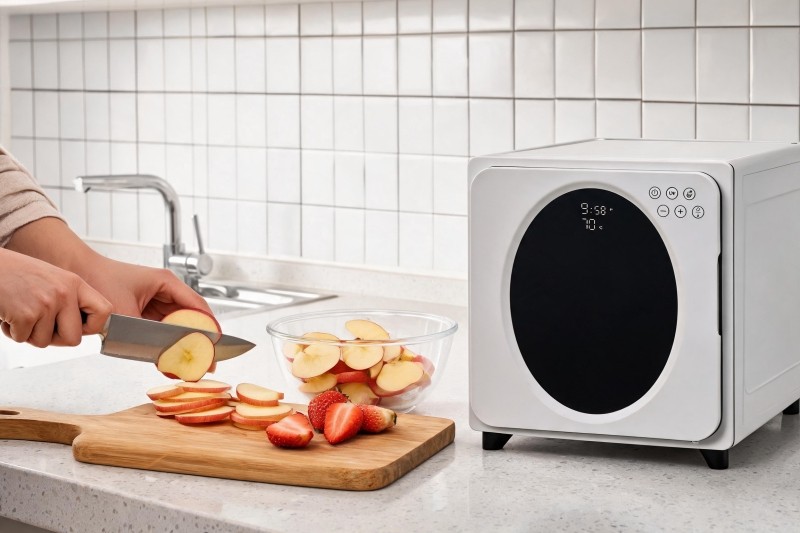
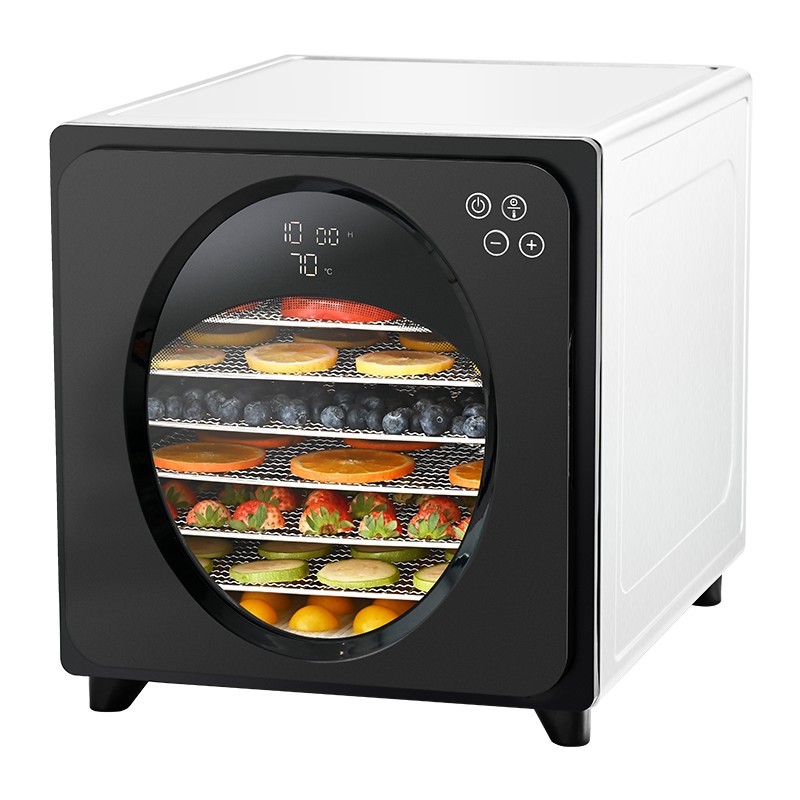
A food dehydrator is, in physical terms, a controlled heat-and-mass-transfer machine: it supplies energy to evaporate water, then uses moving air to carry that vapor away before the air around the food becomes saturated. Get the airflow right and the machine dries evenly and predictably; get it wrong and you get case-hardened leather on the outside, damp centers, flavor cross-contamination between trays, and cycles that run twice as long as they should. This article breaks down the physics behind moisture removal and airflow dynamics — water activity, psychrometrics, drying-rate curves, boundary layers, and venting — and explains why the airflow architecture of a dehydrator is the single most important engineering decision a buyer or brand owner should evaluate. The market context is straightforward: global shipments of food dehydrators have been growing at roughly 6% annually as home preservation and shelf-stable snacking expand, and the largest engineering split inside that market is airflow design. Understanding the food dehydration science behind tray-to-tray consistency is not academic — it directly predicts drying time, energy cost, food safety, and the service life of the product you source. If you are new to the category, our earlier explainer on the science of food dehydration covers temperature, airflow, and nutrient retention from a food-preservation viewpoint; here we go one level deeper into the underlying physics and what it means for equipment design. Moisture content — the percentage of water in a food — is the number consumers think about, but the physics that matter for shelf stability is water activity (aw): the ratio of the water-vapor pressure exerted by a food to the vapor pressure of pure water at the same temperature. Water activity measures the available, unbound water that microorganisms and enzymes can use, not total water. Two foods with identical moisture percentages can have very different water activities depending on how tightly water is bound inside their cellular structure. Because water activity tracks the vapor pressure of water inside the food, the drying process is really a race to pull aw below these thresholds before enzymes discolor the food or microbes begin to grow. This is why target endpoints are expressed the way extension services teach them. The University of Georgia's National Center for Home Food Preservation (Andress & Harrison, So Easy to Preserve, 6th ed., 2014) specifies that dried fruit should reach about 20% moisture and be leathery but not sticky, while vegetables should be brittle or crisp at about 10% moisture; properly dried produce stored in airtight containers keeps for roughly 1 year at 60°F (16°C) or 6 months at 80°F (27°C), with vegetables having about half the shelf life of fruit. Kentucky's Cooperative Extension (University of Kentucky) similarly reports that most dried carrots are stable around 20% wet-basis moisture, whereas raisins, prunes, and potatoes are closer to 11–12%, and that produce below about 15% moisture is generally safe and stable — evidence that endpoint "dryness" is food-specific, which is exactly why precise, low-temperature control matters in the equipment. An honest engineering corollary: you cannot measure aw in a kitchen, and even moisture content is hard to measure at home. That is why reputable dehydrators and process guidance use conservative endpoints — bend-and-snap tests, conditioning of fruit for 7–10 days to equalize moisture, and texture targets — rather than trying to hit an exact aw. The physics simply means the machine's job is to keep removing water until the food's own vapor pressure falls to a safe equilibrium with the surrounding air. Air is the workhorse of moisture removal, and its behavior is described by psychrometrics — the relationship between air temperature, humidity, and moisture capacity. The single most useful physical rule for dehydration engineers is that the moisture-holding capacity of air roughly doubles for every 20°F (about 11°C) rise in temperature. Because saturation vapor pressure increases exponentially with temperature, warm air is a much larger "sponge": air at 140°F (60°C) can hold roughly an order of magnitude more water vapor than room-temperature air. When that warm air passes over food, its relative humidity drops sharply, creating a large vapor-pressure deficit that pulls water out of the food and into the airstream. Three consequences follow directly from this physics: There is a ceiling on how much heat helps, and it is physical rather than economic: above roughly 140–160°F, food begins to cook rather than dehydrate — proteins denature, sugars caramelize, and the outer surface can seal before interior moisture escapes (the case-hardening failure discussed below). This is why Illinois Extension's home food-drying guidance notes that dehydration works best around 140°F and that at higher temperatures food tends to cook instead. The engineering challenge is therefore not "how hot can we run" but "how do we move the most moisture per kilowatt-hour while holding a food-appropriate temperature." Dehydration is a simultaneous process of heat transfer into the food and mass transfer out of it. Heat reaches food by three mechanisms — conduction (contact with a hot surface), convection (the moving air itself), and radiation (infrared). In a cabinet dehydrator, convection dominates: heated air both delivers energy to the food surface and collects the moisture leaving it. Inside the food, water migrates outward by several physical routes at once: liquid diffusion down the concentration gradient from wet interior to drier surface, capillary flow through the food's pore structure, and pressure-driven movement as internal vapor builds up. At the surface, water changes phase to vapor — and that phase change is the thermodynamic anchor of the whole process. Vaporizing 1 kg (about 1 litre) of water requires roughly 2.3–2.5 megajoules of latent heat — approximately 0.65–0.70 kWh of energy as a theoretical minimum. That number sets the floor for every drying economics calculation: Two practical lessons follow for anyone evaluating equipment. First, higher wattage only helps if the thermostat and airflow can use it — a 1,000 W element in a poorly vented cabinet just heats the room. Second, slice geometry and load density are part of the physics: uniform slice thickness maximizes surface area per unit volume, and overloading trays reduces the air gap between food layers, throttling airflow and extending the constant-rate period well beyond what the wattage would suggest. Dehydration does not proceed at a steady pace. It follows a two-phase drying-rate curve familiar to every drying engineer, and the shape of that curve explains both cycle times and many quality failures. Constant-rate period. Early in the cycle, the food surface is saturated with moisture, so evaporation proceeds almost as if from a free water surface. Drying rate stays roughly steady, and the food itself remains cool — near the wet-bulb temperature — because evaporative cooling removes heat as fast as the air supplies it. This phase is governed almost entirely by external conditions: air temperature, air velocity, and the humidity of the incoming air. If those are good, this phase is fast. Falling-rate period. Once surface moisture is depleted, internal moisture must diffuse to the surface before it can evaporate. Internal transport becomes the limiting step, drying slows steadily, and the food surface begins to warm because evaporative cooling no longer keeps pace with incoming heat. Most of the total drying time — and most of the risk of quality damage — sits in this falling-rate phase, which is why foods dried too aggressively on the outside while their centers are still wet develop case hardening: a moisture-impermeable surface shell that traps water inside and creates conditions where mold can grow weeks later even though the exterior looks and feels dry. The engineering implication for dehydrator design is that thermostats, timers, and airflow interact: a stable low temperature holds the falling-rate phase in the safe band where vitamins and aroma survive, while continuous airflow prevents the boundary layer of humid air at the food surface from artificially extending the constant-rate period. Our earlier technical article on thermostats, timers, and consistency examines the control side; here the point is that no controller can compensate for airflow that leaves one corner of a tray in still, humid air. Where does the moisture actually go? As air moves across a piece of wet food, a thin, still layer of air — the boundary layer — clings to the surface. Water evaporating from the food must first saturate this boundary layer, then diffuse through it into the moving airstream, which carries the vapor away. The boundary layer is therefore the single greatest resistance to moisture removal, and airflow velocity is the lever that thins it: faster, more turbulent air scrubs the boundary layer away, re-establishing the vapor-pressure deficit at the food surface and letting evaporation continue at full rate. This simple mechanism explains most of the practical differences between dehydrator designs: For the manufacturer and importer, the takeaway is that a dehydrator's performance is largely set by three airflow numbers that are rarely printed on spec sheets: fan flow rate, the velocity actually reaching each tray surface, and the exhaust path's ability to remove saturated air. This is why identical wattage and tray-count units from different factories can dry the same batch at meaningfully different speeds and uniformity — and why buying on price per tray alone is a physics mistake. Putting the physics together produces the industry's main engineering split. The table below summarizes how the two dominant airflow architectures handle heat, moisture, and uniformity — and what each trade-off costs. Neither architecture is "wrong," and both can dry food safely when used within their limits — the physics simply assigns them different operating instructions. A vertical unit is a legitimate, economical choice for occasional small batches as long as the user accepts tray rotation and single-flavor loads. A rear-heat horizontal unit buys uniformity and unattended runs at a higher price point. That distinction is worth understanding before you choose a private-label model or write a specification, because the airflow architecture is baked into the tooling and cannot be changed after production begins. Even the best airflow design can be defeated by how the machine is loaded and where it is placed — physics that applies equally to home and commercial drying. Several operating variables have outsized effects on moisture removal: From an industry standpoint, these operating variables are why reputable manufacturers publish load guidance, why digital timers with auto shut-off reduce the failure mode of overrunning a batch, and why certification and food-contact documentation matter as much as airflow design. Compliance context for exports — electrical safety, food-contact materials, and energy efficiency — is covered in our guide on export compliance for kitchen appliances. When food dehydration science is translated into a sourcing checklist, a small set of specifications predicts most of a dehydrator's real-world performance: Kangye designs its dehydrator family around the rear-heat, horizontal-airflow principle described in this article: the fan and heating element sit behind the trays so that warm, dry air crosses each tray surface independently, exhausting moisture rather than recirculating it. Models range from a compact 4-tray home unit to a 10-tray digital glass-door series up to 20–22-tray commercial machines, all sharing the same physics-first architecture. For capacity-by-business guidance, our commercial food dehydrator buying guide maps machine size to throughput; for temperature-band details relevant to the science above, see our explanation of top, bottom and rear heating systems. KYS-315 Series 10-Tray Food Dehydrator — digital 35–75°C (95–167°F) control, 600–700 W at 220–240 V (600 W at 120 V), a 48-hour timer with auto shut-off, a fan-only mode, and a glass door with LED display. Ten BPA-free stainless steel trays plus a fruit-roll tray give the airflow a large, even surface area to work on. Ideal as the flagship unit of a home or private-label line. KYS-218A/B 8-Tray Food Dehydrator — an 8-tray stainless steel model with back heating, 600–700 W at 220–240 V, and a 48-hour timer. Its larger tray footprint (330 × 305 mm) in a 461 × 350 × 380 mm body suits households that want rear-heat uniformity at a more compact capacity. Heat supplies the energy for evaporation, but airflow removes the vapor. Without moving air, the boundary layer at the food surface becomes saturated, relative humidity inside the chamber climbs, and the vapor-pressure deficit that drives drying collapses — the food steams instead of drying. Airflow continuously replaces humid air with drier air, which is why a machine with modest heat but good airflow dries more reliably than one with high wattage and stagnant air. Yes. Dehydration depends on the difference between the vapor pressure of water in the food and the vapor pressure in the air around it. When the room air is already humid, that difference shrinks and drying slows; the effect can stretch a typical cycle by a meaningful margin. Running the dehydrator in a drier room or in an air-conditioned space shortens drying time in humid climates. Case hardening happens when food dries too hot or too fast on the surface while the interior is still wet — the outer layer becomes a moisture-impermeable shell that traps water inside. The product can look and feel dry but spoil from the center weeks later as trapped moisture feeds mold. It is one of the strongest arguments for low, stable temperatures combined with real airflow rather than high heat alone. Extension guidance is consistent: fruit should be leathery and pliable with no sticky surface (about 20% moisture) and should be conditioned for 7–10 days to equalize moisture; vegetables should be brittle or crisp (about 10% moisture) and need no conditioning; herbs should crumble. Store everything in airtight containers in a cool, dark place — dried fruit keeps about a year at 60°F but only six months at 80°F, and vegetables roughly half as long. No — it is a legitimate trade-off, not a defect. Vertical units are compact, affordable, and expandable, and they dry safely if you rotate trays every few hours and avoid mixing strongly flavored foods in one batch. Horizontal rear-fan units buy uniform drying and unattended operation at a higher price. Choose based on batch size, how often you will run it, and how much attention you are willing to give it. Low drying heat is not a pasteurization step. Food-safety guidance for jerky requires heating meat to a safe internal temperature (160°F for beef, 165°F for poultry) before the low-temperature drying phase, then drying to a texture and water activity that will not support mold at room temperature. Process order and clean, dry airflow — not dehydrator wattage — are what make meat drying safe. Planning to add food dehydrators to your range or private-label program? Kangye is an OEM/ODM manufacturer in Guangdong, China with 35+ years of manufacturing experience, exporting kitchen and pet appliances to more than 100 countries. We engineer every dehydrator around the rear-heat, horizontal-airflow physics described here, with certification-ready compliance packages and voltage, plug, branding, and packaging customization. Contact our team to discuss samples, MOQs, and specifications — or browse the full range on our product list .The Physics of Food Dehydration: Moisture Removal and Airflow Dynamics
Water Activity: The Property That Actually Controls Shelf Life
Water-Activity Thresholds That Drive Dehydrator Design
The Psychrometrics of Drying: Why Warm, Moving Air Removes Moisture
Heat and Mass Transfer: The Two Sides of Moisture Removal
The Energy Cost of Evaporation
Drying-Rate Curves: Constant-Rate and Falling-Rate Periods
The Physics of Airflow: Boundary Layers, Velocity and Dead Zones
Airflow Architecture Compared: Vertical vs Horizontal Designs
Characteristic
Vertical Airflow (stackable)
Horizontal Airflow (rear-fan box)
Fan and heat source
Base or lid; air forced up or down through stacked circular trays
Rear wall; air blown horizontally across each rectangular tray
Uniformity
Temperature and humidity gradient along the stack; lower trays see drier air first; rotation recommended
Each tray receives similar temperature and velocity; rotation largely unnecessary
Flavor separation
Air passes through all trays — aromas can transfer between foods
Independent per-tray airflow minimizes cross-contamination
Footprint and cost
Compact, expandable, lower entry price
Larger cabinet footprint, typically higher build cost
Best suited to
Budget home use, herbs, small batches, limited counter space
Jerky, fruits, larger batches, commercial consistency
Honest limitations
Uneven drying without attention; weaker control of boundary layers
Higher cost; fixed capacity; requires clean rear airflow path
Venting, Load Density and Operating Discipline
What the Physics Means for Design and Sourcing Decisions
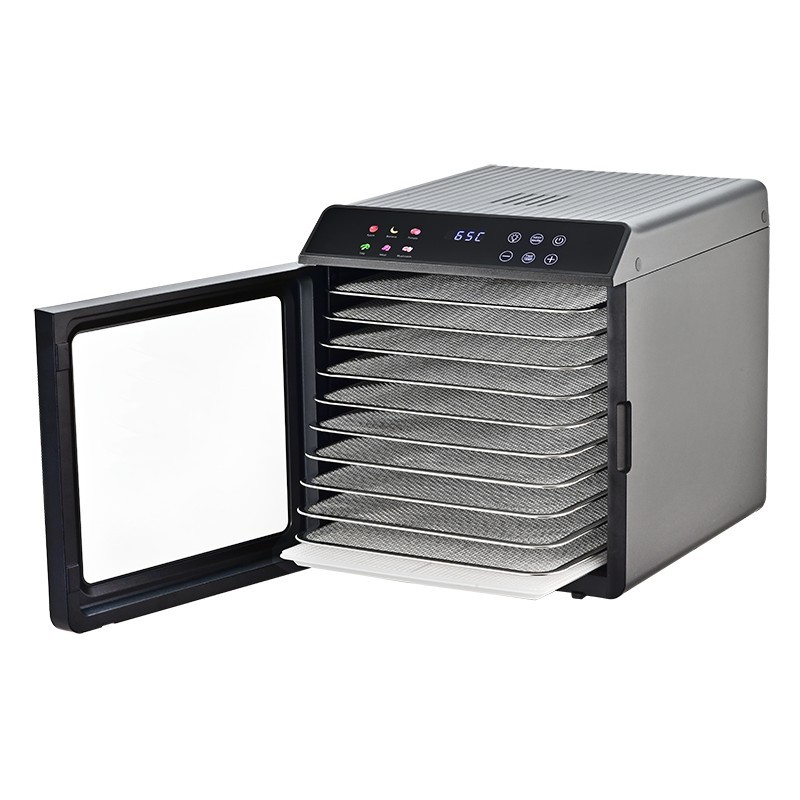
Featured Products: Rear-Heat, Horizontal-Airflow Dehydrators
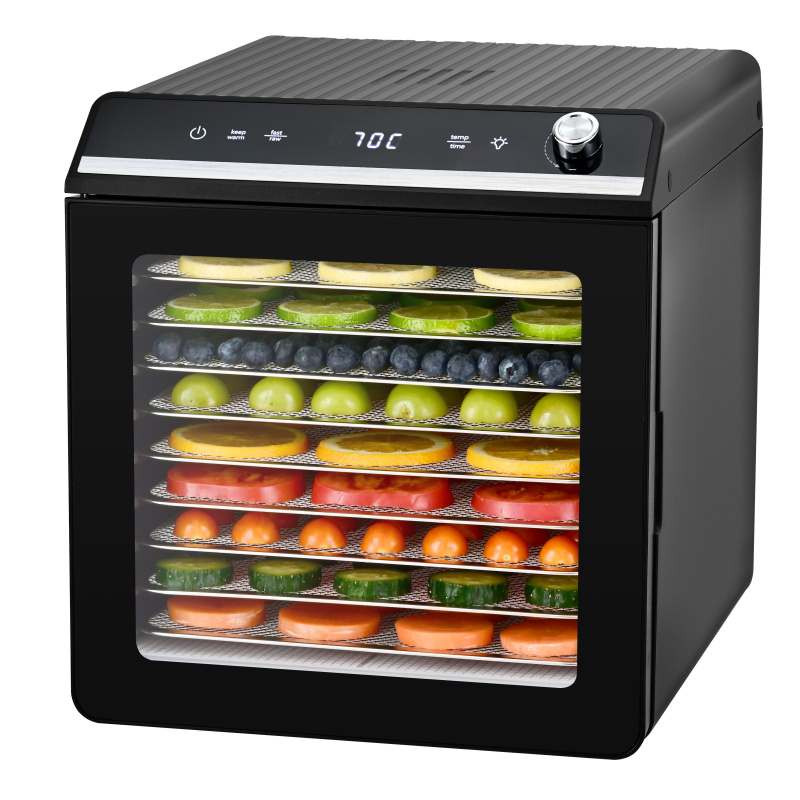
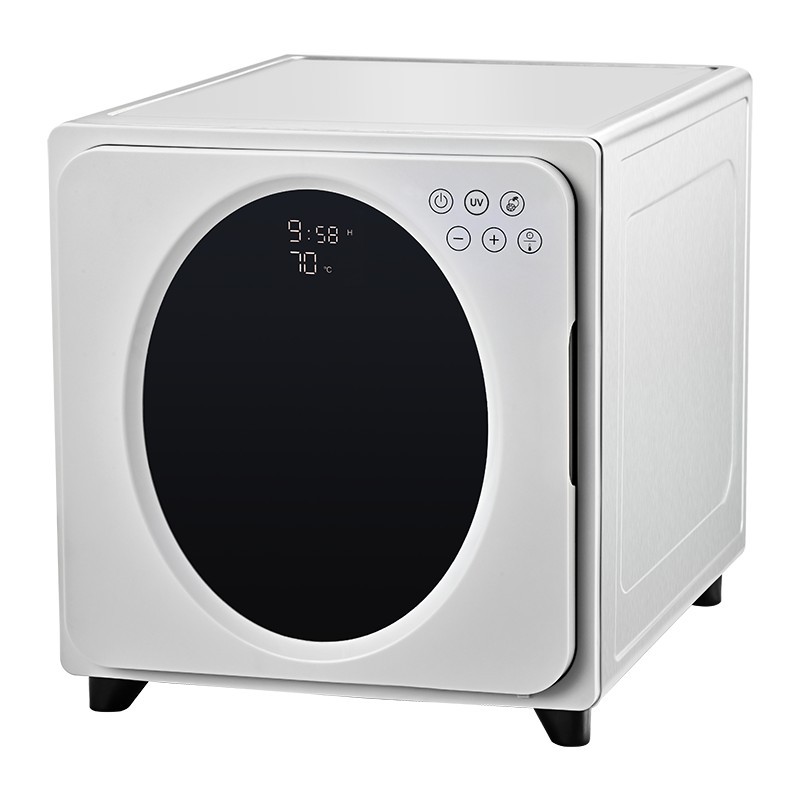
Frequently Asked Questions
Why is airflow more important than heat in a food dehydrator?
Does drying really take longer in humid weather?
What is case hardening and why is it dangerous?
How do I know when dried food is actually dry enough?
Is a vertical-stack dehydrator a bad choice?
Can I just dehydrate meat in a low-temperature dehydrator?
Key Takeaways for Buyers and Engineers