Commercial Food Dehydrator Buying Guide for Small Businesses
Quick Answer: How Do You Choose a Commercial Food Dehydrator for a Small Business?
Choose a commercial food dehydrator by matching three specifications to your real weekly output: tray count (batch size), airflow design (horizontal rear-mounted airflow for consistent drying without rotation), and temperature control plus stainless steel food-contact construction. As a practical rule, a small business producing more than a couple of pounds of finished product per cycle needs at least 12 trays; a 16–17 tray unit covers a café, butcher shop or weekend-market jerky operation, while 20–22 tray models serve small production kitchens running multiple batches daily. The global commercial food dehydrator market is estimated at roughly $729 million in 2024 and is projected to reach about $1.0 billion by 2030 (≈5.5% CAGR), with North America the largest region — a market that keeps pulling small food businesses into dehydration.
Key takeaway: a commercial dehydrator is not a bigger home dehydrator. It is a continuous-duty machine built around stainless steel, an industrial-grade heating element and fan, and a thermostat that holds temperature within a tight band for 12–24 hour runs. If you are an importer, private-label brand or small producer buying for business use, the tray-count-and-airflow decision — not brand or price alone — determines whether the unit becomes the center of a profitable jerky or dried-fruit line or an expensive shelf ornament. This guide is the detailed, sourcing-ready version of that decision.
Why Small Food Businesses Are Buying Commercial Dehydrators in 2026
Commercial dehydration is one of the quieter growth stories in food equipment. Grand View Research values the global commercial food dehydrators market at USD 729.2 million in 2024, growing to about USD 1.0 billion by 2030 at a 5.5% CAGR, with North America the largest region at a 38% revenue share. PW Consulting's tracking is consistent from a different angle: USD 792.7 million in 2025 rising to USD 1.18 billion by 2032 (5.8% CAGR), with fruits and vegetables the largest application at 43.8% and North America the biggest single region at roughly USD 268.6 million. Both trackers point to the same demand drivers: extended shelf life, clean-label snacks, and lower food waste in commercial kitchens.
For a small business the category economics are unusually direct. Hands-on buying guides and small-producer tests consistently report that a 16–20 tray dehydrator in the roughly $400–700 class can turn 6–9 pounds of finished jerky per day into $210–540 of daily revenue at wholesale prices of $25–40 per pound (or $40–60 direct to consumer), against $80–100 in meat and electricity — with payback often measured in weeks rather than months. The same math applies to dried fruit, herbs and vegetable powders for restaurants. None of those numbers are guaranteed — dehydration is a manufacturing process with real food-safety obligations — but they explain why the equipment, not the marketing, is where serious operators spend their attention. Our ultimate guide to buying a commercial food dehydrator covers the category overview; this guide goes deeper on the tray math, airflow engineering and compliance decisions for small-business buyers.
What "Commercial" Actually Means: Duty Cycle, Materials and Certification
"Commercial" is one of the most overused words in small-appliance marketing, so start by defining it operationally. Industry guides agree on the practical thresholds that separate a commercial dehydrator from a home unit:
- Continuous duty cycle. A commercial dehydrator is designed to run 12–24 hours per batch, day after day — the heating element, fan motor and thermostat are rated for it. Home dehydrators top out at roughly 4–9 trays and are not built for daily business loading.
- Capacity. Commercial units commonly range from 10 to 60 trays with tray sizes from 12 × 12 inches up to 18 × 26 inches, processing roughly 50–500 pounds per batch depending on the class.
- Materials. Stainless steel (304-grade for food-contact surfaces) or heavy-duty certified plastic instead of consumer-grade plastic; silicone or EPDM door gaskets instead of foam.
- Certification. NSF or ETL certification is what health inspectors and insurers look for in a commercial kitchen, verifying cool-touch exteriors, overheat protection with auto shut-off and ground-fault protection.
| Specification | Home Unit | Commercial Standard |
|---|---|---|
| Tray count | 4–9 trays max | 10–60 trays |
| Batch capacity | Occasional small loads | 50–500 lb per batch by class |
| Duty cycle | Limited, occasional use | Continuous 12–24 hour runs |
| Construction | Consumer-grade plastic | Stainless steel or heavy-duty certified polycarbonate |
| Heating & control | Consumer-grade elements, basic thermostat | Industrial elements, tight-band thermostat |
| Food-safety certification | None required | NSF or ETL expected in inspected kitchens |
The honest caveat: certification depends on where you sell. In the United States, NSF/ETL matter most when your product will be used in an inspected commercial kitchen or food facility; a manufacturer in China serving export markets typically offers CE/GS for Europe and can advise on UL/ETL for North America as an option. A dehydrator heating technology comparison explains the engineering behind those claims in more detail.
Tray Count and Batch Math: Sizing to Your Weekly Volume
Tray count is the single biggest driver of purchase price and batch size, and it is where most mis-buys happen — usually because the buyer sizes to peak-season ambition instead of regular weekly volume. A widely used planning rule from commercial equipment guides is: weekly volume needed × 1.5 = minimum capacity. The 1.5 multiplier absorbs the reality that you will not run the unit 24/7 — loading, unloading, cleaning and maintenance take time.
| Operation Type | Typical Tray Range | Realistic Batch Size | Best-Fit Unit Class |
|---|---|---|---|
| Weekend market / jerky side business | 12–16 trays | 3–8 lb finished per batch | Compact stainless commercial (1200–1400W) |
| Café, deli, small restaurant | 16–20 trays | 8–15 lb finished per batch | Mid-capacity commercial (850–1010W with 16–17 SS trays) |
| Small production kitchen | 20–30 trays | 15–40 lb finished per batch | High-capacity commercial (1450–1730W with 20–22 SS trays) |
| Industrial / full processor | 30–60+ trays or cabinet systems | 100–500 lb per batch | Industrial cabinet, tunnel or belt dryers |
Real-world yield benchmarks from commercial drying tests are useful for that math. For every 10 square feet of tray area, typical finished yields are roughly: beef jerky strips 4–5 lb wet → about 1.5 lb dry in 6–8 hours; apple slices 15 lb wet → about 2 lb dry in 8–10 hours; tomato halves 20 lb wet → about 2 lb dry in 12–14 hours; leafy herbs 3 lb wet → about 0.5 lb dry in 4–6 hours. Cut pieces to a maximum of about 1/4 inch and load in single layers with space between pieces — overloading trays is the most common cause of uneven drying and longer cycle times.
For importers the tray question is also a portfolio question. A balanced sourcing plan typically carries two capacity classes — a 16–17 tray model for cafés and market vendors and a 20–22 tray model for small production kitchens — under one brand, rather than a single hero SKU. That is exactly the kind of line planning a factory partner can support with OEM/ODM variations.
Airflow Design: Horizontal vs Vertical, and Why It Drives Labor Costs
Airflow design determines drying uniformity, labor and product consistency. The two architectures are fundamentally different:
- Horizontal airflow (rear-mounted fan). A fan at the back of the cabinet pushes warm air horizontally across every tray at similar velocity. Result: you load the trays and walk away — no rotation needed, rectangular trays fit jerky strips flat, and drying is even top to bottom. Commercial equipment guides describe this as the standard for businesses that value consistent yield, and testing reports estimate a horizontal 20-tray unit saves roughly 30–45 minutes of labor per batch versus rotating trays every 2–3 hours on a vertical unit — over a year of daily operation, 180+ hours of labor.
- Vertical airflow (top or bottom fan). Air moves up or down through stacked trays. Vertical units cost less up front but create a temperature gradient from the nearest to the farthest tray that forces regular rotation for even results — manageable for a flexible schedule, painful for overnight or staffed production.
Temperature range matters as well: commercial dehydrators typically span roughly 85–165°F (or higher), with the working range for most foods between 95°F and 160°F, and the spec that really counts is accuracy — look for controls that hold the set temperature within a narrow band (roughly ±5°F or better) so every tray in the stack dries at the same rate. Our detailed pieces on dehydrator heating systems and temperature control and consistency go deeper into why horizontal rear-heat designs and stable thermostats produce repeatable commercial batches.
Temperature, Timers and Food Safety: What a Small Producer Must Know
Dehydration preserves food by removing the water that microorganisms need — but a dehydrator is not a sterilizer, and drying temperatures alone do not guarantee pathogen kill. This is where commercial production diverges from home drying, and where the USDA FSIS guidance for jerky becomes essential reading for any business selling dried meat.
The FSIS Compliance Guideline for Meat and Poultry Jerky Produced by Small and Very Small Establishments makes three points that every jerky producer should internalize. First, jerky is a ready-to-eat, shelf-stable product, and shelf stability is verified by water activity (aw), not by the moisture-protein ratio (MPR) — an MPR of 0.75:1 or below is a labeling standard, not a food-safety measure. Second, FSIS recommends a finished-product water activity critical limit of 0.85 or lower for product stored in air (with steps taken to control mold), or 0.91 or lower when the jerky is vacuum-packaged in an oxygen-impermeable film — limits based on the growth limits of Staphylococcus aureus (aw 0.83 aerobic / 0.90 anaerobic per ICMSF). Third, because dry heat alone may not achieve adequate lethality if the product surface dries too early, lethality treatment (e.g., a validated time-temperature cook with sufficient humidity) precedes drying in a compliant process — which is why equipment with stable, controllable temperature matters so much.
For plant-based foods, extension guidance from the National Center for Home Food Preservation and university programs is the widely used reference: herbs at 95–115°F, fruits and vegetables at 135–140°F, and longer, lower-temperature drying for items like tomatoes that rehydrate well. For any commercial sale of meat or poultry jerky, check with the USDA FSIS (meat/poultry products) or your state's department of agriculture early — most states require a licensed commercial kitchen and appropriate inspection, and jerky is commonly excluded from cottage-food exemptions because it is a meat product requiring pathogen control.
Materials: Stainless Steel Grades for Food-Contact Surfaces
Every tray and interior surface touches food, and dehydration combines warmth, moisture and long cycles — the conditions that make material choice a genuine food-safety and durability issue. The industry baseline for commercial food-contact surfaces is 304-grade stainless steel: non-reactive, corrosion-resistant, cleanable with commercial chemicals, and free of the migration concerns associated with plastic at sustained heat. 430-grade stainless is a lower-cost option that is acceptable for some low-acid applications and exterior parts, but it is less corrosion-resistant; 316 stainless adds extra resistance for high-salt environments such as jerky production and highly acidic foods.
A practical spec sheet question for any commercial unit: are the trays, drip pans and interior walls 304 stainless, and are the trays mesh welded to stainless frames (not stamped sheet metal) with enough gauge to support 10+ pounds per tray without sagging? Sagging trays create uneven airflow and ruined batches. For the import side of this question, our complete stainless steel grade comparison explains SUS304 vs SUS430 vs SUS201 in kitchen appliances, and the science of food dehydration covers how airflow and temperature interact with materials during drying.
Power, Voltage and Electrical Planning
Wattage in a dehydrator buys heat-recovery speed, not drying quality by itself. Commercial units commonly run 1,000–1,500W and above; a 1,200W unit is generally adequate for 10–12 trays, while 16–20 trays benefit from 1,500W or more so the cabinet recovers heat quickly after loading and after the door opens. The practical distinction between home and commercial power is voltage: larger commercial units frequently require 220–240V supply, which is standard in most of the world but a dedicated circuit in US residential and small-commercial settings, where 120V/15A circuits cap continuous loads near 1,440W under the NEC 80% rule.
For a small US business this is a real planning item: a 1,450–1,730W unit needs a proper 240V or dedicated circuit, an electrician's sign-off, and adequate room ventilation because an 8+ hour drying day releases substantial moisture into the space. Exporters face the mirror-image question — a model built for 220–240V must be correctly configured for the target market's voltage and frequency. Our electrical ratings guide explains why this single spec determines market fit, and our export compliance guide maps the certification matrix for both markets.
The Kangye Commercial Dehydrator Range: Two Tiers of Stainless Steel Capacity
Kangye manufactures commercial dehydrators in two capacity tiers that map directly to the small-business classes above, plus the KYS-601 large-capacity stainless model for bridging home and light commercial use. All share the features this guide argues for: stainless steel food-contact trays, rear-mounted horizontal airflow for even drying without rotation, and a 48-hour timer with adjustable temperature for overnight production runs.
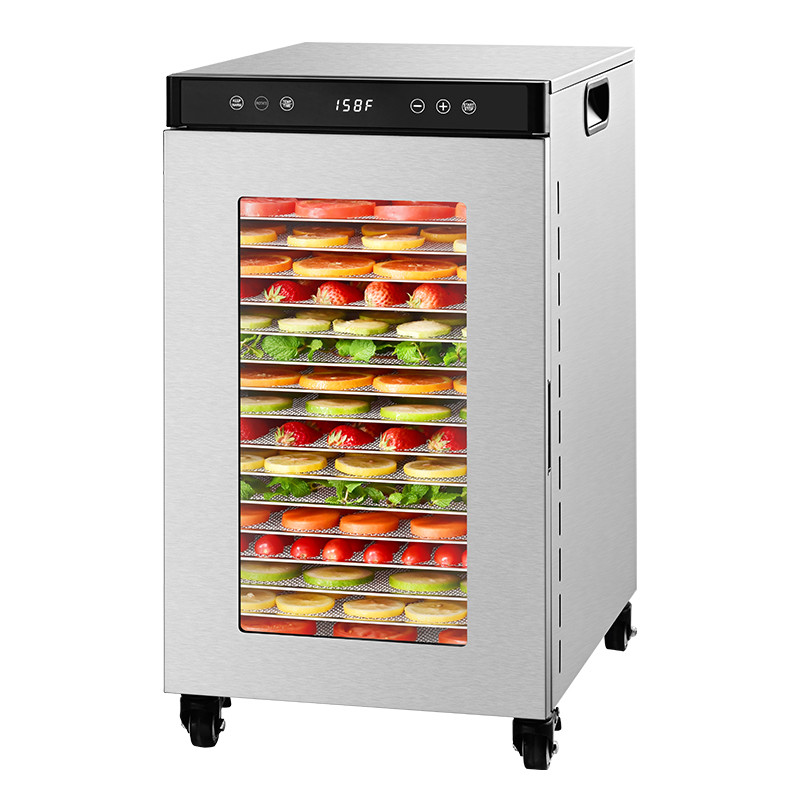
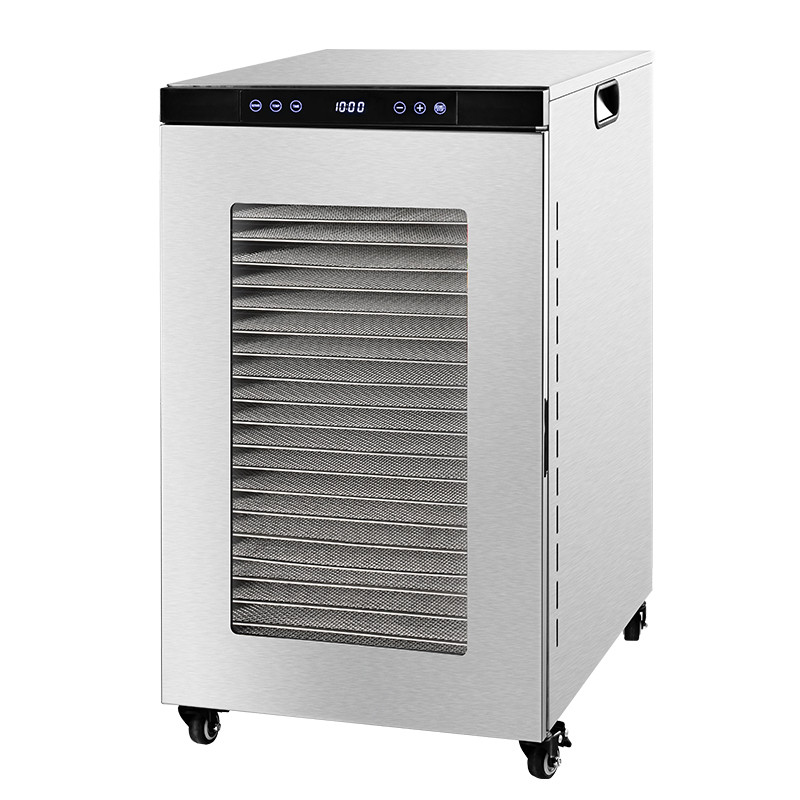
The KYS-500A/R (16/17-tray, 850–1010W) is a medium-capacity commercial dehydrator sized for the "café, deli, small restaurant" row of the table above, and the KYS-510A/R (20/22-tray, 1450–1730W) is the higher-capacity sibling for small production kitchens running several batches a day. Both use stainless steel trays (330 × 305 mm on the 500, 395 × 380 mm on the 510), horizontal airflow, a 48-hour timer and adjustable temperature — with MOQ from a 40HQ container and OEM/ODM customization available for brands.
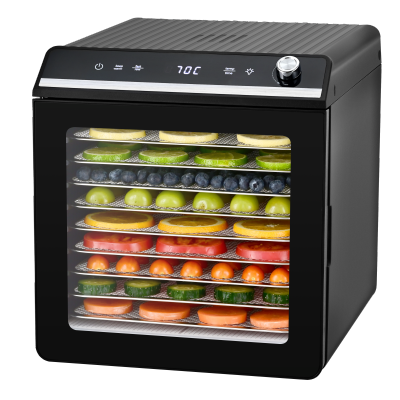
Between the two commercial tiers, Kangye also offers the KYS-601A/B/D 16-tray stainless dehydrator (1200–1400W), a back-heating large-capacity model that suits serious home food businesses and light commercial use, and a full home dehydrator line (5–10 trays) for brands that want a complete range under one label. Sourcing OEM kitchen appliances from China walks through what to verify when you evaluate a factory for this kind of equipment.
Featured Products: KYS-500A/R and KYS-510A/R Commercial Food Dehydrators
Featured Product: KYS-500A/R 16/17-Tray Commercial Food Dehydrator (850–1010W)
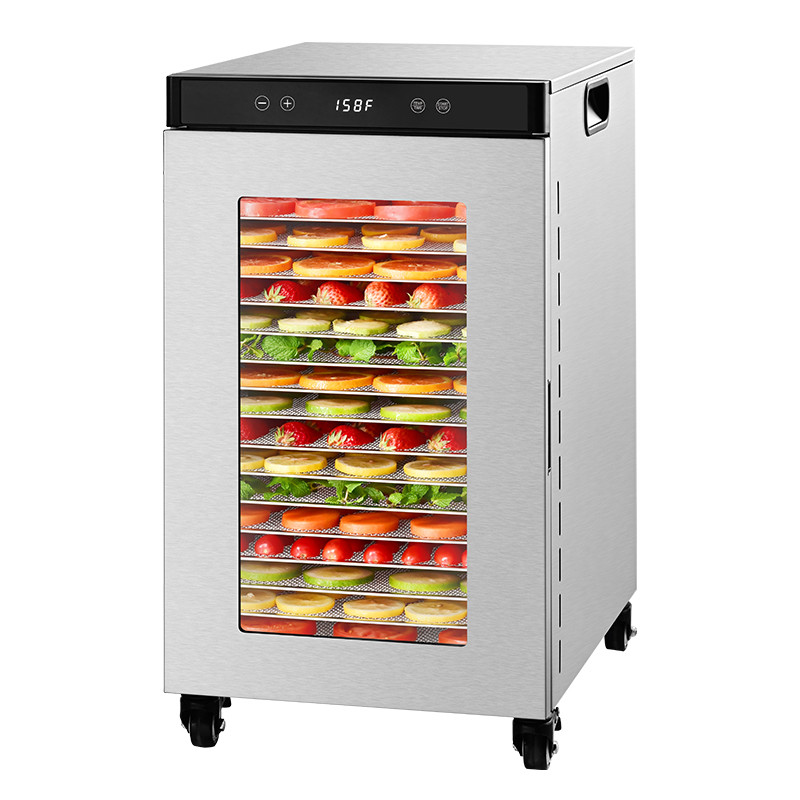
The KYS-500A/R is a medium-capacity commercial food dehydrator with 16 or 17 stainless steel trays (330 × 305 mm each) and an 850–1010W (220–240V) motor with rear-mounted horizontal airflow — even drying across all trays without rotation. A 48-hour timer supports overnight jerky and fruit runs, and stainless construction with food-grade materials makes it a practical first commercial unit for cafés, butcher shops and market vendors.
- 16/17 stainless steel trays — medium commercial capacity
- 850–1010W with horizontal airflow; no tray rotation
- 48-hour timer with adjustable temperature
- Food-grade materials; OEM/ODM ready
- MOQ 518 pcs (40HQ)
Featured Product: KYS-510A/R 20/22-Tray Commercial Food Dehydrator (1450–1730W)
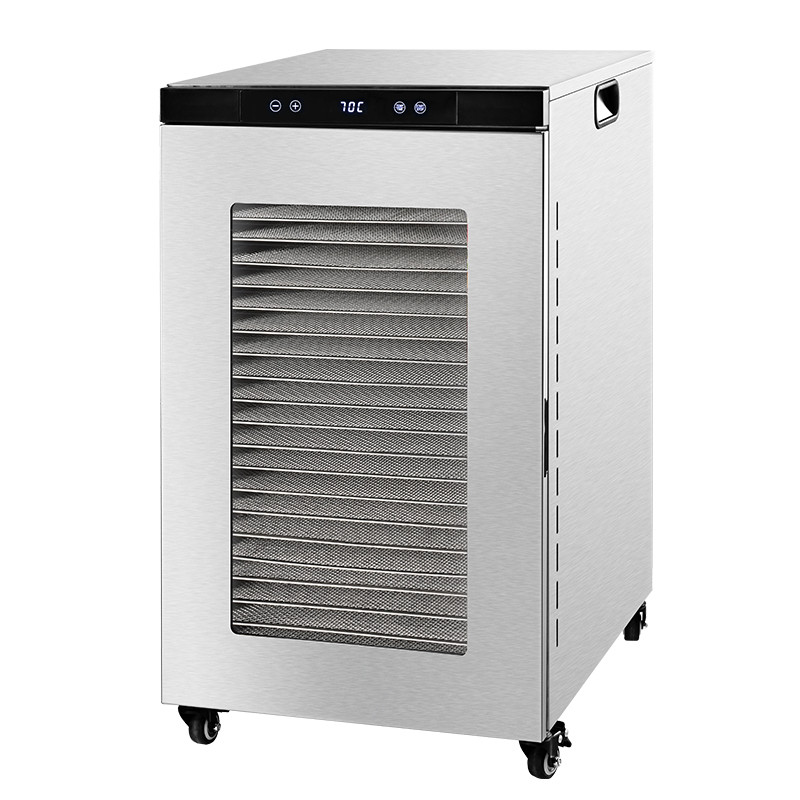
The KYS-510A/R is the higher-capacity commercial partner: 20 or 22 stainless steel trays (395 × 380 mm each) with a 1450–1730W (220–240V) motor and horizontal airflow for consistent results batch after batch. The 48-hour timer, adjustable temperature control and large stainless interior suit small production kitchens, snack producers and bulk jerky operations that need more throughput than a 16-tray unit can deliver.
- 20/22 stainless steel trays — large commercial capacity
- 1450–1730W high power with even horizontal airflow
- 48-hour timer; adjustable temperature
- Food-grade materials; OEM/ODM and private label ready
- MOQ 297 pcs (40HQ)
Kangye is an OEM/ODM manufacturer of food dehydrators and small kitchen appliances based in Guangdong, China, with 35+ years of manufacturing experience and exports to 100+ countries. Alongside the commercial dehydrator line we manufacture 5–10 tray home dehydrators, indoor and outdoor electric grills, BBQ grills, pizza ovens, air fryers, electric steamers, vacuum sealers, and pet feeders and water fountains. Our US kitchen appliance market guide places the category in the wider demand picture.
What to Verify When You Source a Commercial Dehydrator From a Factory
Buying from a factory adds a layer of verification that retail purchasing does not. Before committing to a production run, confirm five things in writing:
- Food-contact and material statements. Request documentation for stainless grade (304 vs 430), and any plastic parts' compliance with FDA 21 CFR (US) or EU 10/2011, with LFGB testing for the German market where relevant.
- Electrical safety certification. CE/GS for Europe, UL/ETL for North America where required, plus RoHS/REACH material declarations. Certification lead time runs 4–8 weeks, so it must be planned in parallel with samples.
- Voltage and plug configuration. Confirm whether the model can be configured for 120V/60Hz (North America) and 220–240V/50Hz (Europe) and how wattage derates between them — a unit sold at 1450–1730W at 220–240V is a different electrical product at 120V.
- Container economics. Commercial dehydrators are bulky; verify packed dimensions and the 20GP/40GP/40HQ loading counts so freight cost per unit is part of the landed-cost model, not a surprise.
- OEM/ODM depth. Can the factory vary tray count, control layout, branding and packaging, and hold quality across repeat runs? Ask for factory audit reports or arrange one — our OEM sourcing guide and private label guide walk through both processes step by step.
FAQ: Commercial Food Dehydrator Buying Guide, Answered
How many trays does a commercial food dehydrator need?
Match tray count to weekly volume: at least 12 trays for any business producing more than about two pounds of finished product per cycle, 16–20 trays for cafés, delis and market vendors, and 20–30 trays for small production kitchens. A common planning rule is weekly volume × 1.5 as your minimum batch capacity.
Is horizontal or vertical airflow better for a dehydrator?
For business use, horizontal (rear-mounted fan) airflow is the practical standard: air crosses every tray at similar velocity so trays never need rotating, which saves roughly 30–45 minutes of labor per batch on a 20-tray unit. Vertical units cost less but develop a top-to-bottom temperature gradient that requires regular rotation.
What temperature should a commercial dehydrator reach?
Commercial units typically span about 85–165°F or higher, with most foods dried between 95°F and 160°F. The more important spec is accuracy — controls should hold the set temperature within a narrow band (roughly ±5°F or better) so all trays dry at the same rate, and the unit should reach at least 160–165°F for meat-related processes where USDA guidelines apply.
How do I know if my jerky is safe to sell?
Follow the USDA FSIS compliance guideline for jerky: apply a validated lethality treatment before drying, then dry to a finished water activity of 0.85 or below for product stored in air (0.91 or below if vacuum packaged in oxygen-impermeable film), and verify with a water activity meter. The moisture-protein ratio of 0.75:1 is a labeling standard only. Meat and poultry jerky is regulated product in most US states and is commonly excluded from cottage-food exemptions.
Is stainless steel worth the extra cost in a commercial dehydrator?
Yes for food-contact surfaces. Stainless (ideally 304-grade) is non-reactive, corrosion-resistant, cleanable with commercial chemicals and durable over years of daily 12–24 hour cycles, whereas consumer-grade plastic can warp under sustained heat. 430 stainless is a lower-cost option for some parts; 316 adds extra corrosion resistance for salty jerky environments.
Can I buy a commercial dehydrator that works on a standard US 120V outlet?
Smaller commercial models can run on 120V, but remember the NEC 80% rule caps a 15A circuit at about 1,440W of continuous load. Larger units such as a 1450–1730W 20/22-tray dehydrator typically require 220–240V or a dedicated circuit — plan electrical work and room ventilation before the unit arrives.
Summary: Size by Volume, Choose Airflow, Verify Compliance
Summary: choosing a commercial food dehydrator for a small business reduces to three decisions. Tray count sizes the machine to your real weekly volume — 16–17 trays for cafés and market vendors, 20–22 trays for small production kitchens, sized at roughly 1.5× weekly output. Airflow decides your labor and consistency — rear-mounted horizontal airflow means no tray rotation and even drying, in a market projected to grow from roughly $729M (2024) toward $1.0B by 2030. Compliance determines whether the product is actually sellable — stainless food-contact surfaces, food-grade certifications, and, for jerky, a validated lethality treatment followed by drying to a water activity of 0.85 or below (0.91 vacuum-packaged) per USDA FSIS guidance. For importers, the same framework becomes a sourcing checklist: verify food-contact material statements, electrical certification, dual-voltage configuration, container loading counts and OEM/ODM depth before production.
- Size tray count to weekly volume × 1.5: 12+ / 16–20 / 20–30 trays by business class.
- Prefer horizontal airflow with a stable (±5°F) thermostat for repeatable batches.
- Specify 304 stainless food-contact surfaces and certified materials.
- Plan voltage, ventilation and power before the unit arrives.
- For jerky, follow FSIS water-activity (aw ≤ 0.85) compliance — not MPR.
Planning a commercial dehydrator line for your market? Kangye is an OEM/ODM manufacturer based in Guangdong, China, with 35+ years of manufacturing experience and exports to 100+ countries. Our product line covers 16/17-tray and 20/22-tray commercial food dehydrators, home dehydrators (5–10 trays), outdoor and indoor electric grills, BBQ grills, pizza ovens, air fryers, electric steamers, vacuum sealers, and pet feeders and water fountains — with dual-voltage options, certification packages (CE, GS, ETL, CB, RoHS, REACH, LFGB, FDA, SAA), private label programs and commercial container loading plans. Contact our team to discuss tray counts, airflow design and compliance requirements for your next commercial dehydrator order.