Food Dehydrator Temperature Control: Thermostats, Timers and Consistency
Quick Answer: How Does a Food Dehydrator Control Temperature?
A food dehydrator controls temperature with a thermostat that cycles the heating element on and off (or modulates its power) to hold the air inside the chamber near a set point, while a timer controls how long that process runs. Cheap dehydrators use bimetallic-strip thermostats that can drift 10–25°F from the dial reading; better machines use electronic sensors (NTC thermistors) with digital displays that hold within roughly ±1–5°F, and the most precise designs add PID (proportional-integral-derivative) algorithms for control bands near ±0.1–1.5°C. Because food safety and drying quality depend on hitting specific temperatures — herbs at 95–115°F, fruits and vegetables at 135–140°F, meat jerky at 160°F (USDA) — temperature control is the single most important specification in the category, and it is the first thing a buyer should verify before sourcing a dehydrator line.
Key takeaway: temperature control determines both food safety and drying consistency. A thermostat that lies by 20°F turns a "160°F jerky cycle" into a case-hardened, under-dried batch; a timer that cannot run long enough limits the machine to small batches. Importers should specify thermostat type, accuracy, temperature range, timer range, and how the machine verifies consistency — not just wattage and tray count.
Why Temperature Control Is the Defining Feature of a Food Dehydrator
Dehydration is a slow, low-temperature process: a typical batch runs 6 to 12 hours, and commercial or high-capacity units run longer. Over that window, the interior temperature has to stay inside a safe, effective band. The stakes are concrete. The USDA and land-grant extension services — Cornell Cooperative Extension, Penn State Extension, the University of Georgia's National Center for Home Food Processing (NCHFP), and the University of California's ANR program — all publish the same core guidance: dehydrate fruits and vegetables around 135–140°F, herbs as low as 95–115°F to preserve volatile oils, and meat jerky at 160°F (or preheat meat to 160°F and poultry to 165°F before drying) to kill pathogens before the drying cycle begins.
| Food Category | Recommended Drying Temperature | Source |
|---|---|---|
| Herbs (leaves, flowers) | 95–115°F (35–46°C) | NCHFP / UGA Extension |
| Fruits & vegetables | 135–140°F (57–60°C) | Cornell CCE Monroe County |
| Meats (jerky) | 160°F (71°C), preheated before drying | USDA FSIS |
| Poultry | 165°F (74°C), preheated before drying | USDA FSIS |
| Safe finished water activity | aw ≤ 0.85 for jerky | UC ANR (Kendall & Sofos, 2012) |
These numbers only work if the machine actually holds them. If a dial marked "160°F" really runs at 180°F, jerky case-hardens — a dry crust seals in moisture and spoilage follows; if it runs at 140°F, the meat never reaches the pasteurization temperature the USDA requires. This is why temperature control is the specification that separates a food-safe dehydrator from a toy, and why our dehydration science guide and dehydrator vs oven comparison both return to temperature accuracy as the deciding factor.
How Dehydrator Thermostats Work: Mechanical vs Electronic Control
Every dehydrator thermostat is a feedback loop: a sensor measures the air temperature, and a switch (or controller) turns the heating element on and off to hold the set point. The hardware that performs that loop determines accuracy, cost, and reliability. There are two broad families:
- Mechanical thermostats — the traditional approach. A bimetallic strip (two bonded metals with different expansion rates) bends as it heats and opens or closes a switch; or a capillary tube filled with temperature-sensitive fluid/gas expands and trips a switch. These are cheap, rugged, and need no electronics, but they are slow (a bimetallic element takes roughly 90 seconds to respond to a large temperature step) and imprecise — experienced users report consumer dial machines drifting 10–25°F from the setting, with oscillation bands of ±5°F or more.
- Electronic thermostats — an NTC thermistor (or RTD) reads the air temperature, a microcontroller compares it to the set point, and a relay or triac switches the heater. Digital control typically holds ±1–5°F at the sensor, adds a readable display, and enables timers and presets. The most advanced tier uses a PID algorithm that modulates heater power to anticipate overshoot — control bands near ±0.1–1.5°C, the same precision class we examined in our PID vs on/off temperature control technical article.
For buyers, the honest trade-off is cost versus precision. A bimetallic thermostat adds a fraction of a dollar to the BOM; an electronic NTC + microcontroller system adds several dollars but is the difference between a dial that says "warm" and a digital readout that says 60°C. In a category where the market is expected to grow from about $2.42 billion in 2025 to $2.58 billion in 2026 (CAGR 6.2%) and reach roughly $3.3 billion by 2030 (The Business Research Company), the growth is concentrated in digital, programmable machines — PW Consulting pegs horizontal-airflow digital designs at 73.9% of market share, and 360iResearch notes buyers increasingly expect programmable control as a baseline.
Thermostat Types Compared: Bimetallic, Capillary, Thermistor and PID
Here is the engineering comparison importers need when reading a specification sheet:
| Thermostat Type | Sensor / Mechanism | Typical Accuracy | Response Time | Cost & Notes |
|---|---|---|---|---|
| Bimetallic strip | Two bonded metals with different expansion rates | ±5–10°F typical; field drift can reach ±10–25°F | ~90 s to a 10–90°C step | Lowest cost; simple; found in budget vertical-airflow units |
| Capillary tube / gas-actuated | Fluid or gas in a tube expands to trip a switch | ±1–2% of full scale | ~30 s | Faster than bimetallic; common in ovens and commercial equipment |
| NTC thermistor + MCU | Thermistor resistance read by a microcontroller | ±1–5°F at sensor | <1 s sensing; control loop dictates response | Digital displays, timers, presets; the mainstream "digital dehydrator" tier |
| PID closed-loop | Thermistor/RTD + PID algorithm modulating heater power | ±0.1–1.5°C | Fast, no steady-state overshoot | Highest precision; premium commercial and high-end home units |
One extra consideration: where the sensor sits matters as much as the sensor type. A thermostat that samples air near the heater will read hotter than the trays; a unit with a fan that circulates air across the sensor gives a truer reading. This is why heating layout and thermostat placement are designed together — the topic we covered in depth in our dehydrator heating systems explained article, where rear-heating horizontal airflow consistently rated as the most uniform configuration.
Timers: Mechanical Dials, Digital Timers and Auto Shut-Off
A thermostat controls temperature; a timer controls how long the process runs — and long cycles are where dehydrators live. Most home drying takes 6–12 hours; whole fruits, dense vegetables, and jerky can need 24 hours or more. That makes timer range a practical specification:
- Mechanical dial timers (typically up to 12–26 hours) are simple and cheap but noisy and only approximate; they also cannot offer auto shut-off with a digital display or presets.
- Digital timers (typically up to 48 hours in modern machines) allow precise, repeatable settings — and critically, they pair with automatic shut-off, so an overnight run ends exactly when the batch is done instead of cooking for another 20 hours.
- Auto shut-off is a safety feature, not a convenience: it prevents over-drying, wasted energy, and unattended-heating risk. NESCO's 2025 dual-zone flagship and Kangye's KYS-365/KYS-315 series both run 0.5–48 hour digital timers with auto shut-off — a useful benchmark for what the market now expects.
From a sourcing perspective, timer and thermostat come as a control-system package. A digital dehydrator's control board handles both: it reads the thermistor, drives the heater relay, and counts down the timer, optionally with a fan-only mode (air circulation without heat) for herbs and delicate batches. That fan-only function is a real differentiator — it extends the usable range below 35°C and gives users an energy-saving finishing step.
Temperature Consistency: Why Even Heat Distribution Matters
Accuracy is one thing; consistency is another. Two dehydrators can both read "140°F" at the thermostat and dry completely differently because of how evenly heat reaches the trays. The failure mode is case hardening: if the top tray runs hot and the bottom tray runs cool, food on the top forms a dry skin that traps moisture inside, producing leathery or moldy results. Sources of inconsistency:
- Heating layout: bottom-heating vertical units tend to run hotter near the base; top-heating units leave lower trays cooler; rear-heating with horizontal airflow across all trays is the most uniform — which is why rear-heat designs dominate the premium tier.
- Load and airflow: overloading trays blocks circulation; every tray of wet food adds evaporative cooling, so a thermostat must recover as moisture leaves the food.
- Ambient conditions: a machine in a cool basement works harder and cycles differently than one in a warm kitchen; wide ambient swings widen the control band.
- Thermostat placement: sensors that sample air rather than a heat-soaked surface give a steadier signal.
The practical test a reviewer or buyer can run: load the machine with a probe thermometer on the top, middle, and bottom trays at 140°F and compare readings after one hour. Uniform designs (rear-heat horizontal airflow) typically show less than 10°F spread across trays; vertical budget units can show 20°F or more. Our bottom vs back vs top heating comparison documents exactly this difference with the engineering behind it.
Recommended Dehydrating Temperatures by Food Type
A well-controlled dehydrator lets the user follow the extension-service temperature map. Here is the consolidated chart (from NCHFP/UGA, Cornell CCE, USDA FSIS, and Illinois Extension):
| Food | Temperature | Finished State / Notes |
|---|---|---|
| Herbs | 95–115°F | Preserve volatile oils; dry until brittle |
| Fruits | 135–140°F | Dry to ~20% moisture (leathery, no moist spots) |
| Vegetables | 135–140°F | Dry to ~10% moisture (crisp) |
| Jerky / meat | 160°F (preheat to 160°F first) | aw ≤ 0.85; internal temperature verified |
| Poultry | 165°F (preheat before drying) | USDA FSIS requirement |
| Roll-ups / fruit leather | 135–140°F | Peelable, pliable, no sticky center |
Note the food-safety boundary: drying below 135°F for perishables extends time in the bacterial growth zone, and drying meat without a 160°F preheat step is the #1 food-safety error in home jerky making (UC ANR, Kendall & Sofos 2012). A dehydrator with a wide, accurate range — like Kangye's 35–75°C (95–167°F) on the KYS-365 and KYS-315 series — covers the full map from herb preservation to USDA-compliant jerky, and its fan-only mode handles the low end without any heat at all.
How to Verify a Dehydrator's Temperature Accuracy
Thermostats drift, and every buyer — retail reviewer or commercial importer — should know how to verify a machine's claims. The field method, used consistently by independent reviewers and extension resources:
- Place an independent oven/probe thermometer on the center tray, not the one nearest the heater.
- Set the dehydrator to 135°F (57°C) and run it for a full hour with the door closed, letting the control system settle.
- Record the reading at the 30-minute and 60-minute marks, plus readings on the top and bottom trays if possible.
- Judge: within ±10°F of set point is acceptable for most home machines; within ±5°F is good (typical of digital units); a dial machine drifting 20°F+ needs calibration or replacement.
For an importer running incoming-quality checks on a container, the same test is the cheapest possible QC step — it costs nothing but an hour and a probe thermometer, and it instantly separates a properly built control system from a loose bimetallic part. When you also need to confirm the electrical side of the equation — voltage, wattage, and the standards the control board must meet — our electrical ratings guide and commercial dehydrator buying guide are the deeper references.
What Importers Should Specify: A Temperature Control Checklist
When you source a food dehydrator under your own brand, put the control system on the specification sheet in writing. Here is the checklist our engineers recommend:
- Thermostat type: bimetallic, capillary, thermistor+MCU, or PID — and the claimed accuracy at the sensor (±°F).
- Temperature range: must span the food-safety map — at least 95–167°F (35–75°C); wider is better, fan-only mode counts.
- Timer range: at least 24 hours; 48 hours with auto shut-off is the current premium benchmark.
- Control type: digital display with independent thermistor sensing versus a dial; digital enables presets and repeatable results.
- Consistency data: ask the factory for tray-to-tray temperature spread measured at 140°F (documented test results, not marketing).
- Safety controls: thermal cutoff / overheat protection, auto shut-off, and compliance with IEC 60335-2-9 (household heating appliances) for the target market plus CE/GS/ETL marks as applicable.
- Calibration and QC: ask whether the factory tests thermostat accuracy on the line, and request the incoming inspection procedure.
These are exactly the specs Kangye locks into its digital dehydrator line: the KYS-365 6-tray and KYS-315 10-tray series both carry 35–75°C electronic control, 0.5–48 hour digital timers, auto shut-off, fan-only mode, stainless steel trays, and BPA-free construction — with OEM/ODM options for panel labels, presets, and packaging. If you are comparing machines tray-by-tray and power-by-power first, our home dehydrator buying guide walks through the full decision matrix.
Featured Products: Kangye KYS-365 and KYS-315 Series
Featured Products: KYS-365 Series 6-Tray & KYS-315 Series 10-Tray Food Dehydrators
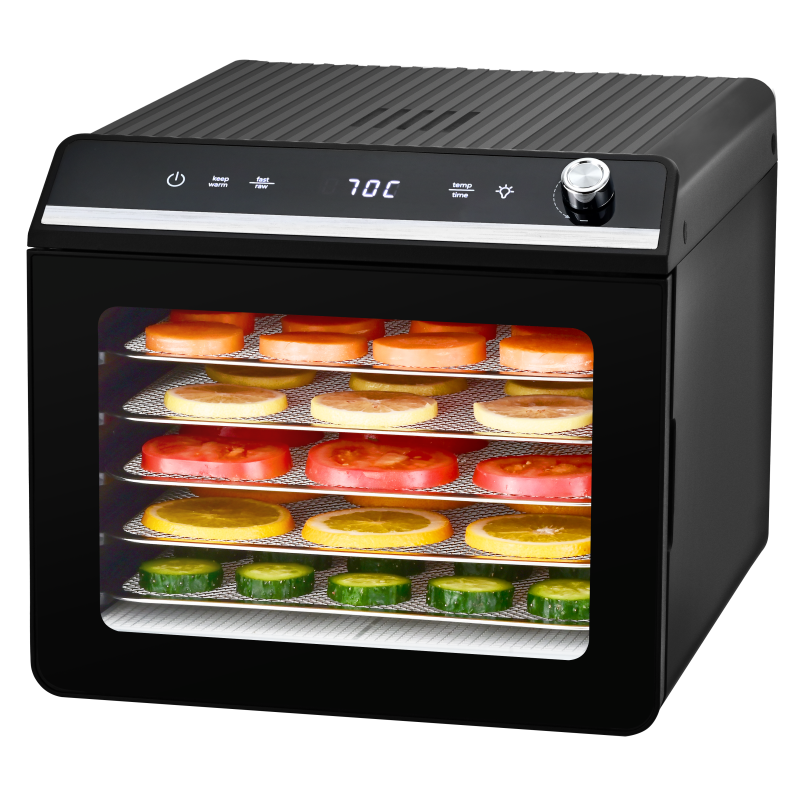
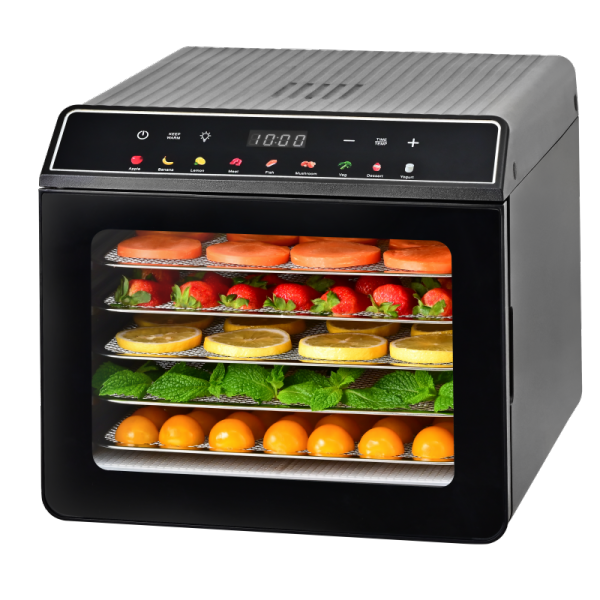
The KYS-365 Series (model KYS-365A/B/C) is a 6-tray digital dehydrator built around precise temperature control: 35–75°C / 95–167°F adjustable range with a 0.5–48 hour digital timer, auto shut-off, and a fan-only mode for no-heat air circulation. Rear-positioned heating with horizontal airflow promotes even drying across all 6 stainless steel trays; power is 220–240V 500–600W or 120V 550W, with a compact 313 × 372 × 286 mm footprint.
- Digital thermistor control — repeatable, readable temperature setting
- 35–75°C range covers herbs to USDA-compliant jerky
- 48H timer with auto shut-off + fan-only mode
- 6 stainless steel trays + fruit roll tray; back heating, horizontal airflow
- MOQ 1,463 pcs / 40HQ; OEM/ODM options available
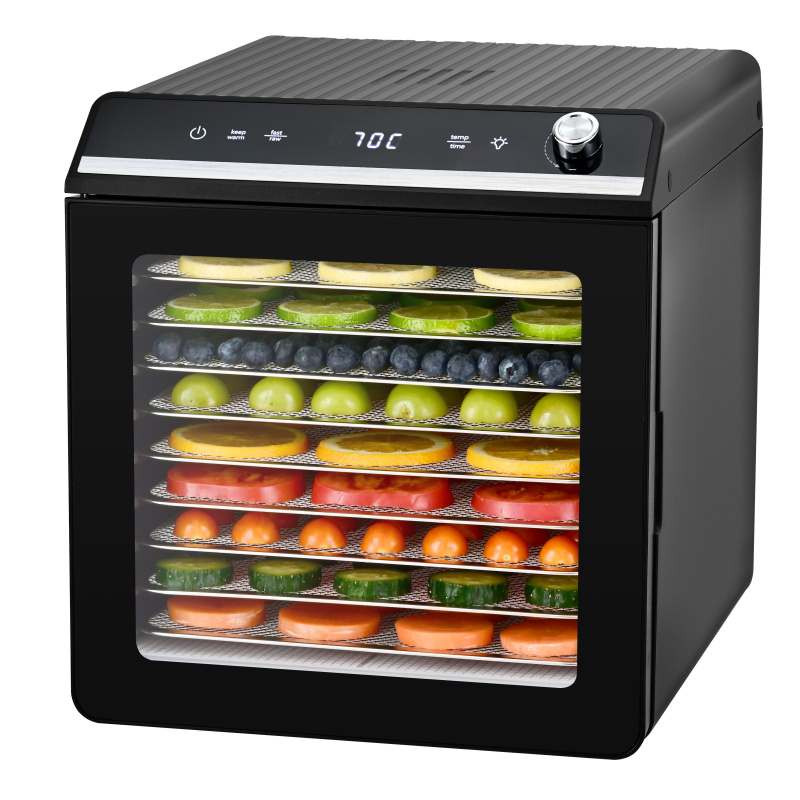
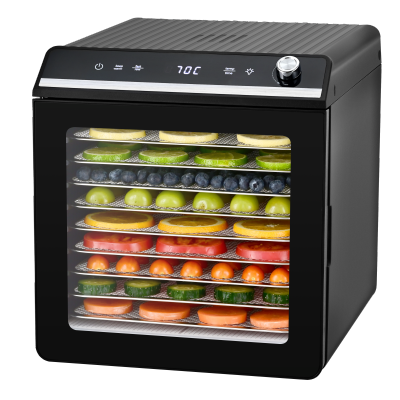
The KYS-315 Series (model KYS-315E/F/G/H) scales the same control system to 10 stainless steel trays for higher batch throughput: 35–75°C / 95–167°F digital control, 0.5–48 hour timer with auto shut-off, fan-only mode, and 220–240V 600–700W power in a 313 × 372 × 342 mm body. BPA-free materials throughout the food-contact path, with the same OEM/ODM flexibility as the 6-tray platform.
- 10 stainless steel trays — bigger batches, same precision control
- 35–75°C digital thermostat + 48H timer + auto shut-off
- BPA-free, food-contact safe construction
- MOQ 1,235 pcs / 40HQ; private label ready
FAQ: Dehydrator Temperature Control, Answered
What temperature should a food dehydrator be set to for meat jerky?
The USDA recommends 160°F (71°C) for jerky, and poultry should be preheated to 165°F (74°C) before drying. For food safety, preheat the meat to that temperature before the drying cycle begins, then dry; finished jerky should have a water activity (aw) of 0.85 or below (UC ANR, Kendall & Sofos 2012).
Is a digital dehydrator more accurate than a dial model?
Usually, yes. Digital machines use an NTC thermistor read by a microcontroller, typically holding ±1–5°F at the sensor with a readable display. Bimetallic dial thermostats are cheaper and simpler but commonly drift 10–25°F and oscillate wider. The practical check is an independent probe thermometer test at 135°F for one hour.
Why does my dehydrator temperature fluctuate during a run?
All dehydrators cycle their heater on and off — fluctuation itself is normal. Wide swings usually mean a crude mechanical thermostat, a sensor placed too close to the heater, overloading that blocks airflow, or cool ambient conditions forcing longer cycles. Rear-heating horizontal airflow designs generally show the least tray-to-tray variation.
What is case hardening in dehydrated food?
Case hardening happens when the outside of the food dries into a hard shell while the inside stays moist — typically because the temperature ran too high or airflow was uneven. The trapped moisture can spoil the batch later. Consistent, moderate temperatures (135–140°F for most produce) and uniform airflow prevent it.
Do I need a 48-hour timer?
Not for every batch — but long-cycle foods (whole fruits, dense vegetables, jerky) can run 24+ hours, and a 48-hour timer with auto shut-off means you never have to interrupt an overnight run or overcook a batch. It has become the standard specification on premium digital dehydrators in 2025–2026.
What should I check when sourcing a dehydrator for my brand?
Put the control system in writing: thermostat type and accuracy, temperature range (aim for 95–167°F minimum), timer range with auto shut-off, digital display, tray-to-tray consistency data at 140°F, overheat protection, and IEC 60335-2-9 plus CE/GS/ETL compliance for your market. Then run the one-hour probe test on the first sample.
Summary: The Temperature Control Equation
Summary: temperature control is the specification that makes a food dehydrator food-safe, consistent, and worth sourcing. The chain is simple — a thermostat holds the set point, a timer controls the run, and airflow spreads the heat evenly; mechanical controls drift (10–25°F), digital controls hold tight (±1–5°F), and PID is the precision tier (±0.1–1.5°C). Buyers should verify the range covers the extension-service temperature map (95–115°F herbs to 160°F jerky), demand a timer long enough for overnight batches, and run a probe-thermometer test on first samples — because in dehydration, the dial's promises are only as good as the thermostat that keeps them.
- Specify thermostat type, accuracy, range, and timer in every sourcing document.
- Look for rear heating + horizontal airflow for the most consistent tray temperatures.
- Verify with an independent probe test at 135°F for one hour before approving samples.
- Pair dehydration with vacuum sealing to maximize shelf life — see our chamber vs external sealer guide.
Sourcing a digital food dehydrator with precise temperature control for your brand? Kangye is an OEM/ODM manufacturer based in Guangdong, China, with 35+ years of manufacturing experience and exports to 100+ countries. Our product line covers food dehydrators (6- to 10-tray digital series), BBQ grills, pizza ovens, air fryers, steam cookers, vacuum sealers, indoor electric grills, and pet feeders and water fountains. Contact our team to discuss MOQs, control-system options, certification packages, and private label programs for your market.