Vacuum Sealer Technology: How Suction and Sealing Create Airtight Packaging
Vacuum Sealer Technology: How Suction and Sealing Create Airtight Packaging
A vacuum sealer does two jobs in sequence: a vacuum pump draws air out of a bag, then a heated sealing bar melts the bag's mouth shut while the bag is still under reduced pressure. That two-step sequence — suction, then sealing — is the entire technology, yet the engineering details inside each step determine everything a buyer cares about: how strong the vacuum is, whether liquids get sucked into the pump, which bags the machine can use, and whether the seal stays airtight in the freezer for months. This article explains the physics and engineering of both external-suction and chamber vacuum sealers, compares them head to head, and translates the science into concrete RFQ specifications — using Kangye's KYS-960 Series compact vacuum sealer as a working example.
Understanding how a vacuum sealer works matters beyond curiosity. The global food vacuum sealer market was valued at roughly US$4.46 billion in 2025 and is projected to reach US$5.03 billion in 2026 — a 12.7% CAGR — and grow to about US$8.07 billion by 2030, driven by frozen food consumption, food waste reduction, and home food storage practices. Food packaging accounts for more than 70% of vacuum sealer installations worldwide, and over 42 million U.S. households now use food preservation equipment. For importers and brands adding a vacuum sealer line, knowing how the machine actually works is the difference between a spec sheet and a sellable product.
The Two-Step Core: Suction, Then Heat Sealing
Every vacuum sealer — from a US$40 home unit to a US$20,000 chamber machine — executes the same fundamental cycle:
- Load: the filled bag's open end is positioned in the sealing area, with the mouth kept clean, straight, and free of food particles.
- Evacuate: a vacuum pump removes air from inside the bag until a preset vacuum level, time, or sensor threshold is reached.
- Seal: a sealing bar applies heat and pressure across the bag mouth, melting the inner sealant layers together.
- Cool: the seal sets under pressure before the package is released, so the weld has time to form a durable bond.
The result is a package with dramatically reduced oxygen inside. Keeping residual oxygen under roughly 0.5% blocks most aerobic spoilage organisms and slows lipid oxidation — the chemical reaction that turns fats rancid. This is why vacuum packaging extends shelf life: not by sterilizing food, but by removing the oxygen that spoilage microbes and oxidation need. USDA research confirms vacuum packaging extends shelf life roughly 3–5× versus conventional packaging for many perishables — for example, refrigerated beef lasts 5–8 days conventionally but 20–45 days vacuum-sealed, and semi-hard cheeses keep 2–4 weeks conventionally versus 6–12 months vacuum-packed.
The honest caveat belongs right here: vacuum packaging removes air; it does not kill pathogens. Anaerobic bacteria such as Clostridium botulinum can thrive in an oxygen-free environment, which is why temperature control remains mandatory — a point we expand on in the food safety section below.
Anatomy of a Vacuum Sealer: Pump, Channel, Seal Bar and Controls
Strip away the case and a vacuum sealer is four subsystems:
| Subsystem | What it does | Why it matters for buyers |
|---|---|---|
| Vacuum pump | Moves air out of the bag (or chamber). Common designs: diaphragm, piston, and rotary-vane pumps. | Pump type and flow rate set evacuation speed and maximum vacuum depth. Oil-lubricated rotary-vane pumps reach the deepest vacuums but cost more. |
| Vacuum channel / chamber | External units: a channel holds the bag opening during evacuation. Chamber units: a sealed box contains the whole package. | Determines bag compatibility and whether liquids/powders can be sealed safely. |
| Seal bar and heating element | Applies heat and pressure to melt the bag mouth into a hermetic weld. | Sealing width sets the maximum bag size; dual seal bars add reliability. A 30 cm sealing length is the mainstream home format. |
| Controls and sensors | Select vacuum time/level, seal time, and product modes; sensors detect liquid reaching the seal area. | Pulse mode and moisture sensing prevent liquids from entering the pump — a key durability feature for wet foods. |
Gaskets and covers complete the picture: they let the machine close and maintain a stable vacuum path. When comparing equipment, use the manufacturer's documented pump type, rated flow, supported bag format, and duty cycle rather than inferring performance from a similar-looking model — the pump label alone does not predict packing performance.
External Suction Sealers: How Air Leaves the Bag
External-suction sealers — the format of most home machines, including the KYS-960 — keep the product outside the machine. The open end of the bag is inserted into a sealing channel, a vacuum pump draws air directly through the bag opening, and once the target vacuum is reached, the nozzle retracts and the sealing jaws close across the mouth.
Because suction is applied from one end, external machines generally require embossed or channelled bags: the textured inner surface keeps a continuous air path open from the product end of the pouch to the machine, so air can escape even as the bag collapses around the food. This is a real constraint — standard smooth bags do not evacuate well on most external sealers. Typical external machines reach about −0.6 to −0.8 bar (roughly 24–28.5 inHg) of vacuum, which is plenty for freezing, portioning, and sous vide at home, though not the deepest possible vacuum.
External sealers are compact, affordable, and ideal for large or irregular packages that would never fit inside a chamber. Their known weaknesses: vacuum consistency depends on bag channeling and nozzle placement, and liquids or powders near the seal area risk being pulled toward the pump. Manufacturers address this with moisture sensors, drip trays, and pulse modes that let users control evacuation manually for delicate or wet foods. The KYS-960, for example, ships with four fresh-keeping functions — Dry, Moist, Seal, and Pulse — precisely so one machine can handle both dry goods and moisture-rich food without pulling liquid into the pump.
Chamber Sealers: Vacuum Around the Package
Chamber vacuum sealers work differently: the entire package goes inside a sealed chamber, the pump evacuates air from the chamber and the bag together, and the bag is heat-sealed while the chamber is still under vacuum. Only after sealing does the chamber re-pressurize, allowing outside air pressure to compress the bag tightly around the product.
Two consequences follow from this architecture. First, the vacuum is more even and deeper — chamber machines routinely exceed −0.9 bar (29 inHg), and professional models approach near-total vacuum above 99%, which is why commercial kitchens use chamber machines for sous vide and for liquids. Second, because pressure falls evenly around the whole package, liquids and powders are not drawn out of the bag the way they can be through a single suction point — soups, sauces, and marinades seal cleanly on chamber units. Chamber machines also accept smooth, less expensive bags.
The trade-offs are size, cost, and speed: the package must fit inside the chamber, chamber machines cost significantly more, and each cycle is a full load-and-close operation. That is why chamber units dominate commercial food processing (roughly 45% of vacuum sealer revenue) while external sealers lead the fastest-growing household segment — a split worth reflecting in any product portfolio decision.
External vs Chamber: A Side-by-Side Technical Comparison
| Comparison factor | External suction sealer | Chamber sealer |
|---|---|---|
| Air-removal method | Draws air directly through an external nozzle/channel | Evacuates chamber and bag together |
| Typical vacuum depth | −0.6 to −0.8 bar (24–28.5 inHg) | −0.9 bar and deeper; professional models >99% vacuum |
| Package-size limit | Limited by seal length and channel position; large/irregular packages OK | Limited by chamber dimensions |
| Liquids and powders | Higher risk of liquid entering the vacuum system; needs moisture sensor/pulse mode | Generally easier to control; suits soups, sauces, marinades |
| Bag compatibility | Requires embossed/channelled bags for an air path | Works with smooth, less expensive bags |
| Cycle throughput | One bag at a time; limited by pump flow and operator handling | Chamber loading; multiple bags possible per cycle |
| Typical price band | US$40–300 (home), higher for professional nozzle units | US$300–20,000+ depending on size and pump |
| Best-fit applications | Home portioning, freezing, dry goods, sous vide, bulky items | Commercial food processing, wet foods, high-throughput kitchens |
The takeaway: don't compare the two formats by headline vacuum figures alone. Capacity, product type, bag compatibility, cleaning routine, and operator workflow usually matter more. A home brand serving families needs a compact external unit with good moisture handling; a commercial customer needs chamber throughput and seal repeatability. For a deeper look at how vacuum packaging extends shelf life — the food science side of this equation — our article on how vacuum sealing extends food shelf life covers the preservation mechanisms in detail.
Sealing Science: Heat, Pressure, Time and the Multilayer Bag
The seal is where airtight packaging is actually won or lost. A vacuum pouch is typically a multilayer film — commonly PA (polyamide) for strength, a barrier layer sometimes including EVOH to control oxygen transmission, and PE (polyethylene) as the heat-sealing, food-contact layer. During sealing, the seal bar heats the PE layers until they melt and fuse; pressure holds them together while the weld cools and sets.
Three variables determine seal quality:
- Seal temperature: too cool, and the layers do not fuse; too hot, and the film burns or melts through. Modern units control this automatically via seal-time settings.
- Seal pressure and cooling: the weld needs pressure while setting — releasing the bag too early yields a weak seal that fails in the freezer.
- Clean, flat sealing area: food particles, moisture, or wrinkles in the seal zone cause leaks. A "loose" bag is often a bag problem or a loading problem, not a pump problem.
This is why a 30 cm sealing length — the format Kangye specifies for the KYS-960 — has become the mainstream home standard: it covers the most common retail bag sizes while keeping the heating element's power draw modest (the KYS-960 runs on 130W at 220–240V or 120V). Buyers should treat seal-bar width as a spec to be tested with the actual bags they intend to sell, not assumed from the marketing sheet.
Vacuum Degree in Practice: What "≥50kPa" Really Means
Vacuum specifications are published in confusingly different units — negative pressure, residual pressure, mbar, kPa, inHg, or a percentage — and they are only comparable when the unit, reference pressure, test condition, and measurement point are clear. For home vacuum sealers, a common meaningful figure is the maximum vacuum degree, often stated as ≥50 kPa (about 0.5 bar of negative pressure, or roughly 15 inHg).
What does 50 kPa actually buy you? Enough air removal to firmly compress the bag around food, suppress aerobic spoilage, and prevent freezer burn — the outcomes home users actually care about. It is not the deepest vacuum in the industry: chamber machines reach 90+ kPa and professional sous vide setups need near-total vacuum. But chasing maximum vacuum for a home product is the wrong instinct: deeper vacuum on an external sealer can crush fragile items, pull moisture into the pump, and slow the cycle. A well-designed 50 kPa external sealer with good bag channeling often preserves food better than a poorly executed "high-vacuum" machine with incompatible bags.
The honest spec-sheet advice: verify the vacuum figure with the intended bag and product, ask for the pump type (diaphragm vs piston vs rotary-vane), and check the evacuation speed — the KYS-960 completes a rapid vacuum cycle in about 8.5 seconds, which is the throughput number that matters in daily use. For a deeper dive on the electrical side — voltage, frequency, and power ratings across markets — see our guide to electrical ratings and voltage specifications.
Food Safety: What Vacuum Does — and Does Not — Do
This section is where manufacturers and importers must be disciplined, because vacuum packaging has a genuine food-safety blind spot. Removing oxygen suppresses aerobic spoilage organisms such as Pseudomonas and Aspergillus molds — the visible spoilage that makes food smell and turn bad. But an oxygen-free environment is ideal for anaerobic pathogens, most notably Clostridium botulinum, which can form toxin without oxygen.
The USDA, university extension services, and the FDA are consistent on the safeguards:
- Temperature control is non-negotiable: keep vacuum-packed perishables refrigerated at or below 40°F (4°C), or frozen at 0°F (−18°C). Botulinum toxin can form within 48 hours at just 10°C, so cold chains cannot slip.
- Intrinsic food properties matter: foods with pH above 4.6 (most meats, dairy, cooked vegetables) allow C. botulinum spores to germinate without additional barriers; foods at or below about pH 4.6 (pickles, fermented products) are naturally protected. Low water activity (aw ≈ 0.85 and below) similarly blocks bacterial growth.
- Vacuum is not sterilization: it does not replace safe handling, cooking, or validated shelf-life processes. Michigan State University Extension notes that USDA requires processors to validate the shelf-stability of heat-treated ready-to-eat meat products under vacuum packaging rather than assume it from labeling standards.
- Commercial guidance: for raw meats, USDA storage guidance is 3–5 days refrigerated (beef, veal, pork, lamb) and 1–2 days for poultry and ground meats — vacuum packaging extends usable life significantly when cold chains hold, but it does not change safe-handling rules.
For an importer, this translates into three concrete product decisions: include clear storage instructions in the retail pack, specify food-grade bags with documented food-contact compliance, and — for any refrigerated or RTE positioning — have your factory document the temperature assumptions behind claimed shelf-life extensions. Michigan State's guidance on validating vacuum-packaged RTE products is a useful technical reference for commercial buyers building safety programs.
What to Specify in an RFQ for a Vacuum Sealer Line
When you send a vacuum sealer RFQ to a factory, translate this article into testable specifications:
- Format: external suction vs chamber, and why — home/retail positioning usually means external; food-service means chamber.
- Pump specification: pump type (diaphragm/piston/rotary-vane), rated flow, maximum vacuum degree (e.g., ≥50 kPa for a home external unit), and evacuation speed.
- Sealing system: sealing length (30 cm mainstream), single vs dual seal bars, seal-time control, and cooling cycle.
- Modes: Dry/Moist/Seal/Pulse coverage and moisture-sensor behavior — the features that protect the pump from wet foods.
- Accessory port: canister/marinade hose compatibility extends the product beyond bags.
- Electrical: voltage/frequency variants (120V 60Hz for North America; 220–240V 50/60Hz for EU/Asia) and power draw.
- Certification: IEC 60335-1/2-9 household appliance safety, UL/ETL for North America, CE for the EU, and food-contact compliance for the bag and drip tray.
- Packaging and MOQ: retail box dimensions, included bags, and container loading quantities.
For the end-to-end sourcing process — factory qualification, samples, and QC — our step-by-step OEM sourcing guide covers the journey from RFQ to container loading. And for buyers choosing between vacuum sealing and other preservation methods, our comparison of food dehydrators vs oven drying and the science of food dehydration round out the preservation toolkit.
Featured Product: Kangye KYS-960 Series Compact Vacuum Sealer
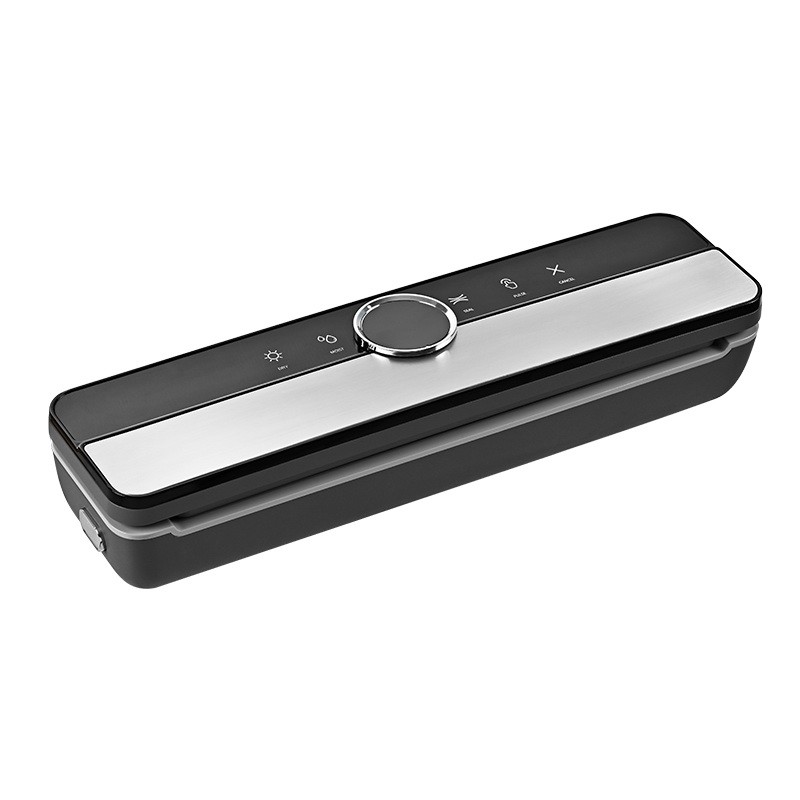
Kangye's KYS-960 Series (models A/B/C/D) is a compact automatic vacuum sealer engineered around the technology this guide explains: a 130W vacuum system that pulls to a maximum vacuum degree of ≥50 kPa, a 30 cm sealing length for mainstream retail bags, and a rapid 8.5-second vacuum cycle. Four fresh-keeping functions — Dry, Moist, Seal, and Pulse — let one machine handle everything from jerky and coffee to marinated meat without pulling liquid into the pump. It ships in a slim 393×100×80mm footprint with five vacuum bags included, and supports 120V 60Hz or 220–240V 50/60Hz variants for global markets.
- 130W · max vacuum ≥50 kPa · 30 cm sealing length
- 8.5s rapid vacuum · 4 modes: Dry / Moist / Seal / Pulse
- 120V 60Hz or 220–240V 50/60Hz variants · 5 vacuum bags included
- OEM/ODM: branding, bag counts, accessories, and retail packaging
Frequently Asked Questions
How does a vacuum sealer work?
A vacuum sealer works in two steps: a vacuum pump draws air out of a bag (either directly through a nozzle in external-suction models, or from a sealed chamber in chamber models), then a heated sealing bar melts the bag's mouth shut while the package is under reduced pressure. The reduced-oxygen environment suppresses aerobic spoilage organisms and slows oxidation, extending shelf life roughly 3–5× for many perishables.
What is the difference between external and chamber vacuum sealers?
External sealers keep the package outside the machine and draw air through the bag opening; they are compact, affordable, and suit home use and bulky packages, typically reaching −0.6 to −0.8 bar. Chamber sealers enclose the whole package in a sealed chamber and evacuate chamber and bag together, reaching deeper, more consistent vacuums (over −0.9 bar) and handling liquids cleanly — the standard for commercial kitchens, at higher cost and with package-size limits.
What does a 50 kPa vacuum mean?
A maximum vacuum degree of 50 kPa (about 0.5 bar of negative pressure, roughly 15 inHg) means the machine removes enough air to compress the bag tightly around food and suppress aerobic spoilage and freezer burn — the outcomes home users need. It is not the deepest vacuum available (chamber machines reach 90+ kPa), but for an external home sealer it is a well-matched, practical target.
Is vacuum-sealed food safe?
Yes, with correct handling. Vacuum packaging suppresses aerobic spoilage but creates conditions favorable to anaerobic pathogens like Clostridium botulinum, so temperature control is mandatory: refrigerate at or below 40°F (4°C) or freeze, and never rely on vacuum alone for shelf life. Foods above pH 4.6 (most meats and dairy) need cold chains; low-water-activity foods are naturally protected. Vacuum does not replace cooking or safe handling.
Can I vacuum seal liquids with an external sealer?
Yes, with care — external sealers risk drawing liquid into the pump, so look for moisture-sensor technology and pulse modes. Kangye's KYS-960 handles this with its Dry/Moist/Seal/Pulse modes; chamber sealers are the cleaner solution for frequent liquid sealing, which is why commercial kitchens choose them.
What bags do vacuum sealers need?
External sealers generally require embossed or channelled bags, whose textured surface keeps an air path open during evacuation. Chamber sealers accept smooth, less expensive bags. Always specify food-grade bags with documented food-contact compliance, and verify seal quality with the actual bags you plan to sell.
Key Takeaways for Buyers
- The technology is suction plus sealing: pump type, vacuum channel, seal bar, and controls are the four subsystems that define performance.
- External vs chamber is a use-case decision: external suits home and retail (compact, affordable, bulky packages); chamber suits commercial (deep consistent vacuum, clean liquid handling, higher cost).
- The seal, not the pump, makes it airtight: temperature, pressure, cooling, and clean loading determine whether packages survive months in the freezer.
- Read vacuum specs carefully: kPa, mbar, inHg, and percentages are only comparable with stated test conditions; verify with your actual bags.
- Food safety is a temperature game: vacuum suppresses aerobic spoilage but demands cold chains for pH >4.6 foods; vacuum is not sterilization.
- Put it in the RFQ: pump type, vacuum degree, sealing length, modes, electrical variants, certifications, bags, and MOQ are all testable specifications.
Planning to add vacuum sealers to your product portfolio? Kangye is an OEM/ODM manufacturer based in Guangdong, China, with 35+ years of manufacturing experience and exports to 100+ countries. Our product line covers vacuum sealers, food dehydrators, gas and electric grills, pizza ovens, air fryers, steam cookers, and pet appliances. Contact our team to discuss samples, MOQs, bag sourcing, certifications, and private-label programs.