Electric Grill Heating Elements: Quartz, Mica and Metal Tube
Quick Answer: What Type of Heating Element Is Inside an Electric Grill?
Electric grills use one of three main heating element families — metal tube (sheathed) elements, quartz tube elements, and mica elements — and the choice determines how fast the grill heats, how evenly it cooks, how long it lasts, and what it costs to build. Metal tube elements (a nickel-chromium resistance wire sealed inside a stainless or Incoloy tube packed with magnesium oxide) are the workhorse of commercial and high-power grills, rated for 5,000–8,000 hours. Quartz elements trade that ruggedness for raw speed: they reach working temperature in seconds and convert over 90% of input energy into infrared radiation. Mica elements wrap the wire in thin mineral sheets — cheap, fast, and light, but with shorter life under heavy duty. This guide compares all three for buyers and product managers, with real market data, the safety standards that govern them, and honest notes on what each technology cannot do.
Key takeaway: there is no single "best" electric grill heating element. The right choice depends on your target price point, cooking temperature range, expected duty cycle, and destination-market safety requirements. For a residential 120V grill that needs fast searing, quartz or mica wins on speed-to-heat; for a commercial unit that runs all day, a sealed metal tube element is the reliability benchmark. Understanding the engineering trade-offs is exactly what separates a competent sourcing conversation from a guess.
Why the Heating Element Defines the Electric Grill
The global electric grill market is growing steadily as urban housing, fire-code restrictions and smoke-free cooking preferences push buyers toward plug-in grills. Fortune Business Insights values the market at USD 2.94 billion in 2025, rising to USD 3.10 billion in 2026 and USD 4.43 billion by 2034, a CAGR of 4.57%, with North America holding a 47.35% share in 2025. 360iResearch's projection is even more bullish — USD 5.01 billion in 2026 reaching USD 6.92 billion by 2032 at 5.57% CAGR — and portable models alone account for about 51% of unit share. Inside every one of those grills sits a heating element, and that component quietly determines the product's preheat time, temperature ceiling, energy draw, warranty risk and gross margin.
| Electric Grill Market Signal | Data | Source |
|---|---|---|
| Global electric grill market, 2025 | USD 2.94 billion | Fortune Business Insights |
| Market, 2026 → 2034 forecast | USD 3.10B → 4.43B (CAGR 4.57%) | Fortune Business Insights / GII |
| Alternative forecast, 2026 → 2032 | USD 5.01B → 6.92B (CAGR 5.57%) | 360iResearch |
| North America market share, 2025 | 47.35% | Fortune Business Insights |
| Portable segment share, 2026 | ≈ 51% | GII (by type) |
For importers and brands, the element choice is a cost line, a certification line, and a marketing claim all at once — a grill that preheats in 30 seconds sells differently from one that takes three minutes. This guide gives you the vocabulary and the data to evaluate both. For the broader product-level comparison of grill types, our indoor electric grill buying guide is the companion reference.
The Three Families of Electric Grill Heating Elements
Every resistance-based electric grill heating element works on the same physics — current through a nickel-chromium (NiCr) resistance wire generates heat via Joule heating — but the packaging around that wire changes everything. The element jacket controls how fast heat escapes, how it radiates, whether the wire is protected from oxygen, and how robustly the assembly survives shipping and daily use.
| Characteristic | Metal Tube (Sheathed) | Quartz Tube | Mica Plate |
|---|---|---|---|
| Construction | NiCr wire in a stainless/Incoloy tube, packed with magnesium oxide (MgO) insulation, sealed ends | Wire filament inside a quartz glass tube, often with tungsten or carbon-fiber core | Resistance wire sandwiched between thin mica mineral sheets |
| Typical surface temperature | 500–800°C (932–1,472°F) | Up to ~500°C long-term; short bursts to 800–900°C | 300–600°C depending on watt density |
| Heat-up speed | Moderate (1–3 min to working temp) | Very fast (3–5 seconds to full output) | Fast (low thermal mass, seconds) |
| Typical rated life | 5,000–8,000+ hours; well-designed units can exceed 10 years | 3,000–7,000 hours, strongly cycle-dependent | 2,000–5,000 hours depending on watt density |
| Shock / vibration resistance | High — sealed metal armor | Low — quartz is brittle | Low–moderate — mica can flake |
| Oxidation protection | Excellent (sealed) | Good (glass shields filament) | Limited (wire exposed at edges) |
| Relative cost | Highest | Mid | Lowest |
| Typical use | Commercial grills, high-power outdoor units | Indoor infrared grills, fast sear modes | Portable/budget grills, small tabletop units |
The table above is a generalization — real products blend technologies (a grill may use quartz for a top broiler and a sheathed element for the main plate) — but it frames the decision space buyers actually navigate. Below, each family in detail.
Metal Tube (Sheathed) Heating Elements: The Long-Running Workhorse
A metal tube heating element is the most robust electric grill heating element architecture in production. A spiral NiCr resistance wire runs through a stainless steel or Incoloy tube; the space between wire and tube is filled with tightly packed magnesium oxide, a ceramic powder that conducts heat while insulating electricity; and both ends are hermetically sealed. That seal is the whole story: the wire never touches oxygen, so it does not oxidize the way a bare element would, and the metal jacket absorbs mechanical abuse that would shatter glass or crack mica.
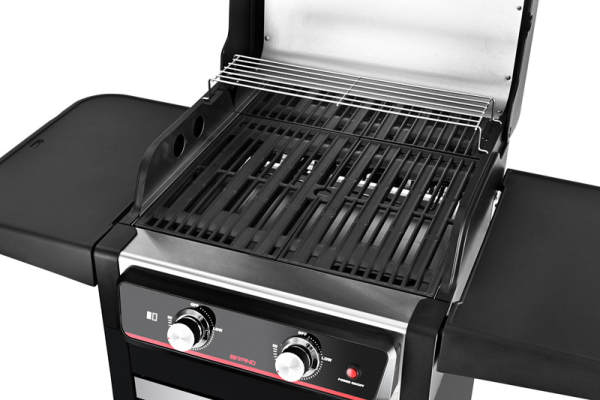
Manufacturers quote element life in hours: typical figures run 5,000 to 8,000 hours, and with conservative watt-density design the assembly can outlive the grill itself — industry sources note that properly designed, sealed tubular elements can exceed a decade of service, with most field failures traced to the outer jacket or insulation rather than the wire. That longevity is why metal tube elements dominate commercial equipment and high-power outdoor grills, where a failed element means lost revenue and a service call.
Honest trade-offs: metal tube elements are the most expensive family to manufacture, heat up more slowly than quartz because the MgO and metal jacket add thermal mass, and their heat output is a mix of conduction and radiation rather than pure infrared. For a grill that must sear at 300°C+ and survive shipping to 100 countries, though, the reliability math usually wins. The sheathed element is also the design that pairs best with thermostats, because its slower thermal response gives a controller stable feedback to regulate against.
Quartz Heating Elements: Fast, Bright and Infrared
Quartz heating elements put a resistance filament — often tungsten or carbon-fiber — inside a transparent quartz glass tube. When energized, the filament glows and the quartz tube transmits the heat as infrared radiation. The physics advantage is real: because energy travels as radiation rather than through a thick metal jacket, quartz elements reach working temperature in roughly 3–5 seconds — several times faster than a metal tube — and manufacturers cite thermal efficiencies above 90% with the majority of input energy emitted as infrared in the 1.5–8 micron band, the wavelengths that food absorbs well.
Quoted lifetimes for quartz elements are commonly 5,000–7,000 hours under continuous operation, but that headline number hides the real constraint: quartz element life is governed by thermal cycles, not running hours. Every on/off cycle expands and contracts the filament, and filament fatigue — not the quartz tube itself — is the dominant failure mode. Contamination on the tube (fingerprint oils burning on, grease spatter) creates hot spots that accelerate stress. The tube is also genuinely brittle: a sharp jolt or drop can crack it instantly, which is why shipping packaging and mounting design matter more for quartz grills than for sheathed-element units.
Where quartz shines is speed and sear. For indoor grills and infrared top-broiler modes that must reach searing temperatures quickly, quartz is the technology of choice. The honest caveat: pure quartz radiant heat is directional — it sears the surface directly under the element — so airflow and reflector design are critical to avoid cold zones. For buyers, a quartz grill is a performance story; the sourcing job is verifying the mounting, the reflector geometry and the thermal-cutout wiring, not just the wattage label.
Mica Heating Elements: The Compact Low-Cost Option
Mica heating elements are the budget-friendly member of the family: a resistance wire is sandwiched between thin sheets of mica, a natural mineral with excellent dielectric (electrical insulation) properties that holds up at high temperature. The assembly is thin, flat and light — which is why mica elements dominate electric fireplaces and appear in portable tabletop grills where space and cost are tight.
Mica's virtues are speed, silence and cost. The low thermal mass means the element heats almost instantly and responds quickly to thermostat commands, and mica's inherent insulation physically separates the live wire from the housing, which simplifies safety design. The trade-offs are equally clear: mica elements typically carry shorter rated lives (roughly 2,000–5,000 hours depending on watt density) because the wire is only partially protected from oxidation; they are susceptible to physical damage (the sheets can flake or crack in shipping or rough handling); and they are best suited to lower watt densities and moderate temperature ranges rather than sustained commercial duty.
For a buyer, mica is not inherently "bad" — it is the correct engineering answer for a specific price tier. The discipline is matching the element to the duty cycle: a mica-element grill advertised for occasional home use is a legitimate product; the same element inside a unit marketed for daily commercial service would be a warranty problem waiting to happen. Specifying the element family is one of the clearest ways a private-label buyer communicates quality expectations to an OEM factory.
How Infrared Radiation Shapes the Cooking Experience
Element family choice is ultimately about how heat reaches the food, and that means understanding infrared. Radiant electric heating elements emit in the infrared band; quartz elements with a tungsten or carbon-fiber filament radiate strongly in the 1.5–8 micron range that food absorbs efficiently. This is why a quartz grill can sear a steak crust while the interior stays medium-rare — the radiation deposits energy at the surface faster than conduction alone, approximating the "grill marks and crust" experience of a gas flame without combustion.
What consumers feel as "grill flavor" is mostly the Maillard reaction — surface browning at roughly 150°C and above — and rapid infrared heat is very good at producing it. The honest engineering note is that radiant heat does not penetrate; a thick steak still needs time for the interior to come up to temperature, and infrared-only designs can over-sear the surface before the center cooks. Good electric grill design combines radiant elements with reflector geometry and, in higher-tier models, convection airflow to balance surface browning with even cooking. If you are comparing gas and electric grills at the product level, our gas vs electric grill comparison covers the category-level trade-offs, and the gas burner design deep dive explains how the gas side achieves similar infrared results.
Power, Voltage and Element Sizing
Element type matters, but wattage and voltage decide whether the grill works in your target market at all. Element sizing follows a simple relationship: power (watts) determines the temperature the grill can reach and hold, and the supply voltage constrains how much power a given circuit can deliver. Three rules cover most sourcing decisions:
- 120V markets are power-limited: a US 120V/15A household circuit peaks at 1,800W, and the NEC 80% continuous-load rule effectively caps a countertop grill near 1,440W. Grills rated above that in North America either need a dedicated circuit or are labeled for short-duration use.
- 220–240V markets unlock higher wattage: EU/UK/AU 220–240V circuits allow 2,000–3,000W grills with no special wiring, which is why the same model is often rated 1,600W at 120V and 2,400–3,000W at 220–240V.
- Match element watt density to duty cycle: cramming 3,000W into a small element surface raises watt density, shortens life, and can overstress mica or quartz; a properly sized sheathed element spreads the load.
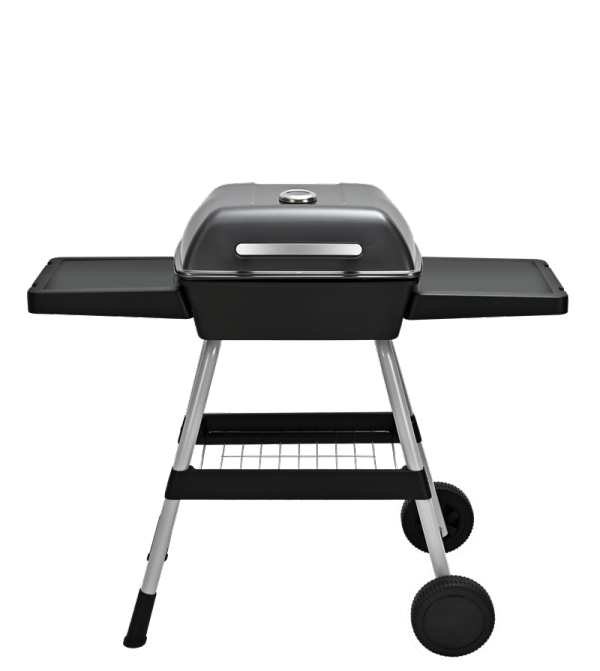
Kangye's outdoor electric grill line illustrates the pattern. The KYS-203A runs 1,600W at 120V or 2,400–3,000W at 220–240V with an adjustable range of 100–330°C and a 1,750 cm² cooking surface — a high-wattage sheathed-element design for serious grilling. The portable KYS-390E is rated 1,350W at 120V / 2,000–2,400W at 220–240V with a 100–200°C range and a 498×365mm cooking plate — a lighter, portable configuration with two wheels and a 2-in-1 table/stand frame. For the full voltage, frequency and plug picture across destination markets, our electrical ratings guide is the reference.
Safety Standards: How Heating Elements Are Tested
Heating elements are the highest-risk component in a grill, and certification regimes treat them accordingly. The governing standard for portable electric cooking appliances is IEC 60335-2-9 — Particular requirements for grills, toasters and similar portable cooking appliances — with the seventh edition published in 2019 and the European version harmonized as EN IEC 60335-2-9:2023 under the EU Low Voltage Directive (2014/35/EU). Note the scope boundary: indoor barbecues and radiant grills fall under Part 2-9, while outdoor barbecues are covered by IEC 60335-2-78; knowing which one applies to your product is a certification-planning decision, not a detail.
| Test Area | What It Verifies | Why It Matters |
|---|---|---|
| Surface and handle temperature | Temperature rise on touchable surfaces under maximum operation; EN A11 adds a +40K allowance for some front/top surfaces and mandates the "CAUTION: Hot surfaces" symbol (IEC 60417-5041) | The most common failure category — poor insulation or airflow pushes surfaces past limits |
| Thermal protection | At least one automatic-reset thermal cut-out and one non-self-resetting thermal fuse; tested under normal and single-fault conditions | Prevents overheating and fire if the element runs dry or airflow is blocked |
| Construction / guarding | Clause 22 checks that a defined test probe cannot reach live parts through element guards | Protects users from direct contact with the element |
| Dielectric strength | High-voltage withstand (e.g. 3,750V for 1 minute) and insulation resistance (≥ 100 MΩ) | Proves the element's insulation isolates live wire from the user |
| Mechanical robustness | Impact testing (e.g. 0.5J strike) on the enclosure | Verifies brittle elements like quartz survive real-world handling |
For North America the equivalent frameworks are UL/CSA standards for household cooking appliances (the UL 197/UL 1026 family for grills and cooking appliances, depending on classification), and for export beyond that, GS, CB, SAA and others apply per destination. A factory that holds CE/GS/ETL plus RoHS and REACH — and can show you the test reports per model, including the standard edition and amendment level — is the kind of partner that turns certification from a surprise into a checklist item. Our 2026 export compliance guide walks through the destination-market matrix in detail.
How Manufacturers Choose Elements by Grill Tier
Inside a factory, element selection is a cost-and-risk decision made at the product spec stage. A typical tiering looks like this:
- Entry tier (budget portable): mica elements or low-watt-density metal tubes; 1,000–1,500W; simple mechanical thermostats; positioned for promotional price points.
- Mid tier (home/balcony grills): sheathed metal tube elements with thermostat control; 1,500–2,400W; removable non-stick plates and drip trays; the sweet spot for most private-label programs.
- Premium/commercial tier: high-wattage sheathed elements (3,000W+) with precise control, or quartz infrared assemblies for fast sear; thicker gauge materials, better guarding, and full certification stacks.
For a brand, the tier decision drives the whole bill of materials — element, control board or knob, plate material, chassis gauge, packaging — and the retail price lands where those choices land. That is why the first question a good OEM asks is not "what wattage do you want?" but "what price point, cooking style and duty cycle are you targeting?" Getting the element family right upstream avoids the classic failure of a spec that looks good on paper and dies in the field.
Honest Limitations: What Each Element Cannot Do
Credibility in this category means saying plainly what each technology does not deliver:
- Metal tube elements are slow to preheat. The thermal mass that gives them longevity also delays first heat — a 300°C+ outdoor grill can take several minutes to reach temperature. Marketing should not claim "instant heat" for a sheathed-element product.
- Quartz elements are fragile and cycle-limited. A 5,000–7,000 hour rating assumes continuous operation; frequent on/off cycles, vibration and contamination all shorten real life. Never promise "maintenance-free forever" for a quartz grill.
- Mica elements are not for heavy duty. At high watt densities their life drops sharply, and physical damage is a real field-failure mode. Honest positioning: compact, fast, budget — not commercial.
- No electric element replaces flame flavor. Radiant and conductive heat brown beautifully, but the smoke and aroma compounds of burning wood or gas are absent. The honest claim is "great crust, no open flame," not "identical to charcoal."
- Infrared does not penetrate. Surface searing is excellent; thick cuts still need time and, ideally, a lid and convection to cook through evenly.
None of these limitations makes electric grills a lesser product — they define what the product is, and honest positioning builds the consumer trust that repeat business is made of.
Featured Products: Kangye Outdoor Electric Grills
Featured Products: Kangye Electric BBQ Grill Series
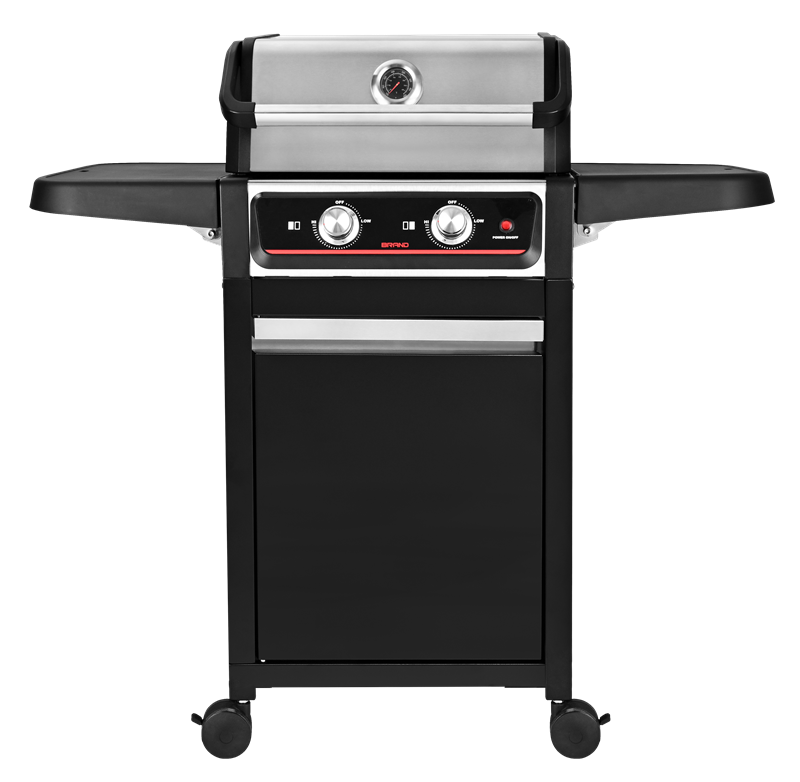
KYS-203A — High-Power Outdoor Grill
The KYS-203A is a high-power outdoor electric BBQ grill engineered for serious grilling: 1,600W (120V) or 2,400–3,000W (220–240V), an adjustable temperature range of 100–330°C, a large 1,750 cm² cooking surface, a stainless-steel lid, folding side tables and locking wheels. A sheathed metal tube element design provides the even, sustained heat this power tier requires.
- 100–330°C adjustable control for searing and slow grilling
- 1,750 cm² cooking surface; 1,100×560×1,100 mm footprint
- Stainless-steel lid, folding tables, locking wheels
- 155 / 317 / 375 pcs per 20GP / 40GP / 40HQ
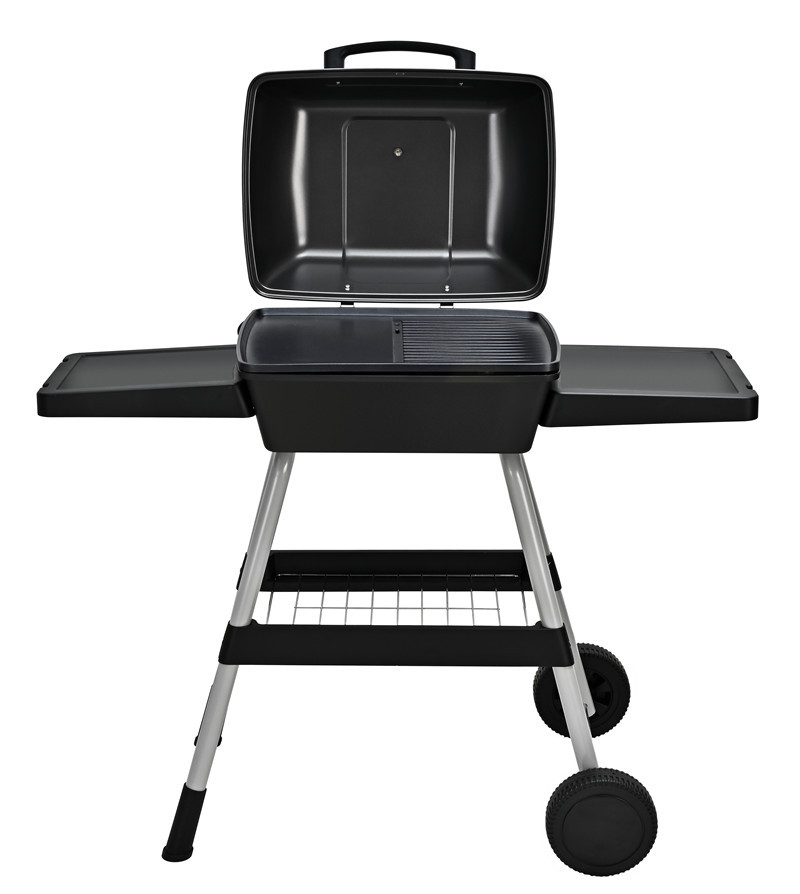
KYS-390E — Portable Grill with 2 Wheels
The KYS-390E is a portable outdoor electric BBQ grill that packs serious capability into a mobile frame: 1,350W (120V) or 2,000–2,400W (220–240V), a 100–200°C adjustable range, a 498×365 mm cooking plate, a 2-in-1 table/stand design, two wheels for easy transport, and a ribbed + flat plate combo with a center fat drain for healthier grilling.
- 2-in-1 table/stand frame + two wheels for portability
- Ribbed and flat plates with center fat drain
- 1085×487×929 mm; 269 / 562 / 669 pcs per 20GP / 40GP / 40HQ
- OEM/ODM: colors, branding, packaging, certification packages
Food Safety: Cooking Temperatures That Matter
Element technology delivers the heat, but safe grilling depends on temperature discipline at the food level. The USDA's Food Safety and Inspection Service (FSIS) is unambiguous: use a food thermometer and cook to safe minimum internal temperatures — 145°F (63°C) for whole cuts of beef, pork, lamb and veal (with a 3-minute rest), 160°F (71°C) for ground meats, and 165°F (74°C) for all poultry. FSIS also notes that more than half of Americans now grill outdoors year-round, which makes these rules a year-round concern, and that food left in the 40–140°F "danger zone" for more than two hours (one hour above 90°F) should be discarded. A grill that can hold a precise low temperature — like the 100–200°C range on portable electric models — is genuinely useful here, because it lets users slow-cook safely while searing surfaces at the end.
FAQ: Electric Grill Heating Elements, Answered
Which electric grill heating element is best: quartz, mica or metal tube?
There is no universal best — it depends on the product tier. Metal tube (sheathed) elements offer the longest life (5,000–8,000+ hours) and best durability, making them the choice for commercial and high-power grills. Quartz elements heat in seconds and radiate infrared for fast searing but are more fragile. Mica elements are the low-cost, fast-response option for portable and budget grills with shorter rated life. Match the element to the duty cycle and price point.
How long does a quartz grill heating element last?
Under continuous operation, quartz elements are commonly rated for 5,000–7,000 hours. Real-world life is governed by thermal cycling: every on/off cycle expands and contracts the filament, and filament fatigue is the dominant failure mode. Frequent cycling, physical shock, and contamination on the tube all shorten life, so the honest answer is "thousands of hours, less if you cycle it hard."
What is the advantage of a metal tube heating element?
Sealed construction. The NiCr wire is packed in magnesium oxide inside a stainless or Incoloy tube with sealed ends, so it never oxidizes — giving the longest rated life (5,000–8,000+ hours, sometimes over a decade with conservative watt density) and the best resistance to shock, vibration and shipping abuse. The trade-offs are higher cost and slower preheat than quartz.
Are mica heating elements safe for food grills?
Yes, when the product is designed and certified correctly. Mica is an excellent electrical insulator that physically separates the live wire from the housing, which helps safety design. The qualification is duty cycle: mica elements suit lower watt densities and moderate temperatures (portable/budget grills), not sustained commercial use. Always verify the finished product carries the required safety certification for your destination market.
What safety standard applies to electric grill heating elements?
Portable indoor grills and radiant grills fall under IEC 60335-2-9 (grills, toasters and similar portable cooking appliances; 7th edition 2019, harmonized in Europe as EN IEC 60335-2-9:2023). Outdoor barbecues are covered by IEC 60335-2-78. North American products follow UL/CSA household appliance standards. Key tests include surface temperature limits, thermal protection (cut-out + fuse), guarding, dielectric strength and mechanical impact.
Can I source electric grills with different heating elements under my own brand?
Yes. OEM/ODM manufacturers like Kangye (Guangdong, China; 35+ years of manufacturing; exports to 100+ countries) build private-label electric grills with the element family, wattage, temperature range, plate type, branding and certification package specified by the buyer. Our line includes the KYS-203A high-power outdoor grill and the KYS-390E portable grill — see our private label guide for the full program.
Summary: Choosing an Electric Grill Heating Element That Fits
Summary: the electric grill heating element is the component that decides preheat speed, temperature ceiling, longevity and cost. Metal tube elements are the durable workhorse (5,000–8,000+ hours, best for commercial and high-power grills); quartz elements are the fast, infrared option (seconds to heat, more fragile, cycle-limited); mica elements are the compact budget choice (fast, light, shorter life). Market data shows steady growth — USD 3.10B in 2026 toward USD 4.43B by 2034 — and the standards picture (IEC 60335-2-9 indoor / 60335-2-78 outdoor, UL/CSA in North America) is well defined. Buyers who specify the element family deliberately, verify per-model test reports, and pair wattage with the destination voltage will source grills that perform, certify and survive.
- Match element family to duty cycle and price tier — not to the largest wattage label.
- Verify certification per model and standard edition (IEC 60335-2-9 vs 2-78, UL/CSA).
- Size wattage to the destination voltage (1,440W practical ceiling on 120V/15A circuits).
- Communicate realistic preheat and life expectations in product marketing.
Sourcing electric grills or any kitchen appliance line for your brand? Kangye is an OEM/ODM manufacturer based in Guangdong, China, with 35+ years of manufacturing experience and exports to 100+ countries. Our product line covers electric and gas BBQ grills, pizza ovens, food dehydrators, air fryers, steam cookers, vacuum sealers, and pet feeders and water fountains. Contact our team to discuss heating element options, MOQs, certification packages and private label programs — or browse the full catalog at our product list .