Indoor Electric Grill Buying Guide: What to Look for in 2026
Quick Answer: What to Look for in an Indoor Electric Grill in 2026
An indoor electric grill buying guide in 2026 comes down to six decisions: heating element type, wattage, temperature control, cooking surface, smoke management, and certification. The category is growing fast — the worldwide indoor electric grill pan market reached about US$865 million in 2025 and is projected to pass US$1.34 billion by 2032 (a 6.45% CAGR), with open grills taking 55.8% of unit share and residential users 82.8% (pmarketresearch). Whether you are a home user choosing between brands or an importer sourcing private label units, the same spec story decides success: at least 1500W of power, adjustable temperature up to 450-500°F (232-260°C), a removable non-stick cooking plate with a drip tray, and UL/CE-class certification. This guide walks through each decision with the physics behind it, honest trade-offs, market data, and a sourcing checklist — using Kangye's KYS-868 indoor grill and KYS-203A outdoor electric grill as real reference platforms.
Key takeaway for buyers: the "smokeless" promise is physics, not marketing. An electric grill stays relatively smoke-free when the cooking surface sits below the smoke point of cooking fats (roughly 200-230°C / 400-445°F) and a drip tray pulls rendered grease away before it burns. That design logic — element placement, plate coating, and grease management — matters more than the brand name on the box.
Why Indoor Electric Grills Are Booming in 2026: The Market Data
Indoor electric grills sit at the intersection of three structural trends: apartment living, health-conscious cooking, and the collapse of the "grilling season" concept. The market numbers across independent research firms are unusually consistent:
- Indoor electric grill pan market: US$865.0 million in 2025, projected to reach US$1.34 billion by 2032 — a 6.45% CAGR. Open grills hold 55.8% of the market versus 44.2% for contact grills, and residential use accounts for 82.8% (pmarketresearch, 2026).
- Residential electric grill market: valued at US$2.94 billion in 2025, forecast to reach US$4.68 billion by 2033 — a 5.97% CAGR, driven by urbanization and compact living where outdoor grilling is impractical or prohibited (Market Report Analytics).
- Electric barbecue grill market overall: US$3.8 billion in 2026 scaling to US$6.64 billion by 2035 at a 6.40% CAGR, with indoor and portable formats the fastest-growing segments as apartment restrictions on open flames reshape purchase criteria (MarkWide Research).
- North America leads: the North American indoor electric grill pan market was the largest region at about US$279.8 million in 2025, ahead of Asia Pacific (US$251.6 million) and Europe (US$246.9 million) — important context for importers targeting the US and Canada.
| Market Signal | 2025/2026 Data | Source | What It Means for Buyers |
|---|---|---|---|
| Indoor electric grill pan market | US$865M (2025) → US$1.34B (2032), 6.45% CAGR | pmarketresearch | Category growth justifies new product investment |
| Open vs contact grill share | 55.8% vs 44.2% | pmarketresearch | Both form factors have volume; open grills lead |
| Residential share | 82.8% | pmarketresearch | Home users, not commercial, drive the category |
| Residential electric grill market | US$2.94B (2025) → US$4.68B (2033), 5.97% CAGR | Market Report Analytics | Compact-living demand is structural, not cyclical |
| Electric BBQ grill market | US$3.8B (2026) → US$6.64B (2035), 6.40% CAGR | MarkWide Research | Indoor/portable formats grow fastest |
The broader context matters for importers: North America's small appliance market is roughly flat in value for 2026, which means growth is won by features and positioning, not by adding SKUs. Our 2026-2027 US kitchen appliance market analysis breaks down which categories reward new entries — and indoor electric grills are one of them.
How an Indoor Electric Grill Works: Elements, Heat and Smoke
An indoor electric grill is a simple machine: an electric heating element under a cooking plate radiates heat, and a drip tray collects rendered fat. But the differences between a US$30 unit and a US$150 unit are almost entirely in the details of these three systems:
- Heating elements: most grills use sheathed metal tube elements (the industry default — cheap, durable, reliable). Higher-end platforms use quartz or infrared/ceramic elements, which heat faster, hold steadier temperatures, and preheat in a fraction of the time. Infrared quartz is the technology premium brands use for rapid recovery between batches.
- Heat transfer: open grills heat food from below through the plate; contact grills (clamshell design) heat from both sides simultaneously, cutting cook time roughly in half and sealing moisture — the classic George Foreman mechanism that still defines the contact category.
- Smoke control: smoke indoors comes from fat dripping onto a hot element and burning. The smokeless design logic is therefore threefold: keep surface temperature below the fat smoke point for normal grilling, route melted fat into a drip tray before it combusts, and (on premium units) add an extraction fan or water tray. No passive system eliminates all smoke from fatty cuts seared at high heat — an honest expectation to set before buying.
Electrical readers will recognize the power equation: heat output scales with voltage squared (P = V²/R), which is why the same platform ships in different wattages for 120V versus 220-240V markets — a topic we cover in depth in our electrical ratings guide.
Wattage and the 120V Circuit Reality: Why 1500W Matters
Wattage is the single most important spec on an indoor electric grill, because it is constrained by the outlet it plugs into. The math for North America: a standard 120V/15A household circuit peaks at 1800W, and continuous loads are normally capped at 80% (1440W) under the National Electrical Code. That is why 1500W is the practical sweet spot — most premium indoor grills run 1500-1760W, and testing communities consistently report that sub-1200W units drop about 100°F the moment cold meat touches the plate and take minutes to recover, producing steamed, grey food instead of a seared crust.
- 1500W baseline: enough to hold searing temperature for 2-4 servings without long recovery between batches.
- 1760W+ fast-recovery tier: the choice for families cooking multiple batches in one session — faster preheat and quicker temperature rebound after loading cold protein.
- 220-240V markets: the same grill design often ships at higher wattage. Kangye's KYS-868, for example, runs 220-240V/50-60Hz at 1200-1400W or a 120V/60Hz 1120W variant for North America — an important detail for brands selling the same SKU across markets (and a common source of returns when voltage mismatches, as our electrical ratings analysis documents).
The buying rule: never spec an indoor electric grill below 1300W for serious grilling, and treat 1500W as the entry point for any unit expected to sear properly. For importers, wattage variants are also a certification issue — each voltage/frequency configuration typically requires its own safety evaluation.
Temperature Control: Dial, Presets and the 450-500°F Searing Zone
A grill that cannot reach searing temperature is a panini press with grill marks. Real browning (the Maillard reaction) accelerates above roughly 300°F (150°C) and a proper sear on steak needs surface heat in the 450-500°F (232-260°C) range. How a grill manages that heat matters just as much as the maximum:
- Simple dial thermostats: continuous adjustment with a mechanical thermostat. Honest, repairable, and cheap — but temperature consistency depends on the thermostat's tolerance and the element's recovery speed.
- Step controls (e.g., 5 levels): discrete settings that map to practical cooking modes — low for vegetables and fish, medium for poultry, high/sear for steaks. The KYS-868 uses a five-level control, which is a good balance of simplicity and utility for a mass-market grill.
- Digital PID-style control: sensor-driven regulation that holds temperature within a narrow band. Premium 2026 platforms add this, and some integrate Bluetooth/app temperature logging — a fast-growing feature tier (MarkWide notes smart connectivity is the fastest-growing premium feature).
A concrete range matters: the KYS-203A outdoor electric grill spans 100-330°C (212-626°F), while typical indoor units top out around 450-500°F. For a buying decision, ask three questions: What is the maximum temperature? How quickly does it recover after loading cold food? Is the control continuous, stepped, or digital? The first two determine whether you can actually sear; the third determines how repeatable your results are.
Cooking Surface: Non-Stick Coatings and Removable Plates
The cooking surface is the part that touches your food and the part that fails first. Two decisions dominate:
| Coating Type | Pros | Cons | 2026 Compliance Note |
|---|---|---|---|
| PTFE non-stick (traditional) | Excellent release, low cost, proven at scale | Degrades under high heat; aerosol cooking sprays damage the polymer binder; some consumers avoid PTFE | PFAS regulations in the EU are tightening — verify coating chemistry with the factory for EU market entry |
| Ceramic / ceramic-titanium | PFOA-free by design, more abrasion-resistant, better heat conduction, longer release life | Higher cost; release can fade faster than PTFE if overheated | PFOA-free ceramic is the fast-growing preference in Europe and premium US tiers |
| Enamel / stainless (outdoor-style) | Very durable, no coating chemistry concerns, dishwasher-friendly | Food sticks more; needs oil | Common on outdoor electric grills like the KYS-203A's enamel plates |
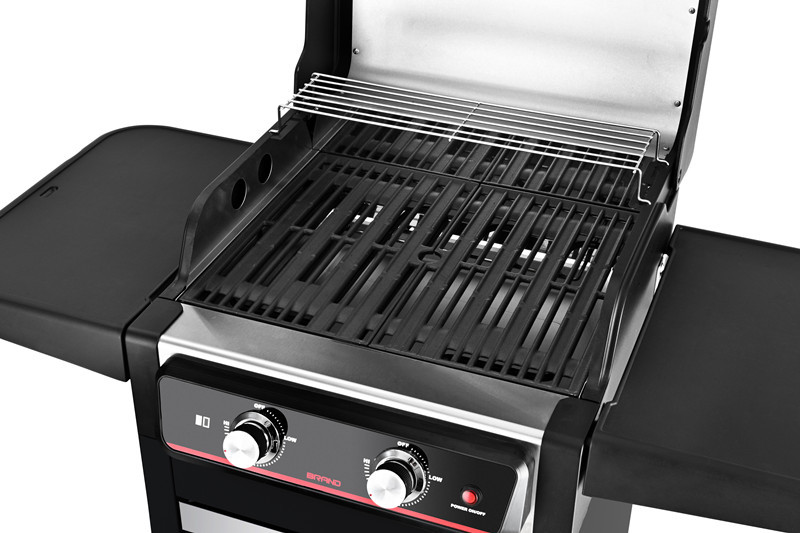
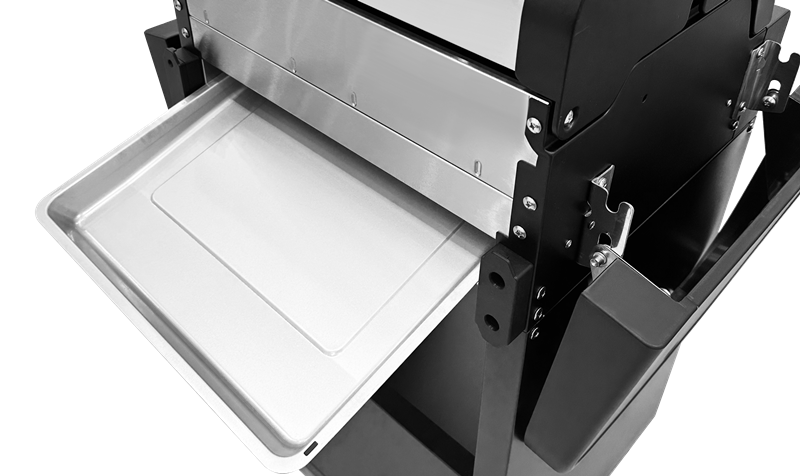
Beyond chemistry, removability is a durability feature. Fixed plates bake grease into carbon buildup over time; removable plates that detach from the heating core can be soaked or placed in a dishwasher. The KYS-868's removable non-stick plate and detachable drip tray are exactly the configuration reviewers now treat as table stakes. Also check the cooking area: small units around 60 sq in serve one or two; 100+ sq in (roughly 650+ cm²) serves four to six. The KYS-203A's 1750cm² plate is designed for batch cooking.
Smoke Management and Grease Handling: The Honest Version
Every indoor electric grill claims to be "smokeless." The honest engineering version is: smoke output is minimized, not eliminated. Cooking fats have smoke points — most animal fats around 190-205°C (375-400°F), refined vegetable oils 200-230°C (400-445°F). When the cooking surface stays below the smoke point of the fat, and when a drip tray removes rendered grease before it hits the hot element, smoke stays at nuisance-free levels for lean and moderately fatty foods.
- Drip tray design: the most important smoke feature. Grease should drain away from the heat source immediately, not pool and smoke.
- Lid or splash guard: contact grills with a floating lid trap spatter; open grills benefit from a splash shield.
- Active extraction: premium units add a fan-and-filter system or a water tray that absorbs smoke — the closest thing to truly smokeless cooking.
- The exception: high-fat cuts (ribeye, chicken thighs) seared at maximum heat will produce some smoke on any indoor grill. Set expectations accordingly and cook fatty cuts at moderate heat or with the lid closed.
This honest framing is exactly the kind of nuance buyers should expect from a manufacturer: a supplier that admits "smokeless means low-smoke, not zero-smoke" is more trustworthy than one that promises miracles — which is the spirit of our gas vs electric grill comparison.
Open Grill vs Contact Grill: Two Form Factors, Two Use Cases
Indoor electric grills split into two physical designs, and the choice changes the cooking experience:
- Open grills (55.8% of the market): a flat, exposed cooking surface heated from below. Best for real grill marks, large batches, and foods you want to flip and watch — the format that dominates the "indoor BBQ" positioning and the KYS-868's category.
- Contact grills (44.2%): a clamshell that cooks both sides at once, cutting cook time roughly in half and keeping meat juicier by trapping moisture. Best for quick weeknight protein — chicken breast in 4-5 minutes instead of 8-10 — at the cost of less visible "grilling" and more limited capacity per batch.
For importers, the two form factors address different consumer jobs. Contact grills sell on speed and convenience; open grills sell on the BBQ experience indoors. Many 2026 multi-function platforms blur the line — reversible plates and grill/air-fryer combos are the fastest-growing segments. A manufacturer that offers both form factors (as Kangye does across its grill line) lets a brand test both jobs with one supplier.
Indoor vs Outdoor Electric Grills: Know the Difference
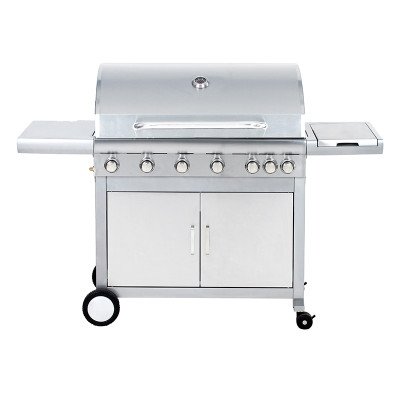
"Electric grill" spans two very different products. Indoor units are compact (usually under 60cm), capped near 1500-1800W by the 120V circuit, and optimized for smoke control. Outdoor electric grills are larger, often 2000-3000W on 220-240V supply, with bigger cooking areas, weather-resistant materials, and less need for smoke suppression because they live in open air. Comparing them side by side clarifies which product a buyer actually needs:
| Spec | KYS-868 (Indoor Electric Grill) | KYS-203A (Outdoor Electric Grill) |
|---|---|---|
| Positioning | Smokeless indoor tabletop BBQ | Standing outdoor electric BBQ with cart |
| Power | 220-240V 50/60Hz 1200-1400W | 120V 60Hz 1120W | 220-240V 50/60Hz 3000 or 2400W | 120V 60Hz 1600W |
| Temperature | 5-level control | 100-330°C adjustable |
| Cooking surface | Compact tabletop plate (removable non-stick + drip tray) | 1750cm² enamel cooking area, SS lid, foldable tables |
| Product size | 510 × 260 × 90 mm | 1100 × 560 × 1100 mm |
| Loading (approx.) | 1,534 pcs / 20GP; 2,920 pcs / 40GP | 155 / 317 / 375 pcs per 20GP / 40GP / 40HQ |
The 2026 outdoor kitchen boom — covered in our outdoor kitchen trends report — is pulling electric outdoor grills into balcony and apartment patios where gas is banned. For most importers, the indoor format is the higher-volume, lower-logistics-risk entry; the outdoor electric format is the premium, higher-price-tier opportunity.
Safety, Certification and Food Safety: Non-Negotiables
An electric grill is a heating appliance that touches food, sits near flammable surfaces, and plugs into household mains — which means three layers of compliance matter:
- Electrical safety standards: household electric grills fall under the IEC 60335 series (specifically IEC 60335-2-9 for grills and similar portable cooking appliances), with national adoptions such as UL/ETL in North America, GS in Germany, and CB-scheme recognition globally. Certification must match the destination market — see our 2026 export compliance guide for the full regulatory map, including EU PFAS restrictions on non-stick coatings and REACH chemical compliance.
- Food-contact compliance: surfaces that touch food need food-contact documentation — FDA compliance in the US, LFGB in Germany, EU 1935/2004 in Europe. Non-stick coatings, in particular, are under rising scrutiny; verify coating chemistry documentation with the factory before committing to a program.
- Food safety at the cooking level: regardless of appliance, the USDA recommends safe minimum internal temperatures of 145°F (63°C) for whole cuts of beef, pork, lamb, and fish (with a 3-minute rest), 160°F (71°C) for ground meat, and 165°F (74°C) for poultry — a chart every brand should print in its manual, and a spec story that manufacturers like Kangye bake into user documentation.
Also watch accessory safety: US CPSC has issued recalls tied to wire grill-brush bristle ingestion hazards, which pushed the industry toward nylon or bristle-free brushes — a detail worth including in retail kits and marketing content for the US market.
Sourcing Considerations for Importers and Brands
If you are sourcing indoor electric grills as a brand — private label or OEM — the buying criteria above translate into a concrete factory conversation:
- Certification library first: ask for the certificate matrix per model and per voltage variant (CE, GS, ETL, UL, CB, RoHS, REACH, LFGB/FDA) before sampling. This is the difference between a $1,500 sample order and a failed market entry.
- Voltage variants as SKU planning: one platform, two markets (120V and 220-240V) means two electrical variants, two certification files, and two BOMs. Plan the SKU tree before committing — our step-by-step OEM sourcing guide walks through the full selection, sampling, and payment workflow.
- MOQ and container economics: grill MOQs are container-based. The KYS-868 loads 1,534 pcs per 20GP and 2,920 pcs per 40GP; the KYS-203A loads 155/317/375 pcs per 20GP/40GP/40HQ. A first program commonly starts with samples plus a trial quantity, then scales — with production timelines of 35-45 days standard and 45-60 days for customized variants, as detailed in our OEM manufacturing process guide.
- Customization depth: colorways, panel labels, presets, packaging, and manuals are standard ODM options; exclusive model numbers need MOQ commitments. For the full private label playbook, our private label kitchen appliance guide is the definitive 2026 reference.
Kangye, based in Guangdong, China, has 35+ years of appliance manufacturing experience and exports to 100+ countries, with a product line spanning food dehydrators, BBQ grills, pizza ovens, air fryers, steam cookers, vacuum sealers, indoor electric grills, and pet appliances — a single-supplier breadth that simplifies multi-category private label programs.
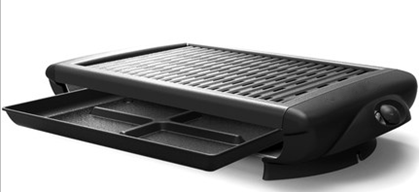
Featured Products: Kangye Electric Grill Platforms
Featured Product: Kangye KYS-868 Indoor Electric BBQ Grill
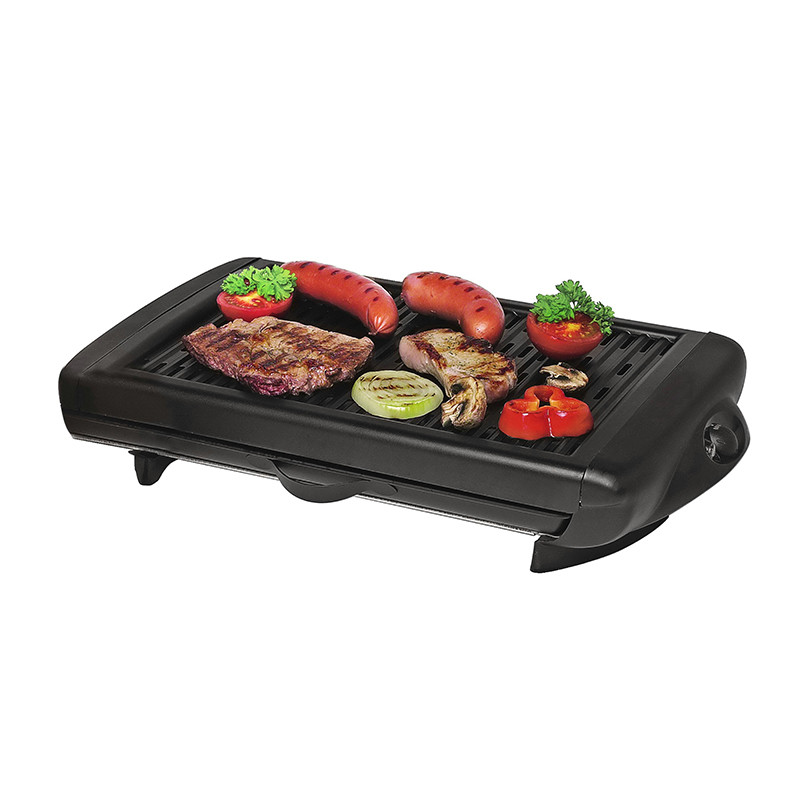
The KYS-868 is a complete indoor electric grill platform: 1350W smokeless design, five-level temperature control, a removable non-stick plate, and a detachable drip tray. It runs on 220-240V/50-60Hz (1200-1400W) or a 120V/60Hz 1120W variant for North America, measures a compact 510×260×90mm, and packs 1,534 pcs per 20GP / 2,920 pcs per 40GP.
- 5-level temperature control — the spec story that wins marketplace search
- Removable non-stick plate + detachable drip tray — dishwasher-friendly cleanup
- Compact 510×260×90mm footprint for apartment kitchens
- OEM/ODM ready: logo, colorway, panel labels, presets, packaging, manual localization
Also Available: Kangye KYS-203A Outdoor Electric Grill
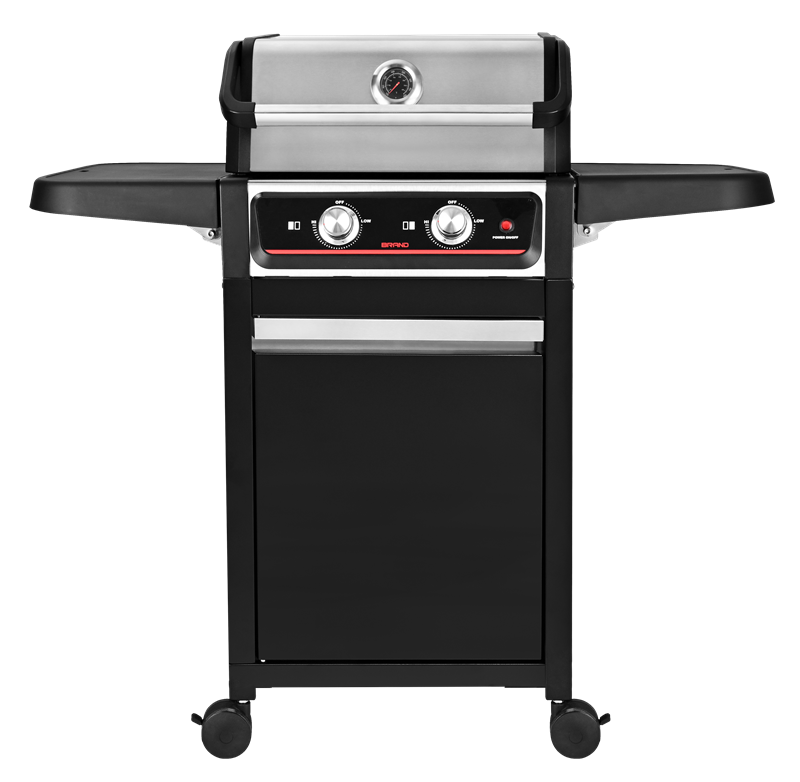
For balcony and patio programs, the KYS-203A is the large-format option: 1600-3000W, 100-330°C adjustable temperature, a 1750cm² enamel cooking area, stainless steel lid, foldable side tables, and lockable castors. It ships 155/317/375 pcs per 20GP/40GP/40HQ.
- Wide 100-330°C range — from gentle warming to high searing
- 1750cm² cooking area for family and batch cooking
- Enamel plates, SS lid, foldable tables, lockable castors
- Flexible indoor-outdoor placement for markets where gas grills are restricted
Explore Kangye's full product lineup
Honest Limitations: What Electric Grills Can't Do
EEAT means telling buyers the truth about trade-offs. An indoor electric grill is excellent at many jobs and genuinely limited at others:
- No smoke, no smoke flavor. The very design that makes indoor grilling possible removes the smoke that gives charcoal and wood-fired grilling its signature flavor. Electric grilling is clean, not smoky.
- Searing ceiling. Most 120V indoor units top out around 450-500°F; gas grills can exceed 600°F and commercial pizza ovens reach far higher. A proper steak sear is achievable, but crust development on very thick cuts is slower than on a live-fire grill.
- Batch capacity. Compact indoor units cook 2-4 servings comfortably; large gatherings need multiple batches or an outdoor-format grill. Cooking area per batch is the spec to check before buying.
- Heat recovery on budget units. Sub-1300W grills lose temperature quickly under load — the "steamed instead of seared" failure mode. Wattage is not marketing; it is physics.
- Kitchen ventilation still helps. Even low-smoke grills release cooking odors; an exhaust fan or open window improves the experience, especially for fatty cuts.
None of these limitations make electric grills a bad buy — they define which electric grill to buy and what to expect from it. The honest positioning is: electric indoor grills deliver real grilling results with apartment-friendly convenience, in exchange for no smoke flavor and a practical capacity ceiling.
FAQ: Indoor Electric Grill Questions, Answered
What wattage should an indoor electric grill have?
Treat 1500W as the baseline for real grilling on a 120V circuit, and 1760W if you regularly cook multiple batches. Below roughly 1300W, grills struggle to hold searing temperature when cold food is loaded, producing steamed rather than seared results. On 220-240V markets, the same design typically ships at higher wattage — confirm the variant matches your market's voltage and circuit capacity.
Are smokeless indoor electric grills actually smokeless?
They are low-smoke, not zero-smoke. Smoke indoors comes from fat burning on hot surfaces; smokeless designs keep the surface below the fat smoke point and drain grease into a drip tray before it combusts. This works well for lean and moderately fatty foods. High-fat cuts seared at maximum heat will still produce some smoke on any indoor grill — use moderate heat or a closed-lid contact grill for those.
What is the difference between an open grill and a contact grill?
Open grills have a flat exposed cooking surface heated from below — best for grill marks, large batches, and an indoor-BBQ experience. Contact grills are clamshell designs that cook both sides at once, cutting cook time roughly in half and keeping meat juicier, but with less capacity per batch. Open grills hold about 55.8% of the indoor electric grill pan market; contact grills about 44.2%.
Are PTFE non-stick coatings safe on electric grills?
PTFE non-stick is safe within its rated temperature range and is used by most manufacturers. It degrades under sustained high heat, and aerosol cooking sprays damage the polymer binder. PFOA-free ceramic and ceramic-titanium coatings are the growing preference in Europe and premium US tiers, and EU PFAS restrictions are tightening coating chemistry requirements in 2026 — verify the coating documentation with the factory for your destination market.
What certifications do indoor electric grills need?
Electrical safety under the IEC 60335 series (IEC 60335-2-9 for grills and similar portable cooking appliances) with national adoptions: UL/ETL in North America, CE (LVD + EMC) plus RoHS/REACH in Europe, GS in Germany, and CB-scheme recognition globally. Food-contact surfaces need FDA/LFGB/EU 1935/2004 documentation. Certification must match both the model and the voltage variant for each destination market.
What is the realistic MOQ for sourcing indoor electric grills?
Grill MOQs are typically container-based. As a reference, the Kangye KYS-868 packs 1,534 pcs per 20GP and 2,920 pcs per 40GP. A first program usually starts with samples plus a trial quantity, then scales once sell-through is proven; production runs 35-45 days standard and 45-60 days for customized variants. New partnerships often negotiate trial quantities — confirm MOQ in writing before sampling.
Summary: The 2026 Indoor Electric Grill Buying Checklist
Summary: the indoor electric grill category is growing at 6-6.5% annually (market of US$865M in 2025 heading toward US$1.34B by 2032), and the winning 2026 buying criteria are consistent across home users and importers:
- Wattage: at least 1500W on 120V; confirm the voltage variant matches your market.
- Temperature: adjustable control reaching 450-500°F for real searing; stepped or digital control for repeatability.
- Cooking surface: removable non-stick plate and drip tray; ceramic/PFOA-free coatings for EU and premium positioning.
- Smoke management: drip-tray-first design; set honest low-smoke expectations.
- Form factor: open grill for BBQ experience and capacity; contact grill for speed.
- Certification: IEC 60335-2-9 / UL / CE plus food-contact documentation per destination market.
Buyers who apply this checklist — and source from a manufacturer that can show the certificate matrix, the voltage variants, and the container loading math — will sell grills that actually sear, actually clean easily, and actually pass inspection in their target market.
Sourcing an indoor electric grill line for 2026? Kangye is an OEM/ODM manufacturer based in Guangdong, China, with 35+ years of manufacturing experience and exports to 100+ countries. Our product line covers food dehydrators, BBQ grills (gas and electric), pizza ovens, air fryers, steam cookers, vacuum sealers, indoor electric grills, and pet appliances. Contact our team to discuss MOQs, voltage variants, certification packages, and private label programs for electric grills.