Smart Pet Feeder Engineering: Portion Control and Anti-Jam Mechanisms
Quick Answer: How Does a Smart Pet Feeder Work?
A smart pet feeder works by combining a sealed food hopper, a motor-driven dispensing mechanism (usually an auger screw or a rotating paddle wheel), and a control board that turns the motor for a set time or number of rotations to release a measured portion, on a schedule the owner programs through a keypad or a mobile app. Portion control comes from the repeatable relationship between motor run time, auger rotation count, and the volume of kibble moved per turn; anti-jam engineering prevents that same mechanism from clogging when kibble size, humidity, or food shape varies. On a mid-range 2026 model — like Kangye's KYS-13B — the system delivers roughly 10 g of dry food per portion, adjustable across 1–5 portions per meal and up to 9 scheduled meals per day, with a Type-C main power supply and a D-cell battery backup that keeps the schedule alive during outages.
Key takeaway: a smart pet feeder is a precision dispensing machine, not just a "food bucket with a timer." The two engineering pillars — portion accuracy and jam resistance — decide whether pets are fed consistently and whether owners trust the device enough to leave it in charge. For importers, the internal mechanism, motor control logic, food-contact materials, and power backup design are the specs that separate a sourceable product line from a returns problem.
Why Portion Control and Anti-Jam Engineering Matter in 2026
The market context makes the engineering stakes concrete. The global automatic pet feeder market is projected to grow from roughly US$543.8 million in 2026 to US$981.4 million by 2033 at a CAGR of 8.8% (Persistence Market Research), while the broader automatic and smart pet feeder segment is estimated at US$2.69 billion in 2026, reaching US$4.55 billion by 2032 at a 9.09% CAGR (360iResearch), and The Business Research Company tracks the category growing from $1.96 billion in 2025 to $3.5 billion by 2030 at a 12.3% CAGR. North America leads the market; Asia-Pacific is the fastest-growing region. Within the segment, Wi-Fi-connected smart feeders are the fastest-growing subcategory, displacing gravity dispensers, and the largest untapped opportunity is automated wet and fresh-food dispensing.
Health data explains why portion control is the feature buyers actually pay for. The Association for Pet Obesity Prevention (APOP) 2025 clinical survey classifies 59% of dogs and 61% of cats in the US as overweight or obese, with 22% of dogs and 33% of cats explicitly obese; excess weight shortens a pet's life by an average of about 2.5 years and raises the risk of diabetes, joint disease, and heart conditions. Veterinary guidance — from AAHA, WSAVA, and the RER (resting energy requirement) formula endorsed by AAHA — calls for calorie-controlled, measured meals rather than free feeding. That is exactly the use case a portion-controlled feeder automates: a device that consistently releases ~10 g per portion makes a veterinarian-approved feeding plan practical for owners who are away 9–12 hours a day.
Honest caveat: smart feeders solve real problems, but they are not magic. They work reliably with dry kibble of a compatible size range (roughly 2–15 mm in most designs, with 5–12 mm the sweet spot), they still jam with irregular freeze-dried treats or oversized kibble, and their connectivity features depend on power and network stability — which is why dual power supplies and offline scheduling are core engineering requirements, not marketing extras.
Anatomy of a Smart Pet Feeder: Core Subsystems
Every smart pet feeder, regardless of price tier, is built from the same set of subsystems. Understanding them is the fastest way to compare products and to know which questions to ask a factory:
- Food hopper (storage tank): the sealed reservoir that holds dry food. Material matters — food-grade ABS or stainless steel — and an airtight seal with a desiccant holder keeps kibble fresh and dry. Capacities commonly run 3–5 L (Kangye's KYS-13B uses a 3 L tank, roughly a 15–20 day supply for an adult cat).
- Dispensing mechanism: the engine of the feeder. Common types are the auger screw (a rotating corkscrew that pushes kibble forward), the paddle/rotary wheel (flexible paddles collect kibble in pockets and drop it), and the carousel or tray indexer (a rotating chamber releases a fixed volume per step). This is where portion accuracy and jam resistance are won or lost.
- Motor and gear train: a small DC motor (typically 5–12 V) turns the mechanism through a reduction gearbox. Gear ratio and torque matter for jam recovery — a motor that can momentarily reverse or deliver higher torque clears most blockages.
- Control unit: the "brain" — a microcontroller with a real-time clock that stores feeding schedules in memory, drives the motor, reads sensors, and (in connected models) communicates over Wi-Fi or Bluetooth with a companion app.
- Power system: modern designs are dual-power: an AC adapter (or Type-C) as the primary source plus battery backup (e.g., 4 × 1.5 V D-cells on the KYS-13B) so scheduled meals continue through outages. A 2026 FDA recall bulletin flagged 18 feeder models that stopped dispensing during regional blackouts — a reminder that power redundancy is a safety feature, not a luxury.
- Bowl and chute: the dispensing chute routes food into a removable bowl; stainless steel bowls resist bacteria and clean easily. Sensor-equipped bowls or infrared detectors can confirm food actually landed.
Dispensing Mechanisms Compared: Auger, Rotor and Carousel
The dispensing mechanism is the mechanical heart of portion control, and each architecture has a different strength profile. Importers should match the mechanism to the kibble types their target market feeds:
| Mechanism | How It Works | Best For | Weaknesses |
|---|---|---|---|
| Auger screw | A rotating corkscrew threads through a tube, pushing kibble forward toward the chute; portion = f(rotation time/count) | Small to medium, uniform kibble; precise portioning; most common in smart feeders | Can crush delicate food; a wedged oversized piece can stall the screw without a jam sensor |
| Rotary paddle wheel | A flexible silicone/rubber wheel with paddles collects kibble into pockets and drops it through the chute per rotation | Versatile with round or irregular kibble; forgiving of shape variation | Can struggle with very large or flat disc-shaped kibble; portion varies more with fill level |
| Carousel / rotary disc | Food sits in a rotating chamber; each indexed step releases a fixed volume | A wide range of kibble sizes; consistent volume per step | Mechanically more complex; more parts to clean; slightly higher cost |
Industry practice illustrates the trade-offs. Xiaomi's Smart Pet Food Feeder uses a six-paddle dispensing structure with a soft silicone agitator and paddle blades, validated over 10,000+ dispensing cycles, with a wide channel sized for 5–12 mm kibble — a design chosen to maximize flow reliability across common dry foods. High-precision units from specialist brands calibrate augers or rotating drums to release portions accurate down to roughly 1/12 cup (7–10 g) per cycle, and compatibility is typically specified as 2–15 mm kibble diameters. The takeaway for buyers: specify the kibble size range in the product brief, and ask the factory which mechanism they use and how it was tested.
Portion Control Engineering: How Accuracy Is Achieved
Portion accuracy is the result of three linked choices: the mechanical repeatability of the dispensing element, the control logic that governs motor run time or rotation count, and the calibration data that maps rotations to grams for the actual food being used.
Mechanical repeatability. A molded auger or paddle wheel has a fixed volume per revolution only if the geometry is consistent and the food density is stable. High-quality molds hold tight tolerances; the same tool running 500,000 cycles still releases a consistent volume per turn. This is why tooling quality and QC matter in sourcing — a low-cost mold with warped pockets produces portions that drift meal to meal.
Control logic. Basic feeders run the motor for a fixed number of seconds per portion; better ones count rotations (via a Hall-effect sensor or encoder on the motor shaft) so portion size is independent of battery voltage and motor wear. Rotation-counted dispensing is the current engineering benchmark — it holds portion consistency as the supply voltage sags and as the gear train warms up.
Calibration. Because portion weight = volume × kibble density, the same rotation dispenses slightly different gram weights for different foods. Good designs let users calibrate per-feed portion weight in 1–10 g steps; the KYS-13B, for example, is factory-set to roughly 10 g per portion with a 1–5 portion adjustment per meal, covering a 10–50 g range per feeding event. The 2026 product brief for a sourceable feeder should state: portion step size, portion accuracy (±g), meals per day, and whether portioning is time-based or rotation-counted.
Anti-Jam Design: Failure Modes and Countermeasures
Jams are the #1 mechanical reliability complaint in automatic feeders, and in a device that must work while the owner is away, a jam is not an inconvenience — it is a missed meal. Engineers attack the problem at four levels:
- Wide, low-friction channels: the dispensing channel is sized to clear the largest kibble the feeder supports (e.g., 5–12 mm or up to 15 mm) with generous clearance, and the chute uses inclined surfaces and anti-stick coatings so food slides instead of stacking.
- Soft agitation and flow aids: flexible silicone agitators and paddle blades keep the hopper bridge-free by constantly stirring the food column; some designs add a vibration motor that shakes the mechanism for a moment during dispensing to settle the food bed.
- Jam detection and recovery: a Hall-effect sensor or motor current monitor detects when the auger stalls; the controller then reverses the motor briefly or pulses it to clear the blockage, and alerts the owner via the app if the jam persists. This is the difference between a feeder that self-recovers and one that silently fails.
- Controlled food compatibility: every design has a kibble envelope. Freeze-dried or oddly shaped treats, very large kibble, or dusty food are the classic culprits; responsible designs document the compatible range (e.g., 5–12 mm) and exclude incompatible foods in the manual. Honest specs here reduce both jams and returns.
Testing matters as much as design. Reputable factories run repeated dispensing-cycle tests (10,000+ cycles is the current benchmark in the category) and document jam rates across a standard kibble matrix. When sourcing, ask for: cycle-test data, the compatible kibble range, jam-recovery behavior, and what happens on overload (motor auto shut-off protects both the device and the pet).
Materials and Food-Contact Compliance
Every surface that touches pet food must be food-safe, because the feeder stores food for days and pets eat directly from it. The compliance map importers should recognize:
- Food-contact plastics: FDA-compliant food-contact plastics per 21 CFR 177.1520 (olefin polymers) or equivalent, and BPA-free ABS for the hopper. For water-contact parts, NSF/ANSI 61 certification — the same standard used for human kitchen fixtures — is the appropriate benchmark for fountains.
- Stainless steel: 304 stainless steel with a smooth finish for bowls and food paths resists bacterial buildup and cleaning chemicals; brushed surfaces that hide micro-grooves are preferable for hygiene.
- Global market marks: beyond food-contact materials, the electrical and connected parts fall under the appliance and electronics rules you already know from kitchen appliances — CE/GS for Europe (IEC 60335-2-15/-2-9 families as applicable, plus RED for wireless modules), UL/ETL for North America, and RoHS/REACH for the EU. Wireless modules add radio approvals (FCC, IC, CE-RED).
- Test documentation: credible factories provide third-party food-contact test reports (e.g., SGS-style lab reports) and material certificates, not just a "food grade" sticker. Our export compliance guide walks through the full certification matrix for appliance imports.
Power, Connectivity and Fail-Safe Design
A feeder that cannot feed is worse than no feeder, which is why reliability engineering concentrates on the power path. The 2026 standard is dual power: mains adapter plus battery backup, with the schedule stored in non-volatile memory so meals continue without any network at all. The KYS-13B's 4 × 1.5 V D-cell backup is a typical implementation; cordless models like the KYS-15B fountain go further, running on an internal rechargeable battery (2000–3600 mAh options) for up to 27 days between charges.
Connectivity adds value but also failure modes. Wi-Fi feeders that depend on the cloud for schedules lose function when the network drops; better designs run schedules locally on the device and use the app only for programming and monitoring, so a router reboot never becomes a missed dinner. When sourcing connected models, check: does the schedule execute on-device (offline-capable), what happens on Wi-Fi loss, are there low-food alerts and feed-confirmation sensors, and does the app meet the privacy expectations of your target market (GDPR for Europe, data residency for others)? Our electrical ratings guide covers the voltage and plug variants (120 V/60 Hz US, 230 V/50 Hz EU) that a single SKU strategy must accommodate.
What to Verify When Sourcing a Smart Pet Feeder
Before committing to a factory line, put these seven checks in your sourcing document:
- Mechanism and portion spec: mechanism type, portion step (g), portion accuracy, meals/day, and time-based vs rotation-counted control.
- Kibble compatibility: the certified diameter range (e.g., 5–12 mm) and any excluded food types.
- Anti-jam behavior: jam detection, recovery logic (motor reversal/pulse), and 10,000+ cycle test data.
- Power redundancy: primary input, battery backup type and runtime, and whether schedules run offline.
- Food-contact materials: FDA 21 CFR 177.1520 plastics, BPA-free hopper, 304 SS bowl, third-party test reports.
- Electrical and radio approvals: CE/GS or UL/ETL as applicable, FCC/IC/CE-RED for wireless, RoHS/REACH.
- Safety devices: motor overload protection, anti-tip stability, tamper-resistant lid lock, and child/pet-safe design.
The same diligence applies to companion products: a feeder sold alone creates a weak brand story, while a feeder-plus-fountain bundle (feeding and hydration in one pet-care ecosystem) lifts basket size. That is why Kangye builds both — and why our pet feeder and water fountain buying guide and pet tech market analysis are worth reading back-to-back before you spec a line.
Featured Products: Kangye KYS-13B Feeder and KYS-15B Fountain
Featured Products: Kangye KYS-13B Automatic Feeder & KYS-15B Wireless Fountain
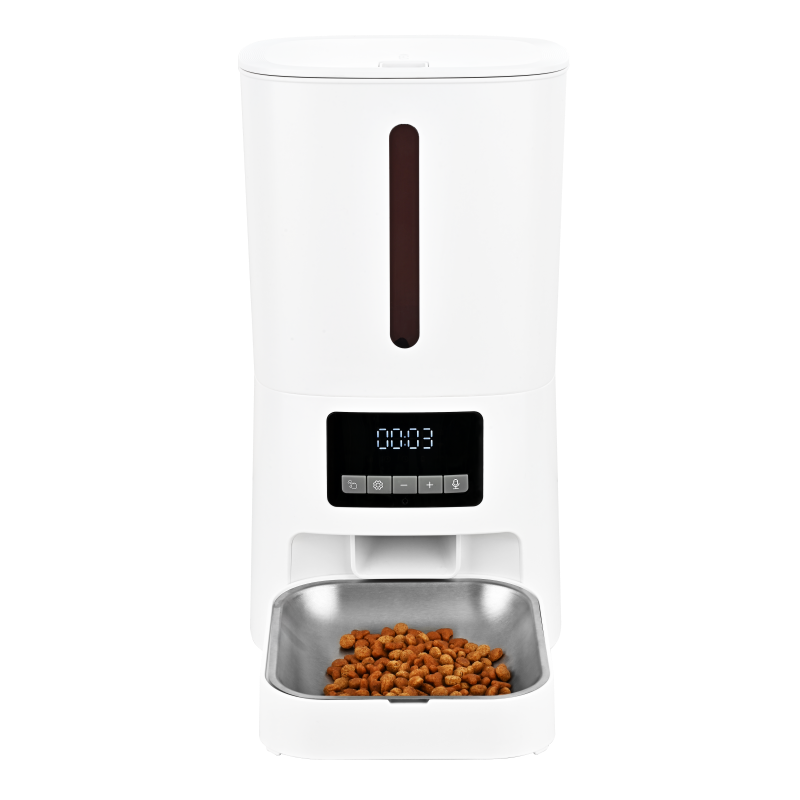
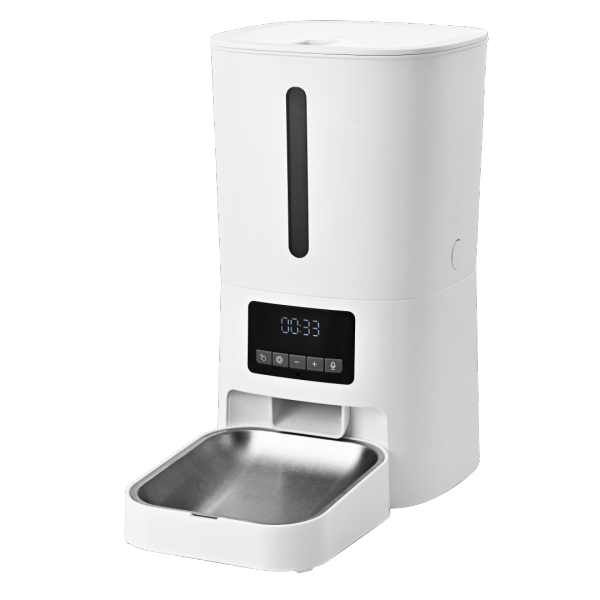
KYS-13B Automatic Cat Dog Feeder, 3L
The KYS-13B is a 3-liter smart pet food dispenser engineered around the two pillars in this article: portion control (~10 g per portion, adjustable 1–5 portions per meal, up to 9 scheduled meals/day) and an anti-jam dispensing design for reliable dry-food flow. A Type-C power supply (5V/2A) plus 4 × 1.5V D-cell battery backup keeps the schedule alive through outages, and the 302 × 172 × 312 mm footprint fits any kitchen corner.
- 3L food tank, ~10 g portion (1–5 portions adjustable)
- Up to 9 scheduled meals per day
- Anti-jam mechanism for consistent dispensing
- Type-C + D-cell dual power backup
- MOQ 5,940 pcs / 40HQ; OEM/ODM ready
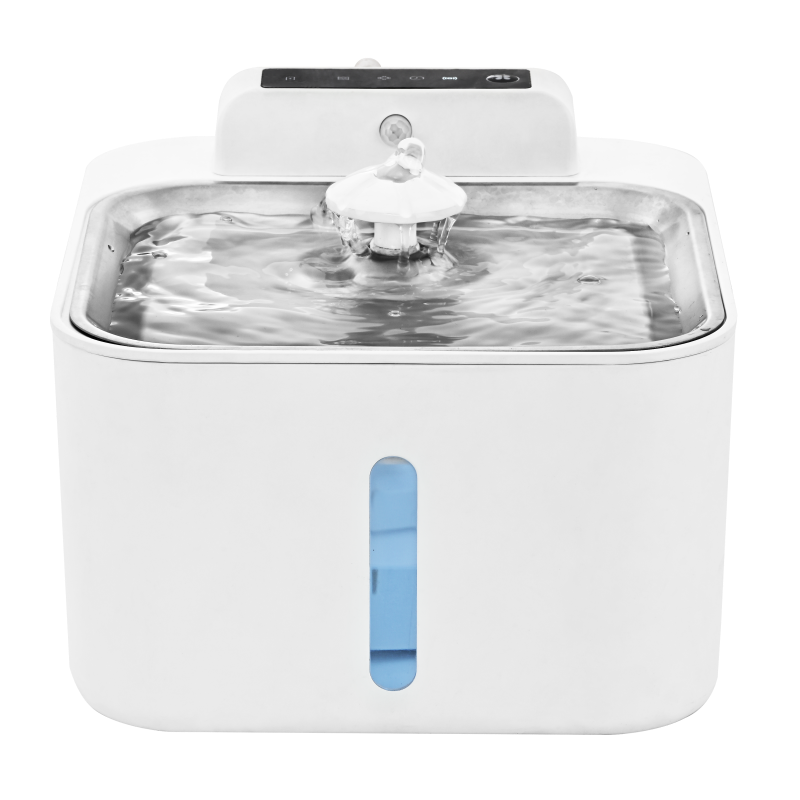
KYS-15B Wireless Pet Water Fountain, 3L
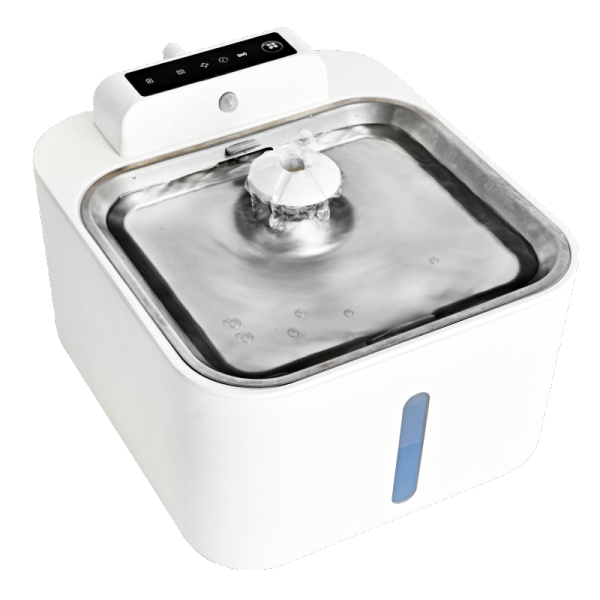
The companion hydration system: a cordless 3L fountain with 2000–3600 mAh battery options delivering up to 27 days of operation, a smart sensor that activates flow when your pet approaches, dual-stage filtration (activated carbon + ion-exchange resin), and an ultra-quiet pump for 24/7 fresh water.
- 3L tank, up to 27 days on battery
- Smart sensor-activated water flow
- Dual-stage carbon + ion-exchange filtration
- Ultra-quiet pump, Type-C charging
- MOQ 7,740 pcs / 40HQ; OEM/ODM ready
FAQ: Smart Pet Feeder Engineering, Answered
How does a smart pet feeder know how much food to dispense?
It converts a desired portion weight into a motor command: the controller runs the auger or paddle wheel for a calibrated time or a counted number of rotations. Because each rotation moves a roughly fixed volume, and weight = volume × kibble density, the device is factory-calibrated (e.g., ~10 g per portion) and often user-adjustable in gram steps for different foods.
What causes a pet feeder to jam, and how can it be prevented?
Jams come from oversized or irregularly shaped food, dusty or humid food that bridges in the hopper, or a channel too narrow for the kibble. Prevention is engineered: wide low-friction channels, soft silicone agitators, vibration aids, and jam sensors that reverse or pulse the motor to clear the blockage. Choosing food within the documented size range (e.g., 5–12 mm) is the user-side half of the solution.
Are automatic feeders safe to leave while I'm away?
Modern designs are safe when the basics are in place: dual power (mains + battery) so meals continue during outages, offline-capable schedules, motor overload protection, anti-tip stability, and food-contact materials compliant with FDA 21 CFR 177.1520 or equivalent. Always test a new feeder with your pet's actual food for a few days before leaving it fully in charge.
Can smart feeders handle wet food?
Most do not — refrigerated wet-food compartments are a separate, emerging product category and remain the largest untapped opportunity in the market. Standard feeders are designed for dry kibble; putting wet food in a dry-food hopper causes clogs, spoilage, and mold. Specify the food type in your product brief and choose accordingly.
What certifications do pet feeders need for export?
For the EU: CE (IEC 60335 series for household appliances), RED for wireless modules, RoHS and REACH. For North America: UL or ETL for the US, cUL for Canada, FCC for wireless. Food-contact parts should carry FDA or EU 10/2011 compliance documentation with third-party test reports. Our export compliance guide has the full matrix.
What is the MOQ and lead time for OEM pet feeders from China?
MOQs for standard smart feeder platforms are typically one 40HQ container (e.g., KYS-13B at 5,940 pcs; KYS-15B fountain at 7,740 pcs), with 35–45 days standard lead time for existing platforms and 45–60 days for customized tooling. Custom branding, panel labels, app co-branding, and packaging are standard OEM/ODM services. Our OEM sourcing guide and manufacturing process explainer walk through the full pipeline.
Summary: The Smart Feeder Engineering Equation
Summary: a smart pet feeder earns its price through two engineering disciplines — portion control and anti-jam reliability — wrapped in food-safe materials and fail-safe power. The market is compounding at 8.8–12.3% CAGR through the early 2030s, obesity statistics (59% of dogs, 61% of cats overweight) make measured feeding a health necessity, and the hardware that delivers it is now a mature OEM category. Importers should spec the mechanism, portion accuracy, kibble envelope, jam recovery, power backup, and certifications — then verify cycle testing and third-party material reports at the factory before committing to a line.
- Specify mechanism type, portion accuracy, and rotation-counted control in every sourcing document.
- Demand 10,000+ cycle test data and documented kibble compatibility ranges.
- Require dual power and offline-capable schedules as baseline reliability.
- Pair the feeder with a smart fountain to build a complete pet-care bundle — see our feeder and fountain buying guide.
Building a smart pet feeder or fountain line for your brand? Kangye is an OEM/ODM manufacturer based in Guangdong, China, with 35+ years of manufacturing experience and exports to 100+ countries. Our product line covers automatic pet feeders (KYS-13B), wireless pet fountains (KYS-15B), food dehydrators, BBQ grills, pizza ovens, air fryers, steam cookers, vacuum sealers, and indoor electric grills. Contact our team to discuss portion specs, anti-jam options, certification packages, MOQs, and private label programs — or browse the full range on our products list.