Sustainability in Food Dehydrators and Small Kitchen Appliances
Quick Answer: What Makes a Small Kitchen Appliance Truly Sustainable?
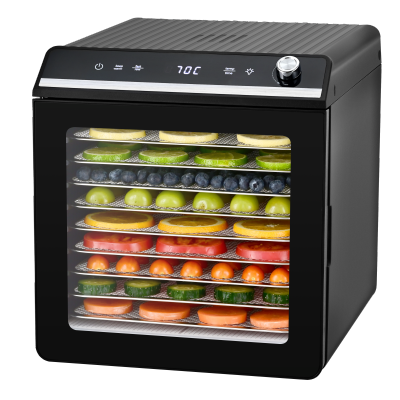
Sustainable kitchen appliances are defined by three measurable things: how little energy they use per batch of food, what they are made of, and how long they last before repair or recycling becomes the better choice. For food dehydrators specifically, the sustainability case is unusually strong — a dedicated dehydrator typically draws 300–1,000W versus 2,400–5,000W for a conventional oven, uses about 60–75% less energy for the same drying task, and directly attacks the single biggest waste stream in American kitchens: the 30–40% of the US food supply that goes uneaten (USDA). This guide covers the energy data, the materials and certifications that separate genuine eco friendly kitchen appliances from greenwashing, the honest limitations, and a sourcing checklist for brands planning an energy efficient food dehydrator line.
Key takeaway: the most sustainable kitchen appliance is the one that gets used. A food dehydrator that runs at a fraction of an oven's wattage, dries food that would otherwise spoil, and lasts a decade in stainless steel outperforms a "certified green" appliance that sits unused on the counter. Sustainability in small appliances is a system — energy per use, material footprint, durability, and food-waste prevention — not a single sticker.
Why Sustainability Is Now a Buying Criterion for Kitchen Appliances
The sustainability conversation in small appliances is no longer a niche concern — it is becoming a mainstream purchasing signal, and the data behind it starts with food waste. The USDA estimates that 30 to 40 percent of the food supply in the United States is never eaten. The EPA's 2025 report Estimating the Cost of Food Waste to American Consumers puts the personal cost at $728 per consumer per year, or $2,913 for a family of four — roughly $56 every week, about 11% of a household's total food spending. Nationally, food is the single largest material stream reaching US landfills, where it generates methane as it decomposes.
| Sustainability Signal | 2025–2026 Data | Source |
|---|---|---|
| US food supply never eaten | 30–40% | USDA |
| Food waste cost per consumer / year | $728 | US EPA, Apr 2025 |
| Food waste cost, family of four / year | $2,913 (≈ $56/week) | US EPA, Apr 2025 |
| Household food spending wasted | ≈ 11% | US EPA, Apr 2025 |
| US food reaching waste destinations / year | ≈ 63 million tons | ReFED, 2024 |
Two federal initiatives frame the response: the EPA and USDA goal to cut US food waste 50% by 2030 (announced in 2015 and still the reference target for sustainability reporting), and EPA's 2023 Wasted Food Scale, which ranks food waste prevention — including home preservation methods like dehydration — as the most environmentally preferred option. For importers and brands, this is not abstract policy: products that help households preserve food, like dehydrators and vacuum sealers, sit directly inside the fastest-growing sustainability narrative in the kitchen.
Energy Efficiency: The Dehydrator vs Oven Math
Energy use per batch is the single most objective measure of how eco friendly kitchen appliances really are — and on this metric, a purpose-built dehydrator wins by a wide margin. Most home dehydrators draw between 300W and 1,000W, while a conventional electric oven needs 2,400W to 5,000W just to hold a low temperature with the door cracked open. The comparison that matters is energy per batch of dried food:
| Appliance | Typical Wattage | 8-Hour Drying Run | Energy Used | Cost at $0.18/kWh |
|---|---|---|---|---|
| Food dehydrator | 600W | 8 hours | 4.8 kWh | ≈ $0.86 |
| Conventional oven | 2,400W | 8 hours | 19.2 kWh | ≈ $3.46 |
In this representative example the oven costs roughly four times more to run for the same batch of apple slices or jerky — and the gap widens for longer runs, because a dehydrator's fan-forced airflow dries more consistently at a lower temperature than an oven can maintain. Independent consumer research (Consumer NZ, KitchenWink) reaches the same conclusion: dehydrators use roughly 60–75% less energy than an oven for drying tasks. That is the difference between an energy efficient food dehydrator being a niche tool and being a genuinely defensible sustainability story for a brand.
Honesty note on ENERGY STAR: food dehydrators are not currently an ENERGY STAR certification category. ENERGY STAR covers refrigerators, dishwashers, clothes washers, and electric cooking products — certified electric cooktops and ranges average about 18% better efficiency than standard models (ENERGY STAR, US EPA). For dehydrators, "energy efficient" is measured by wattage, airflow design, temperature control, and auto shut-off rather than a federal label. A smart brand states this plainly instead of implying certification that does not exist.
For a detailed comparison of drying results, moisture levels, and running costs, our food dehydrator vs oven drying guide covers both methods side by side.
Materials Matter: Stainless Steel, BPA-Free Plastics, and Recyclability
Energy is half the sustainability equation; materials are the other half. The material choices that define an eco friendly kitchen appliance are also the ones consumers can actually verify:
- Stainless steel trays and interiors: stainless steel is infinitely recyclable without losing quality, non-porous, and free of the bisphenols and PFAS that worry food-safety researchers. Food-grade grades such as 18/8 (304) are the benchmark for durable, dishwasher-safe dehydrator trays.
- BPA-free plastics where plastic is unavoidable: housings, dials, and fan shrouds are the honest plastic zones. Verified BPA-free materials in food-contact areas are the acceptable minimum; plastic-free design (metal housings, glass windows) is the premium tier.
- Repairability and parts availability: a dehydrator that ships with replaceable trays, fans, and thermostats stays out of landfill for years. Modular design is the quiet sustainability feature nobody markets but every engineer respects.
- Reduced packaging: FSC-certified cartons, minimal foam, and recyclable gift boxes are low-cost ways manufacturers reduce the logistics footprint of every container.
In 2025–2026, the market trend is unambiguous: stainless steel and PFAS-free materials are the fastest-growing material story in countertop appliances, with brands from COSORI to established cookware houses pivoting interiors to all-metal, ceramic-coated, or explicitly BPA-free designs. Importers planning a new product line should treat material transparency — the ability to state exactly what touches the food — as a baseline requirement, not a differentiator.
Food Waste Prevention: The Sustainability Argument Dehydrators Win
Every appliance has an environmental footprint, but dehydrators are among the few countertop devices that reduce waste elsewhere in the system. The math is simple: a household that dehydrates overripe fruit, garden produce, or leftover batches prevents that food from entering the landfill — where it would have produced methane, the same potent greenhouse gas the EPA flags in its Wasted Food Scale. Dehydrated food lasts 6–12 months at room temperature when properly stored (longer with vacuum sealing), versus days for fresh produce.
From a brand perspective, this is the strongest eco-positioning available in the category:
- Direct waste reduction: apples, bananas, tomatoes, herbs, and meat trimmings that would spoil become shelf-stable snacks and ingredients.
- Lower food miles than store-bought dried goods: home-dried food avoids the packaging, cold chain, and transport of commercial dried products.
- Energy intensity of the alternative: producing and transporting food is energy-intensive; preserving what you already bought avoids that embedded energy entirely.
- Pet-treat crossover: dehydrating meat for pet treats reduces both waste and reliance on heavily packaged commercial treats — a category where pet owners increasingly demand natural, single-ingredient options.
For commercial operators — restaurants, catering kitchens, and pet-food producers — the same logic scales up. Our commercial food dehydrator buying guide covers tray capacity, airflow, and throughput for businesses that want to turn waste produce into revenue streams.
Certifications That Actually Mean Something for Sustainability
EEAT means separating real environmental credentials from marketing language. When a manufacturer claims its kitchen appliances are sustainable or eco-friendly, here is what to ask for:
| Certification / Standard | What It Covers | Why It Matters for Sustainability |
|---|---|---|
| ISO 14001 | Environmental management systems | Factory-level commitment to waste, energy, and emissions management |
| RoHS | Restriction of hazardous substances (EU) | Limits lead, mercury, cadmium, and other toxics in electronics |
| REACH | Chemical registration and restriction (EU) | Confirms chemical safety across the product's supply chain |
| LFGB / FDA | Food-contact safety (Germany / US) | Certifies the materials that touch food are safe — a precondition for "food-grade sustainability" |
| CE / GS / ETL | Electrical safety (EU / Germany / North America) | Safety compliance; a product that fails in the field is not sustainable by any measure |
| WEEE (EU) | Waste electrical & electronic equipment registration | Formal take-back and recycling obligation for e-waste |
The honest framing: no single certification proves a small appliance is "sustainable," but a manufacturer holding ISO 14001, RoHS, REACH, and food-contact certifications, plus energy-efficient design specs, has verifiable evidence for most of the claims that matter. A certificate stack is also a sourcing shortcut — factories that maintain these across models tend to have better quality systems overall. For the full regulatory picture across destination markets, our 2026 export compliance guide is the reference.
How Manufacturers Build Sustainability Into the Product
For OEM/ODM buyers, sustainability is decided at the factory — in component selection, airflow engineering, and production practice. Three design levers separate a genuinely energy efficient food dehydrator from a cheap one:
- Heating element and fan efficiency: rear-mounted fans with horizontal airflow dry evenly without tray rotation, so the unit finishes faster and uses fewer watt-hours per batch. DC motors and well-insulated chambers compound the saving.
- Wide, accurate temperature control: a dehydrator that holds 35–75°C (95–167°F) precisely avoids overcooking (wasted energy) and under-drying (wasted food). A fan-only mode that circulates air without heat is a genuine energy-saver for herbs and quick-drying foods.
- Auto shut-off and timer discipline: digital timers up to 48 hours with auto shut-off prevent overnight over-runs that burn energy and food.
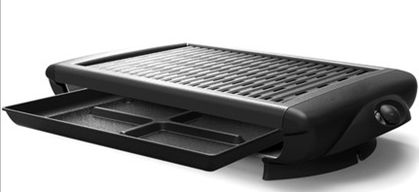
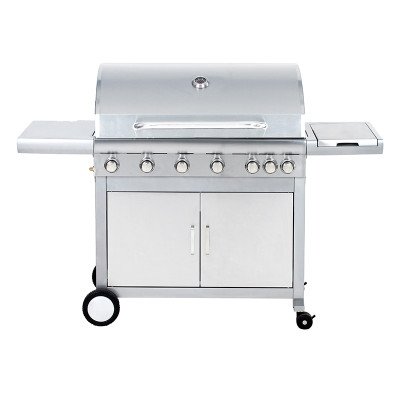
Kangye, the manufacturer behind this guide, is an OEM/ODM appliance factory based in Guangdong, China, with 35+ years of manufacturing experience and exports to 100+ countries. Our line covers food dehydrators, BBQ grills, pizza ovens, air fryers, steam cookers, vacuum sealers, indoor electric grills, and pet feeders and fountains — which means sustainability features like BPA-free trays, fan-only modes, and recyclable stainless steel construction are applied across a full catalog rather than a single hero product. For the end-to-end process of working with a factory on compliance and quality, our OEM sourcing guide walks through factory selection, samples, and payment terms.
Featured Product: Kangye KYS-322 5-Tray Home Food Dehydrator
Featured Product: Kangye KYS-322 Series — Energy Efficient Food Dehydrator
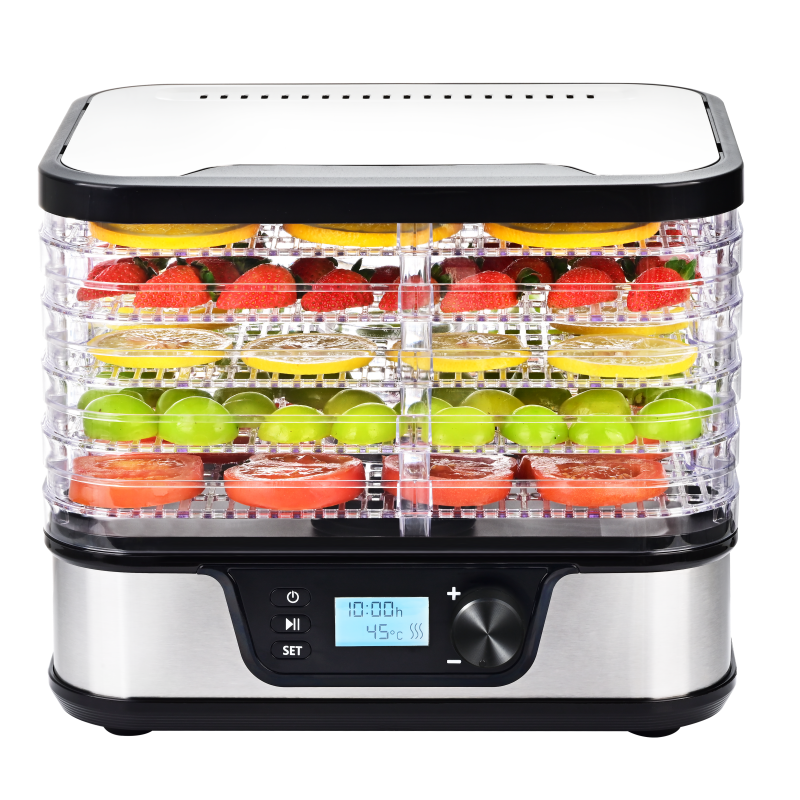
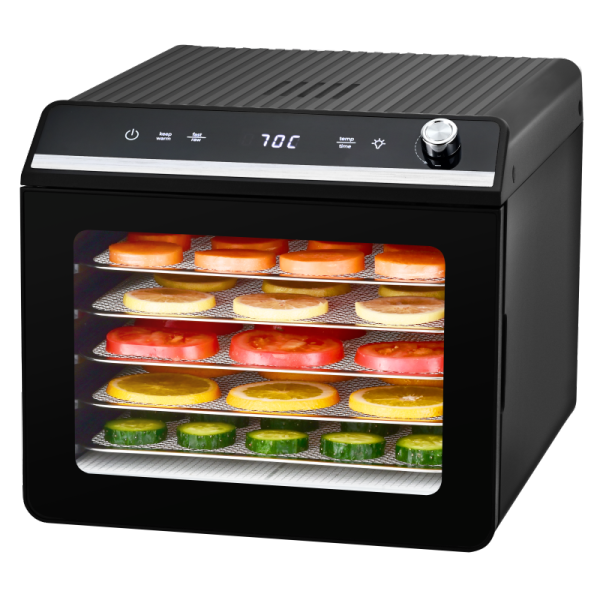
The KYS-322 Series is a 5-tray home food dehydrator designed around the energy and material principles in this guide: a compact bottom-heating dryer drawing 320–380W (220–240V) or 350W (120V), with 5 stainless steel trays (or food-grade plastic trays), a 35–75°C / 95–167°F adjustable range, a 0.5–48 hour timer, and a fan-only mode that circulates air without heat for extra-efficient drying of herbs and light batches.
- Low-wattage bottom heating — a fraction of an oven's energy draw per batch
- 5 stainless steel trays: durable, recyclable, easy to clean
- 35–75°C digital control + fan-only mode + 48H auto shut-off timer
- Compact 320 × 265 mm footprint; 976 pcs / 20GP, 2,000 pcs / 40GP
- OEM/ODM: BPA-free material options, colorways, panel labels, packaging
Honest Limitations: What "Sustainable Kitchen Appliances" Does Not Mean
Credibility requires acknowledging what a dehydrator — or any small appliance — cannot claim:
- Dehydration is not zero-energy. Running 8–12 hours still uses electricity; the honest claim is far less than an oven, not "no energy." Efficient use (full trays, thin uniform slices, fan-only where possible) matters as much as the wattage rating.
- No ENERGY STAR label exists for dehydrators. Claiming otherwise is greenwashing. The category's efficiency evidence is engineering data (watts, airflow design, timer) and third-party tests, not a federal seal.
- Plastic is not automatically bad, stainless is not automatically green. BPA-free plastic components are legitimate where they are not touching food; conversely, "stainless" branding on a product with plastic internals needs scrutiny. Ask what touches the food and what the housing is made of.
- Import logistics have a footprint. A container shipped from Guangdong to North America has embedded transport emissions; buyers should evaluate total life-cycle impact, not just in-home efficiency, and work with factories that consolidate freight and use optimized carton designs.
- Behavior determines outcome. The greenest appliance in the world prevents zero waste if it is never used. Marketing should pair the product with education — recipes, storage guidance, and batch planning — because usage is where the sustainability actually happens.
None of this weakens the case for sustainable kitchen appliances; it sharpens it. The brands that win the eco-positioning are the ones whose claims survive an engineer's checklist.
How to Choose a Sustainable Food Dehydrator: A Sourcing Checklist
Whether you are buying for your home or sourcing an energy efficient food dehydrator line for your brand, the same checklist applies:
- Wattage and airflow: prefer 300–700W models with rear or bottom fan designs that dry evenly; confirm horizontal airflow so trays do not need rotation.
- Temperature and timer range: 35–75°C control plus a fan-only mode and a long (24–48H) auto shut-off timer.
- Materials: stainless steel trays (18/8 or equivalent), BPA-free plastics only outside food contact, no PFAS in any coated surface.
- Certifications: CE/GS/ETL for electrical safety, RoHS/REACH for chemicals, LFGB/FDA for food contact — and ISO 14001 at the factory level for environmental management.
- Repairability and parts: replaceable trays, fan, and thermostat; ask the manufacturer for a spare-parts commitment.
- Packaging: minimal, recyclable cartons; avoid foam-heavy gift packs unless the brand requires them.
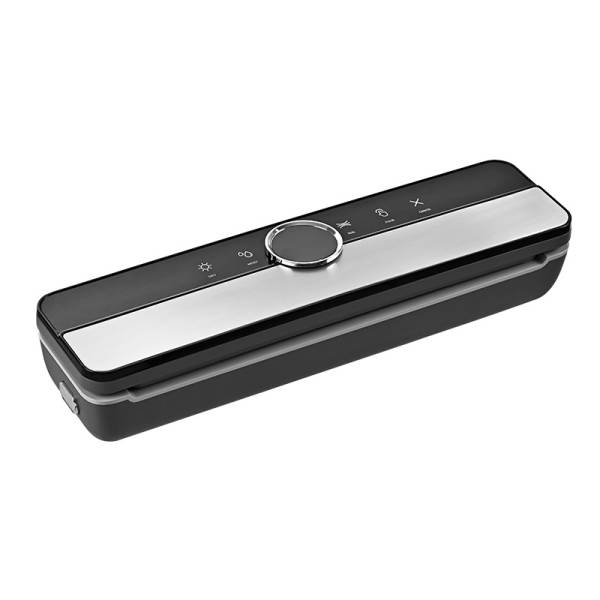
- Companion products: pair the dehydrator with vacuum sealing to maximize shelf life — the combination is the strongest food-waste-prevention story in the kitchen.
For a full comparison of tray counts, heating types, and power tiers, our home food dehydrator buying guide is the deeper reference. If you are evaluating the category for a commercial menu or production line, the commercial guide covers throughput and capacity.
FAQ: Sustainable Kitchen Appliances and Food Dehydrators, Answered
Are food dehydrators considered energy efficient kitchen appliances?
Yes — by comparison. A 300–1,000W dehydrator uses roughly 60–75% less energy than a 2,400–5,000W oven for the same drying task, and a typical 8-hour batch costs under $1 in electricity. The caveat: dehydrators are not an ENERGY STAR certified category, so efficiency is verified by wattage, airflow design, and independent testing rather than a federal label.
How does a food dehydrator reduce food waste?
Dehydration preserves produce, meat, and herbs that would otherwise spoil — extending shelf life to 6–12 months at room temperature when stored properly. Since the USDA estimates 30–40% of the US food supply goes uneaten, and the EPA values a family of four's food waste at about $2,913 per year, dehydration is one of the most direct household tools for cutting both waste and cost.
What materials should an eco friendly kitchen appliance use?
Prioritize stainless steel for food-contact and structural parts — it is infinitely recyclable, non-porous, and free of bisphenols and PFAS. Where plastic is unavoidable (housings, controls), require verified BPA-free materials outside food-contact zones. Ask the manufacturer for material declarations, not just "BPA-free" on the box.
Is there an ENERGY STAR rating for food dehydrators?
No. ENERGY STAR currently certifies refrigerators, dishwashers, clothes washers, and electric cooking products — electric cooktops and ranges certified under the program average about 18% better efficiency than standard models. Dehydrators have no ENERGY STAR category; buyers should judge efficiency by wattage, airflow design, temperature accuracy, and timer features instead.
What certifications prove a manufacturer's sustainability claims?
The meaningful stack is ISO 14001 (environmental management), RoHS and REACH (hazardous substances and chemicals), LFGB or FDA (food-contact safety), plus electrical safety marks (CE, GS, ETL) and WEEE registration in the EU. No single certificate proves sustainability — the combination, verified per model, is the evidence that matters.
Can I source a sustainable dehydrator line under my own brand?
Yes. OEM/ODM manufacturers like Kangye (Guangdong, China; 35+ years; exports to 100+ countries) build private label dehydrators with BPA-free material options, brand colorways, panel labels, packaging, and certification packages. Sustainability specs — low wattage, fan-only mode, stainless trays, ISO-certified production — are exactly the kind of features a manufacturer can lock into an ODM platform.
Summary: The Sustainable Kitchen Appliance Equation
Summary: sustainable kitchen appliances earn the label on three verifiable dimensions — energy per use (a dehydrator uses 60–75% less than an oven), material footprint (recyclable stainless steel, BPA-free, repairable), and food-waste prevention (attacking the 30–40% of US food that goes uneaten, valued at $2,913 per family per year by the EPA). The honest version of the story is stronger than the hype: dehydrators are not zero-energy and carry no ENERGY STAR label, but their low-wattage, high-utilization design makes them one of the most defensible eco claims in the countertop category.
- Buy or source on watts, airflow, materials, and certifications — not stickers.
- Pair dehydration with vacuum sealing for maximum shelf life and minimum waste.
- Verify ISO 14001, RoHS, REACH, and LFGB/FDA at the factory before committing to a line.
- Treat usage education as part of the product — the greenest appliance is the one that gets used.
Sourcing an energy efficient food dehydrator or other sustainable kitchen appliances for your brand? Kangye is an OEM/ODM manufacturer based in Guangdong, China, with 35+ years of manufacturing experience and exports to 100+ countries. Our product line covers food dehydrators, BBQ grills, pizza ovens, air fryers, steam cookers, vacuum sealers, indoor electric grills, and pet feeders and water fountains. Contact our team to discuss MOQs, BPA-free material options, certification packages, and private label programs for your market.