Electric Food Steamer Buying Guide: Tiers, Capacity and Features
Quick Answer: How Do You Choose an Electric Food Steamer?
Choose an electric food steamer by matching three decisions to your household or retail market: tier count (how many dishes you want to cook at once), capacity (how many people you feed), and features (timer, presets, keep-warm and safety). As a rule of thumb, a two-tier steamer around 4–6 quarts suits singles and couples; a three-tier, 8–11 liter unit suits families and batch meal preppers; and 800–1200W of heating power delivers fast steam in under a minute. The global electric food steamer market is projected to grow from roughly $5.75 billion in 2025 to $10.7 billion by 2033 (CAGR 8.1%), with multi-tier steamers alone holding about 45.6% of revenue — which is why the tier question is not a detail, it is the central purchasing decision for most buyers.
Key takeaway: the steamer you choose is a capacity-and-features compromise, not a brand popularity contest. A compact two-tier unit that suits a couple will frustrate a family of five; a large three-tier unit overwhelms a solo cook. For importers and private-label buyers, matching the tier/capacity/features mix to the target demographic — rather than sourcing a one-size-fits-all SKU — is the difference between a line that sells and a line that sits in the warehouse.
Why the Electric Food Steamer Is Growing Faster Than Most Countertop Appliances
The electric food steamer category is expanding on a health narrative that is now backed by hard numbers. Market research tracked through 2026 puts the global electric food steamer market at about $5.75 billion in 2025, growing to $10.72 billion by 2033 at an 8.1% CAGR (Future Market Report), with China the leading single country at a 21.4% share and the Asia-Pacific region the largest regional market at 38.7% of revenue. Other trackers tell a similar story from different angles: the wider "electric steamer" category is valued near $3.84 billion in 2025 with a 5.32% CAGR (Data Insights Market), while the household segment alone was worth about $321 million in 2025 and around 200 million units worldwide, and the commercial electric food steamer segment reached $530 million in 2025, heading to $800 million by 2034 (Intel Market Research).
Three structural drivers sit behind the numbers. First, health and nutrition: steaming is consistently ranked among the cooking methods that best preserve water-soluble vitamins — USDA nutrient retention data shows steaming preserves roughly 85% of vitamin C in vegetables versus about 75% for boiling, because the food never sits in water where nutrients leach out. Second, convenience and safety: a timer-equipped steamer cooks unattended with auto shut-off, which suits busy households in the same way air fryers won their audience. Third, multi-tasking capacity: a three-tier steamer cooks a protein, two vegetables, and rice simultaneously — one appliance replacing three pots and freeing the oven, a value proposition that multiplies at holiday and family-meal moments. Our earlier electric steam cooker guide covered the category basics; this guide goes deeper into the tier, capacity and feature decisions that determine which model you should actually buy or source.
Steamer Tiers Explained: Single, Double, Triple and Stackable
The tier count is the first and most visible decision because it determines what the steamer can do in one session. A "tier" is a stacked steaming basket; steam rises from the base and cooks each level, with the bottom tier receiving the hottest, most direct steam.
| Tier Configuration | Typical Capacity | Best For | Trade-offs |
|---|---|---|---|
| Single tier | 1–3 L / 1–3 qt | Solo cooks, egg steaming, reheating buns or tamales | One dish at a time; most compact; cheapest |
| Two tier | 4–6 qt | Couples; one protein + one vegetable; small batch meal prep | Limited volume; flavor transfer if juices drip between levels |
| Three tier | 8–11 L / 8–13 qt | Families; full meal in one go (protein + veggies + rice/eggs) | Larger footprint; denser foods must sit on the bottom tier |
| Stackable / modular | Varies | Buyers who want to add or remove baskets as household size changes | More parts to store; sealing between levels must be reliable |
Multi-tier designs dominate the market — roughly 45.6% of global steamer revenue comes from multi-tier models (Future Market Report), and the largest manufacturers (Bear, SUPOR, Midea, Buydeem, Philips) concentrate their product development there. The practical reason is simple: a three-tier unit can cook a complete meal, which is the use case that justifies owning a dedicated countertop appliance. Note the stacking logic too — dense items like chicken thighs belong on the bottom tier where steam is hottest, while delicate fish or spinach goes on top to avoid overcooking from falling condensation. The same rule applies whether you are cooking at home or choosing a model to recommend to retail customers.
Capacity: Matching Liters and Quarts to Household Size
Capacity is the second decision, and it is where most mis-buys happen. Market segmentation data groups steamers into small (1–2 L), medium (3–4 L), large (5–6 L) and extra-large (7+ L) classes (MarkWide Research), while US-focused guides tend to quote quarts — 4–6 qt for singles and couples, 7.4 qt for small families, and 9.5–13.7 qt for family batch cooking. A reliable matching rule:
- 1–2 people → 3–5 L / 4–6 qt, two tiers. Enough for a protein and a side; small footprint suits apartments and dorm kitchens.
- 3–4 people → 7–9 L / 8–9.5 qt, two to three tiers. The most common family configuration; medium capacity commands the revenue concentration in most markets.
- 5+ people or batch meal prep → 10–14 L, three tiers. Full-meal cooking, whole-fish preparation, and weekly meal-prep volumes.
- Commercial / catering → 20 L+ or multi-pan units. Institutional portion control; a different product class entirely (often 1200W+ with 6 pans).
For importers, capacity tiering is also a portfolio decision. The US suburban market concentrates demand in the medium and large family tiers, while Europe skews toward premium stainless models in the large tier for multi-generational households, and solo-dweller markets in Asia and urban Europe pull compact two-tier units. A balanced sourcing plan typically carries two or three capacity tiers under one brand rather than a single hero SKU — exactly the kind of line planning a factory partner like Kangye can support with OEM/ODM variations.
Power and Steam Speed: What the Wattage Really Buys You
Wattage controls how fast water becomes steam, and that translates directly into cooking results. Tested models in the 800W class produce visible steam in roughly 25–45 seconds; 1000–1200W units reach steaming in about a minute of preheat and recover faster after you lift the lid; low-wattage units (360–400W) are adequate for eggs and small batches but struggle with dense vegetables or larger loads.
| Power Class | Typical Steam Time | Best Fit | Circuit Note |
|---|---|---|---|
| 400–800W | 30–60 sec | Compact 1–2 tier units; entry price points | Safe on any standard 120V/15A circuit |
| 800–1000W | 25–45 sec | Mid-range family units — the most common class | ~7–8A at 120V; fine on shared circuits |
| 1000–1500W | <30 sec | Large capacity and premium digital models | ~9–12.5A at 120V; check circuit loading |
The honest caveat: higher wattage is not always better. A 1500W unit on a 120V kitchen circuit draws over 12 amps — acceptable but close to the 15A breaker limit, and if the same circuit runs a kettle or microwave, you will trip it. That is one reason the 800–1200W band is the practical sweet spot for household steamers, and why a dual-voltage design matters for exporters: a model sold as 840–1000W at 220–240V may need to be configured as 800W at 120V to stay safely within North American circuit realities. Our electrical ratings guide explains why this single spec determines market fit.
Features That Matter: Timers, Presets, Keep-Warm and Safety
Once tiers and capacity are settled, features separate a steamer that gets used weekly from one that gets donated. Rank them by actual daily value:
- A 60-minute (or longer) timer with auto shut-off — the single most important feature. It lets you start steaming and walk away; auto shut-off prevents overcooking and boil-dry damage. Many family units top out at 60 minutes, which covers everything from 3-minute asparagus to 45-minute artichokes; premium digital models add up to 18-hour delay-start scheduling.
- Pre-programmed modes (vegetables, poultry, grains, seafood, manual) — useful for consistency and for less-experienced users; a digital display with countdown beats guessing.
- Keep-warm — holds food at serving temperature after the cycle, which matters when cooking multiple dishes for one mealtime.
- Boil-dry protection — cuts power if the water evaporates; combined with auto shut-off this is the core safety pair. A visible water-level indicator and a side water-refill inlet (so you can top up without lifting the hot lid) are quality-of-life details that reduce real-world frustration.
- Removable, dishwasher-safe baskets and base — cleaning effort is the #1 reason small appliances stop being used; dishwasher-safe parts keep the steamer in the rotation.
For retail markets, feature tiers map neatly to price points: entry models sell on timer + auto shut-off, mid-range adds presets and digital displays, premium adds keep-warm, delay start, and all-stainless construction. When sourcing, resist the temptation to strip features to hit a price — in the US, 74% of consumers lean toward health-focused and technology features in small appliances, and the medium-capacity digital segment is where unit velocity concentrates.
Materials and Food Contact: BPA-Free Plastic, Glass and Stainless Steel
Every steamer touches the food you eat, so food-contact materials deserve more scrutiny than most appliance specs get. Three material choices dominate:
- BPA-free plastic baskets — the default for budget and mid-range units. Adequate for short steam cycles, but plastic baskets can warp over time and stain from turmeric or tomato-based dishes. Compliance matters: food-contact plastics must meet FDA 21 CFR (US) or EU 10/2011 (Europe) migration limits, and certification documentation (LFGB in Germany, FDA for the US) is the standard proof.
- Glass steam pots — popular in premium compact models (e.g., Cuisinart's glass steamer) because you can watch food cook without lifting the lid. Heavier and more fragile, but excellent for visibility and zero plastic contact.
- Stainless steel baskets (304-grade) — the gold standard for longevity and food safety: corrosion-resistant, no chemical migration at steam temperatures, dishwasher-safe, and they do not yellow. Market research confirms stainless is consolidating as the premium material platform, replacing BPA-free plastics in tier-one product lines, and health-focused households in Germany and North America now specify 304 stainless for all liquid-contact surfaces.
The buying guide bottom line: if the steamer is a budget gift or a dorm appliance, certified BPA-free plastic is fine; if it is a family's daily cook, stainless trays are worth the price step — and for brands, stainless construction is also an easier story to tell at retail than "BPA-free."
The Steaming Science: Nutrient Retention, Temperature and Food Safety
Steaming's health reputation rests on real chemistry. Water-soluble vitamins — vitamin C and the B complex — leach into cooking water when food is boiled; steaming keeps the food out of the water, and USDA retention factors show steaming preserves roughly 85% of vitamin C in vegetables versus about 75% for boiling. A 2020 peer-reviewed study of cauliflower, carrots and sweet potatoes (published in Foods) found steaming increased total phenolics and carotenoids while boiling reduced ascorbic acid and antioxidant activity — and shorter cooking times preserved nutritional quality best. The practical rule: steam until just tender; over-steaming destroys the very nutrients the method is chosen to protect.
On safety, two points matter. First, steaming is not sterilization — food safety agencies (including the USDA) emphasize that steaming alone does not eliminate microbes on unwashed produce, so washing vegetables before steaming is still mandatory. Second, steam cooking operates at roughly 100°C / 212°F at atmospheric pressure, which is hot enough to cook but not to guarantee pasteurization of dense proteins; fish should still reach an internal temperature of 145°F and poultry 165°F to be food-safe. A timer is a convenience, not a safety thermometer — for proteins, verify internal temperature with a probe.
Sourcing Considerations: What Importers and Private-Label Buyers Should Look For
If you are buying steamers to sell, the tier/capacity/feature framework above is your market-fit filter, but sourcing adds four factory-level checks:
- Certification readiness — UL/ETL for North America (or CE/GS for Europe) plus food-contact compliance (LFGB/FDA) and material declarations (RoHS/REACH). Certification adds 4–8 weeks, so it must run in parallel with sample approval, not after production. Our export compliance guide covers the full matrix.
- Dual-voltage and plug flexibility — a single model configurable for 120V/60Hz (North America) and 220–240V/50Hz (Europe) lets you run one platform across markets; confirm wattage derating (e.g., 840–1000W at 220–240V vs 800W at 120V) is engineered, not improvised.
- Container economics — steamer cartons are bulky; check packed dimensions and MOQ per 20GP/40GP. A well-packed unit (nested baskets, compact gift box) meaningfully cuts freight cost per piece.
- OEM/ODM depth — can the factory vary tier count, colors, branding, and packaging for your private label, and hold quality across runs? Our OEM sourcing guide and private label guide walk through both processes in detail.
And one seasonal note for the calendar: steamers are a proven Q4 performer — holiday cooking capacity and health gifting both lift the category in November–December, and the holiday season sourcing timeline means Q4 steamer stock needs its PO placed in August–September, with production slots booked even earlier in a tight year.
Featured Product: Kangye KYS-303A 3-Tier Electric Food Steamer
Featured Product: KYS-303A 3-Tier Electric Food Steamer (11L)
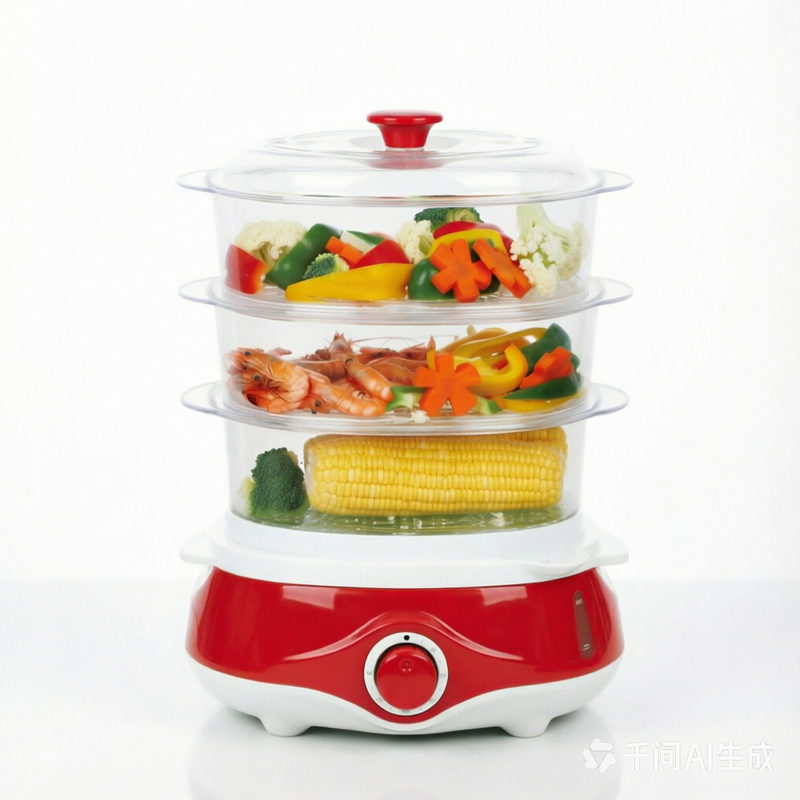
The KYS-303A 3-tier electric food steamer sits at the family tier sweet spot: 11 liters across three transparent steaming trays — enough for a protein, two vegetables, and eggs or dumplings in one session — with a 60-minute timer and auto shut-off for walk-away safety, 840–1000W (220–240V) or 800W (120V) heating for fast steam, and a compact 330 × 235 × 420 mm footprint. BPA-free food-contact materials and dishwasher-friendly stacking trays make it a practical family workhorse and a strong private-label platform.
- 3 tiers / 11L capacity — full-meal steaming
- 60-minute timer with auto shut-off
- 840–1000W (220–240V) / 800W (120V) dual-voltage options
- Compact 330 × 235 × 420 mm; BPA-free materials
- MOQ from 1,428 pcs (20GP); OEM/ODM and private label ready
Kangye manufactures the KYS-303A (factory model reference KYS-302) as part of a broader small-appliance line — outdoor and indoor electric grills, food dehydrators, BBQ grills, pizza ovens, air fryers, vacuum sealers, and pet feeders — from our factory in Guangdong, China, with 35+ years of manufacturing experience and exports to 100+ countries. Our US kitchen appliance market guide places this category in the wider demand picture.
FAQ: Electric Food Steamer Buying Guide, Answered
How many tiers do I actually need in a food steamer?
Match tiers to the number of dishes you cook at once. Two tiers cover a protein plus a side for singles and couples; three tiers let a family cook a main, a vegetable, and rice or eggs simultaneously. Multi-tier models hold about 45.6% of global steamer revenue, making them the mainstream choice — but a solo cook will rarely use a third tier.
What capacity steamer do I need for a family of four?
Plan on roughly 8–11 liters (8–9.5 qt) for a family of four: enough for a whole protein on one tray and two vegetables on the others. Singles and couples can manage with 3–5 liters (4–6 qt); five-plus-person households or weekly meal preppers should look at 10–14 liter three-tier units.
Is higher wattage always better for a steamer?
Not exactly. Higher wattage means faster steam and faster heat recovery after opening the lid, but a 1500W unit draws over 12 amps on a 120V circuit — close to a 15A breaker limit if other appliances share the circuit. The 800–1200W band is the practical sweet spot for household steamers.
Are stainless steel steamer trays worth the extra cost?
For daily family use, yes. Stainless (ideally 304-grade) resists corrosion, does not leach or stain, and survives years of dishwasher cycles, whereas plastic baskets can warp and yellow over time. For occasional use or budget gifting, certified BPA-free plastic is acceptable.
Does steaming actually preserve more nutrients than boiling?
For water-soluble vitamins, yes. USDA retention data shows steaming preserves roughly 85% of vitamin C in vegetables versus about 75% for boiling, because steam-cooked food never sits in water where nutrients leach out. Shorter cooking times preserve nutrients best — steam until just tender, not beyond.
What should I check when sourcing steamers for my brand?
Four things: certification readiness (UL/ETL or CE/GS plus LFGB/FDA food-contact compliance), engineered dual-voltage and plug options, packed carton dimensions and MOQ for container economics, and the factory's OEM/ODM depth for tier, color, and packaging variations. All four are standard for a manufacturer like Kangye with 35+ years of export experience.
Summary: Choose Tiers First, Then Capacity, Then Features
Summary: the electric food steamer buying decision reduces to three questions. Tiers decide how many dishes you can cook at once — two for couples, three for families, and multi-tier models dominate a market projected to grow from $5.75B (2025) to $10.7B (2033). Capacity matches the unit to the household — 3–5 L for one or two people, 8–11 L for a family of four, 10–14 L for batch preppers. Features determine daily usefulness — a 60-minute timer with auto shut-off, boil-dry protection, presets, keep-warm, and dishwasher-safe parts matter far more than brand badges. Materials (304 stainless over BPA-free plastic), wattage realism (800–1200W sweet spot), and food-safety practice (wash produce, verify protein internal temperatures) round out the picture. For importers, the same framework becomes a market-fit filter: certify early, engineer dual-voltage, optimize packed dimensions, and source OEM/ODM depth rather than a single hero SKU.
- Match tier count to dishes-per-session: 2 for couples, 3 for families.
- Match capacity to household size: 3–5 L / 8–11 L / 10–14 L.
- Prioritize timer + auto shut-off + boil-dry protection; treat presets and keep-warm as differentiators.
- Prefer 304 stainless trays for daily family use; certified BPA-free for budget tiers.
- For sourcing: certify early, engineer dual-voltage, check carton economics, buy OEM/ODM depth.
Planning a steamer line for your market? Kangye is an OEM/ODM manufacturer based in Guangdong, China, with 35+ years of manufacturing experience and exports to 100+ countries. Our product line covers 3-tier electric food steamers, food dehydrators, outdoor and indoor electric grills, BBQ grills, pizza ovens, air fryers, vacuum sealers, and pet feeders and water fountains — with dual-voltage options, certification packages (CE, GS, ETL, CB, RoHS, REACH, LFGB, FDA, SAA), private label programs, and production slots for Q4 holiday delivery. Contact our team to discuss tier, capacity, and feature options for your next steamer order.