How to Choose a Gas BBQ Grill: Burner Count, Materials and Size
Aug 23,2026
Quick Answer: How to Choose a Gas BBQ Grill
Choosing a gas BBQ grill comes down to three specifications — burner count, cooking area and materials — matched to the size you actually need. There is no single "best" grill: a compact two-burner portable unit serves a family of four on a small patio, while a six-burner commercial model is built for restaurants that cook all day. The global gas barbecue market reached about USD 4.59 billion in 2026 and is forecast to grow at a 6.76% CAGR to USD 6.88 billion by 2032 (Research and Markets), and roughly 12.3 million gas grills were sold worldwide in 2025 (Business Research Insights). For importers, restaurants and private-label brands, understanding how burner count, materials and size interact is what turns a spec sheet into a product that sells — and lasts.
Key takeaway: more burners do not mean a better grill, and a bigger BTU number is not a performance score. What matters is matching the burner count and cooking area to how the grill will be used, choosing materials that survive the destination climate, and buying from a factory that can document its certifications. This guide walks through each decision with real market data, honest limitations and concrete examples from an OEM factory floor.
Why Burner Count, Materials and Size Define a Gas Grill
A gas grill is a simple machine: burners convert fuel into heat, grates transfer that heat to food, and the firebox, lid and trolley hold everything together. But the way those parts are specified decides the entire cooking experience. Burner count determines how many independent heat zones you can create. Cooking area determines how much food you can cook at once. Materials determine how long the grill lasts before rust, warping or burnout — and how much it costs to build. Size determines whether the unit fits the customer's patio, kitchen or restaurant terrace in the first place.
This is also a market that keeps growing. According to Research and Markets, gas barbecues are evolving from seasonal grills into year-round outdoor cooking systems, driven by patios and compact urban balconies being designed as usable living space. Deep Market Insights reports that freestanding gas grills account for roughly 58% of global revenue, propane models hold about 68% of the market, and North America contributes around 38% of revenue, with Asia-Pacific growing fastest at about 8% CAGR. For a sourcing decision, these figures matter: the fastest-growing segments — premium freestanding units and compact portables — are exactly where most of Kangye's gas grill orders land.
How Many Burners Do You Actually Need?
Each independently controlled burner creates one heat zone. The right number depends on how many people you regularly cook for, not on the maximum you might occasionally host. The table below summarizes the widely used guidance from consumer-testing and buying guides (Everything Grill Reviews, RWFLAME, and UK market data from Best Gas BBQ).
Burners
Typical crowd
Primary area
Best fit
2 burners
2–4 people
300–400 sq in
Couples, small families, balconies, camping and travel
3 burners
3–8 people
350–500 sq in
The practical sweet spot for most households; proper two-zone cooking
4 burners
5–8+ people
450–650 sq in
Regular entertaining; separate zones for searing, roasting and warming
5–6+ burners
Large gatherings, commercial
600+ sq in
Only if you regularly fill the grate; higher purchase, fuel and cleaning costs
Two-zone cooking — keeping one area hot for browning while another stays cooler for gentle finishing — is the single most useful capability a gas grill can offer, and it requires at least two independently controlled burners. It prevents chicken from burning before it is done, gives you a safe place to move food during flare-ups, and makes indirect cooking possible. A three- or four-burner layout makes this easier; a two-burner grill can still create two zones, but the usable indirect area will be smaller.
Be honest about the trade-offs: more burners mean more fuel consumption at full power, more components to maintain, a larger footprint and a higher price. For a commercial kitchen or restaurant terrace, the calculation changes — uptime, standardized parts and serviceability matter more than zone flexibility alone (this is the same logic that drives the commercial segment in the market reports above).
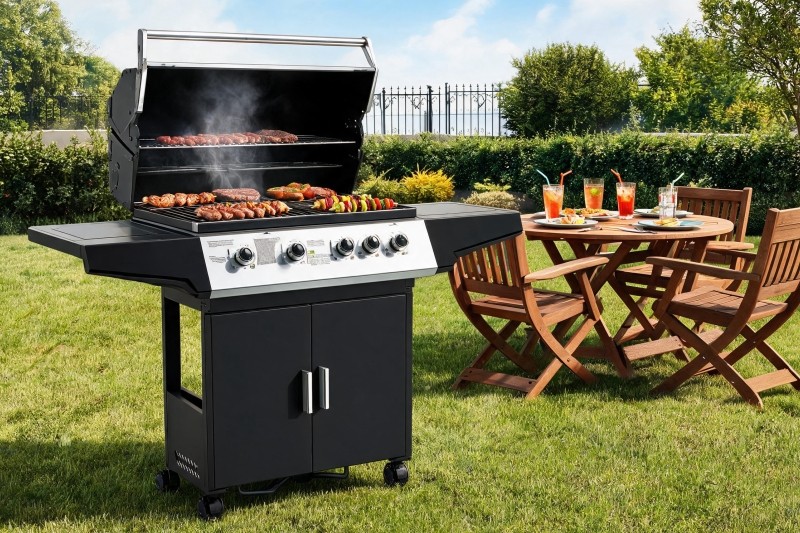
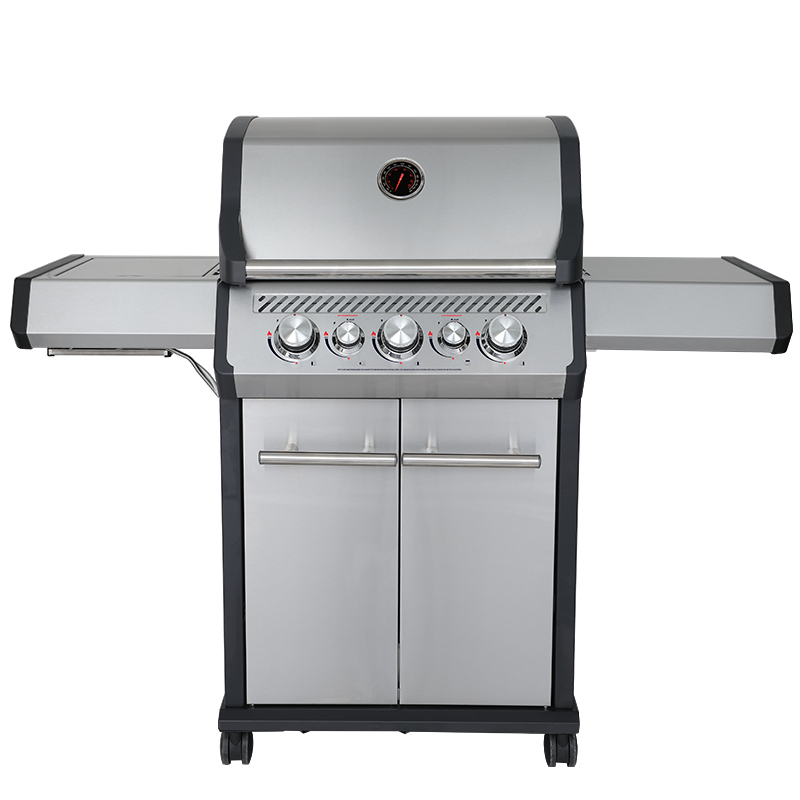
KYQ-LP24S 4-burner gas BBQ grill — four independent heat zones, a side burner and 4 wheels, rated 12.6 kW. View product.
Cooking Area and Heat Density: The Real Numbers
Manufacturers advertise "total cooking area," which often includes a warming rack. The number that matters is the primary cooking area — the usable main grate — because that is where burgers, steaks, fish and vegetables actually sit. A warming rack is useful for buns and finished food, but it is not a substitute for main-grate space.
A practical rule of thumb used by UK retailers: a standard burger needs roughly 100 cm² (15.5 sq in) and a steak about 150 cm² (23 sq in). Multiply your usual guest count by 150 cm² for steaks (or 100 cm² for burgers), add about 30% for breathing room between items, and that is your minimum primary cooking area. A 2,500 cm² grate, for example, handles about 16 burgers at once with proper spacing.
Just as important as raw area is heat density — the heat output divided by the cooking area. A compact 2-burner grill at 6 kW over 1,500 cm² produces higher heat per square centimetre than a 4-burner at 14 kW over 3,500 cm², which is why small grills often sear better than oversized ones. When evaluating a spec, always divide the total kW by the primary area and compare that ratio, not the headline numbers.
BTU Ratings: What They Mean and What They Don't
BTU (British Thermal Units) per hour measures how much fuel energy the burners can consume — it is an input rating, not a measure of cooking quality. A high-BTU grill with poor heat distribution, thin grates and a leaky lid will cook worse than a lower-BTU grill with a well-sealed firebox and properly sized burners. BTU should be read together with cooking area, burner placement, heat diffusers and firebox construction (for a deeper treatment, see our guide to Gas Grill BTU Ratings).
For a quick sanity check, use the conversion 1 kW = 3,412 BTU/hr. On Kangye's current lineup:
Model
Burners
Heat output
Approx. BTU
KYQ-M22
2
6.3 kW
≈ 21,500 BTU/hr
KYQ-193RB
3 + infrared side burner
19 kW total
≈ 64,800 BTU/hr
KYQ-61S
6
18.9 kW total
≈ 64,500 BTU/hr
Notice that the 3-burner KYQ-193RB and the 6-burner KYQ-61S have nearly identical total BTU — the difference is in how the heat is distributed, not how much exists. For searing, look for a grill that can sustain roughly 500°F (260°C) or above on the primary zone. For most families, three or four burners around 10–14 kW is plenty; a compact grill at 6 kW can still sear beautifully because its heat density is high.
Gas Grill Materials: Firebox, Lid and Burners Compared
The materials in a gas grill decide its lifespan, its price and its failure modes. Testing sources and industry analysis (Visual Foodie, CLA Grills, sxburner) converge on the figures in the table below.
Part
Material
Typical life
Notes
Firebox / lid
Cast aluminum
15+ years
Light, corrosion-resistant, holds shape; can discolor over time
Firebox / lid
304 stainless steel
15+ years
18% Cr, 10% Ni; best corrosion resistance; high cost
Firebox / lid
430 stainless steel
3–8 years
Less chromium; rusts in coastal or humid climates
Firebox / lid
Porcelain-enameled steel
2–10 years
Affordable; coating can chip, exposing steel to rust
Burners
304 stainless steel
5–10 years
Thick-gauge 304 is the commercial benchmark
Burners
430 stainless steel
2–4 years
Common on entry-level grills; rusts and burns out faster
Burners
Cast iron
1–3 years wet, 5+ with care
Excellent heat retention; needs seasoning and dry storage
Burners
Cast brass
15+ years
Does not rust; premium, expensive, mostly on luxury grills
The engineering difference is measurable. In ASTM B117 salt-spray testing, cast iron typically shows red rust within 48–72 hours, while 304 stainless exceeds 200 hours and 316 passes 500 hours. Cast iron's high carbon content gives it superb heat retention, but in moist outdoor environments it corrodes through graphitization, and its low elongation makes it brittle under thermal cycling. Stainless steel's chromium oxide layer self-heals after scratching — a real advantage in coastal markets.
For grill hoods and panels, buyers will also see SUS443 on spec sheets. SUS443 is a ferritic stainless with a chromium content around 21% — noticeably higher than 430 (16–18%) — which gives better corrosion resistance at a lower cost than 304. Kangye uses SUS443 for the KYQ-193RB hood and 430 stainless or enamel coatings for other models, matching material grade to market and price point. For a deeper look at burner architectures, see Gas Grill Burner Design: From Tube Burners to Infrared Technology.
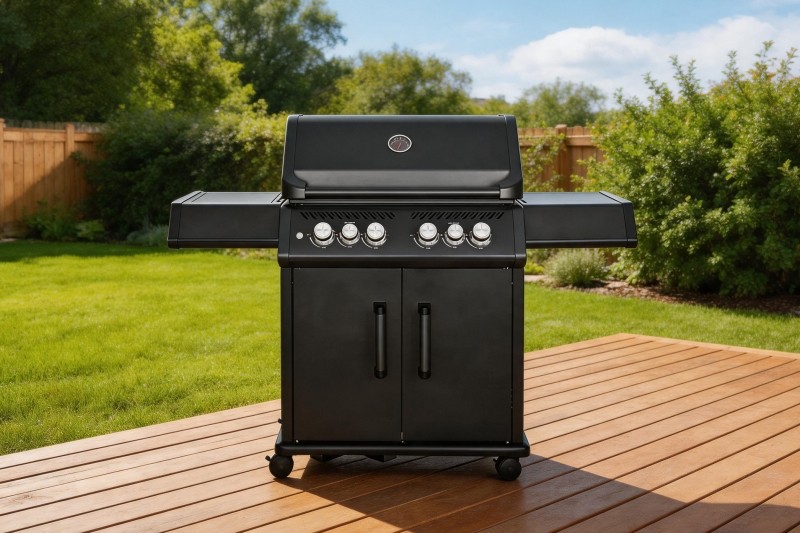
KYQ-A480RB gas BBQ grill with a full cast aluminum chamber and 800°C infrared side burner — built for 15+ years of service in coastal climates. View product.
Cooking Grates and Heat Management
Grates take more abuse than any other component. Three families dominate:
Cast iron grates — best heat retention and sear marks, but uncoated iron needs seasoning and dry storage. Porcelain-enameled cast iron is easier to maintain; the trade-off is that the coating can chip.
Porcelain-enameled steel — light and common on entry-level grills, but thin wires lose heat fast and the coating flakes after 1–3 seasons.
Thick stainless steel rods (7 mm or more) — easiest to keep clean, very durable (10+ years), and excellent for searing.
Above the burners, look for flavorizer bars or heat tents. They catch dripping grease, vaporize it into smoke for flavor, even out heat distribution across the grate, and protect the burners from corrosive drippings — which is the single biggest factor in burner lifespan. Below them, a grease management system (a removable tray or drip pan) is a fire-safety requirement, not a convenience: clogged grease channels are a leading cause of grill fires. When sourcing, ask the factory how the grease path drains and whether the tray is tool-free to remove.
Size and Configuration: Portable, Freestanding and Commercial
Configuration is the first decision most buyers make. Freestanding grills dominate global sales at roughly 58% of revenue because they roll into position and need no construction. Built-in models require a permanent outdoor kitchen and gas-line hookup. Portable grills — typically two-burner units under 30 inches — suit apartments, camping, tailgating and small commercial pop-ups. Our guide to Built-in vs Freestanding vs Portable Gas Grills covers the full comparison, and the market context is in Outdoor Kitchen Trends 2026.
Here is how the three decisions — burner count, materials and size — land on real products from Kangye's gas grill line:
KYQ-M22
KYQ-193RB
KYQ-61S
Positioning
2-burner portable
3-burner premium
6-burner commercial
Heat output
6.3 kW total
19 kW total
18.9 kW total
Special burners
—
800°C infrared side burner + rear burner
Side burner
Chamber / lid
Black coating, SUS430 lid
Cast aluminum, SUS443 hood
Enamel firebox, SUS430 lid
Cooking surfaces
2 enamel grids
3 cast iron grids
2 cast iron grids + cast iron plate
Dimensions
1117 × 567 × 1143 mm
1370 × 615 × 1187 mm
1645 × 545 × 1150 mm
MOQ
40HQ / 413 pcs
40HQ / 216 pcs
40HQ / 160 pcs
Each model answers a different brief: the KYQ-M22 for a compact, easy-to-move grill with a low container cost per unit; the KYQ-193RB for a feature-rich premium grill with infrared searing; and the KYQ-61S for a heavy-duty commercial unit with mobile trolley and enamel firebox. All three are available for OEM/ODM with your branding.
Featured Product
KYQ-M22 2-Burner Portable Gas BBQ Grill 6.3 kW
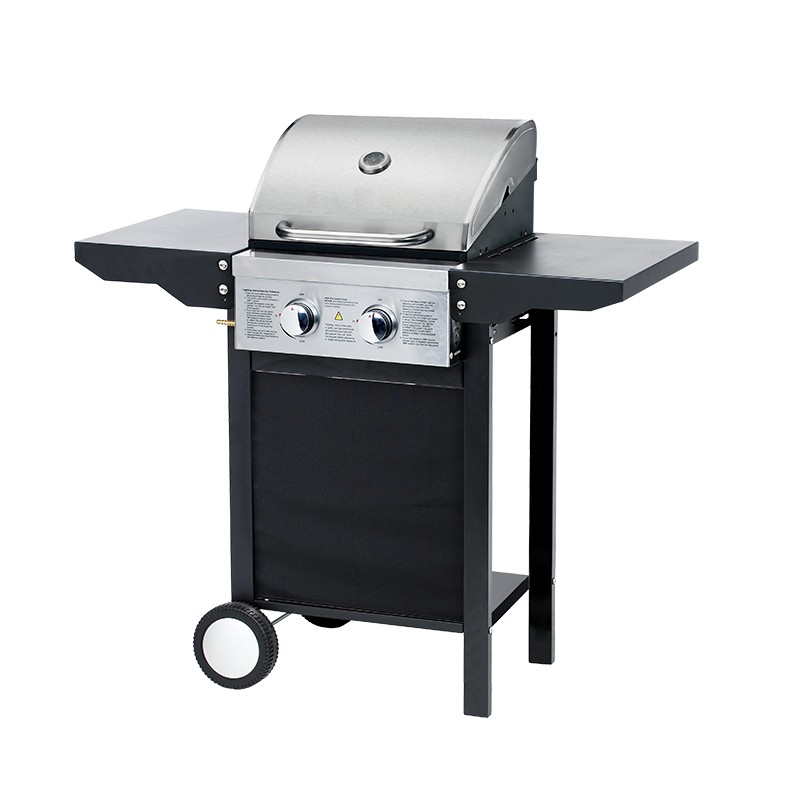
Compact two-burner grill with 2 wheels, enamel cooking grids and SUS430 lid. Total 6.3 kW (3.15 kW per burner), 1117 × 567 × 1143 mm. Ideal for apartments, camping and small commercial pop-ups.
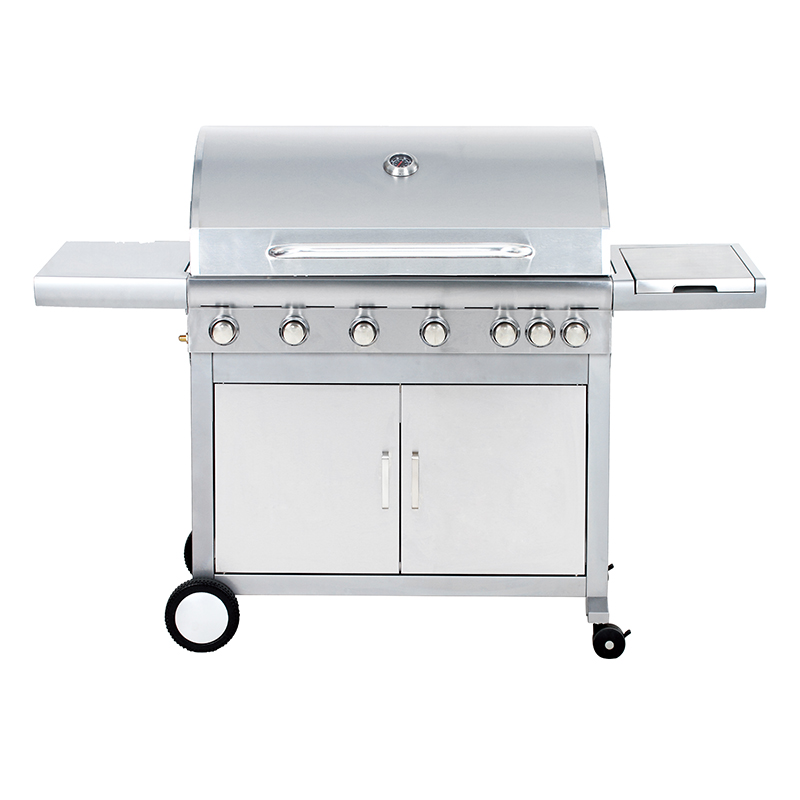
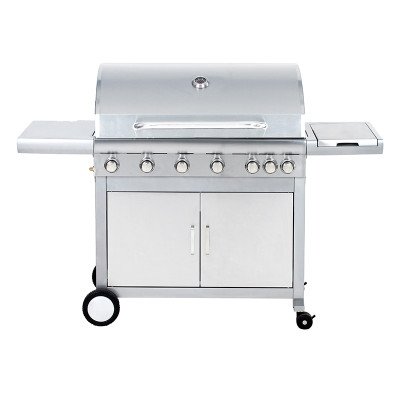
Commercial-grade freestanding grill: 2 cast iron grids plus a cast iron plate, side burner, enamel firebox, SUS430 lid and panel, mobile trolley. 1645 × 545 × 1150 mm; MOQ 40HQ/160 pcs.
Cast aluminum chamber and lid with SUS443 stainless hood, 3 × 3.5 kW main burners, a 4.5 kW infrared side burner reaching 800°C, and a 4.0 kW rear burner. 3 cast iron grids; MOQ 40HQ/216 pcs.
Compliance, Certifications and Sourcing for Importers
Specs only matter if the product clears your destination market. Gas grills are regulated as gas-burning appliances, which means certification is not optional. For European markets, plan for CE marking under the Gas Appliances Regulation plus relevant standards, with RoHS and REACH compliance for materials. For North America, look for UL or ETL listing and ANSI Z21.58 / CSA 1.6 coverage for outdoor cooking gas appliances; retail buyers typically require this documentation before they will even look at your line sheet. Food-contact parts (grates, plates) should meet LFGB or FDA food-contact requirements, and markets like Australia may require SAA approval. Our Export Compliance Guide walks through the full landscape.
From a sourcing standpoint, Kangye supports 11+ certifications (ISO9001, CE, GS, ETL, CB, BSCI, RoHS, REACH, LFGB, FDA, SAA), offers trial orders from one 40HQ container per model for new partnerships, and runs standard lead times of 35–45 days with 45–60 days for custom programs. When you request a quote, ask the factory to confirm which certificates cover the specific model and destination — the certificate list on a website is not the same as the certificate file for your SKU. For a step-by-step framework, see Sourcing OEM Kitchen Appliances from China and the 2026–2027 US Kitchen Appliance Market outlook.
Checklist: 10 Questions Before You Place an Order
Who cooks and how often? Match burner count to regular crowd size, not the annual party.
What is the primary cooking area? Compare primary grate area, not "total" including warming racks.
Is the heat density competitive? Divide kW by cooking area and compare ratios across suppliers.
Which materials match the destination climate? Coastal markets justify 304 stainless or cast aluminum; inland budgets can use enamel.
What grade is the burner? Thick-gauge 304 is the durability benchmark; 430 rusts faster in humid markets.
Are grates suited to the use? Cast iron for sear marks and heat retention; stainless rods for low maintenance.
Does the grease system drain safely? Removable tray, clear drain path, no clog points.
What certifications ship with the SKU? CE/GS for EU, UL/ETL for North America, plus RoHS/REACH/LFGB/FDA as applicable.
Is the container plan realistic? Check MOQ and carton dimensions against your logistics budget.
Can the factory prove it? Ask for factory audit reports, test records and customer references — then verify.
FAQ: Choosing a Gas BBQ Grill
How many burners do I need on a gas grill?
Two burners for 2–4 people on a compact footprint; three burners for most families (4–8 people) with proper two-zone cooking; four for regular entertaining; five or more only for large gatherings or commercial use. More burners mean more fuel consumption and more parts to maintain.
Does a higher BTU rating mean better grilling?
No. BTU measures fuel input, not cooking quality. What matters is heat density (BTU or kW per unit of cooking area), burner placement, heat diffusers and firebox construction. A compact 6 kW grill can sear better than a large 14 kW grill with poor heat distribution.
What is the best material for a gas grill?
For the firebox and lid: cast aluminum and 304 stainless last 15+ years; 430 stainless lasts 3–8 years and rusts faster in humid or coastal climates; porcelain enamel is affordable but chips. For burners, thick-gauge 304 stainless is the commercial benchmark, with cast brass at the premium end.
What size gas grill does a restaurant need?
A commercial kitchen typically needs 5–6 burners with 600+ sq in of primary area, plus a side burner and, ideally, infrared searing. A model like the KYQ-61S (18.9 kW, 6 burners, mobile trolley) is sized for continuous service; confirm uptime, parts availability and serviceability before ordering.
How do I calculate the cooking area I need?
Allow roughly 100 cm² per burger and 150 cm² per steak, multiply by your usual guest count, and add about 30% for spacing between items. That gives your minimum primary cooking area. Always compare primary grate area rather than the advertised "total area."
Are cast iron grates better than stainless steel?
It depends on priorities. Cast iron retains heat and produces the best sear marks but needs seasoning and dry storage. Thick stainless steel rods (7 mm+) are lower-maintenance and very durable. Porcelain-enameled cast iron sits between the two, with the caveat that the coating can chip.
How Kangye Can Help You Source the Right Gas Grill
Kangye is a kitchen appliance manufacturer in Guangdong, China, with 35+ years of OEM/ODM experience exporting to 100+ countries. Our gas grill line covers portable 2-burner units, premium 3-burner models with infrared side burners, and commercial 6-burner grills — each available with private-label branding, destination-market certifications and trial-order MOQs.
Tell us your target market and volume, and we will send spec sheets, certificate files and container-loading plans. Contact our team or browse the full range on our product list .
Since its establishment in 1989, Kangye Electric Appliances has always focused on the research and development and manufacturing of kitchen appliances and outdoor cooking utensils.