Quick Answer: What Do the 2026 Energy Efficiency Regulations Mean for Kitchen Appliance Importers?
In 2026, energy efficiency is no longer a marketing bullet point — it is a gatekeeping requirement with hard compliance dates. In the United States, new Department of Energy (DOE) standby power standards for microwave ovens took effect June 22, 2026, while DOE simultaneously proposed rewriting the rulebook that governs future appliance standards. In the European Union, Regulation (EU) 2023/826 already caps off-mode and standby power for kitchen appliances at 0.5 W (Phase I, effective May 9, 2025) and tightens it to 0.3 W on January 1, 2027, with market surveillance authorities in Germany, France, Italy and the Netherlands targeting air fryers and small kitchen appliances in 2026. Any importer sourcing food dehydrators, air fryers, steamers, grills or other small kitchen appliances from China this year must verify standby power, energy labels and database registration before committing container space — the penalties, from customs holds to fines of up to €100,000 in the EU, land on the importer, not the factory.
Key takeaway: the appliance energy efficiency regulations of 2026 are a sourcing problem, not just a design problem. The rules that bite are the ones with fixed dates — the EU 0.3 W standby limit on January 1, 2027, DOE's amended microwave standards already in force, the A–G energy label rescale completed July 2025, and California's Title 20 MAEDbS registration for covered categories. Products ordered today must be designed for the 2027 limits, because a hardware-level redesign cannot be done in a shipping container. Verify standby power at the specification level, ask for the full test report, and confirm database registration before you sign the purchase order.
Why Appliance Energy Efficiency Regulations Are Front and Center in 2026
Energy efficiency regulation has quietly become the most consequential compliance layer for small kitchen appliances — not because a single dramatic rule landed, but because several dated milestones landed together. On the US side, the DOE's amended energy conservation standards for microwave ovens took effect June 22, 2026, capping standby power at 0.6 W for countertop microwave and convection microwave units and 1.0 W for built-in and over-the-range convection models. The DOE's own analysis estimates average life-cycle cost savings of $0.99 per microwave-only unit and $0.83 per built-in convection unit, with simple payback of 1.3 and 0.8 years respectively — the point being that standby power caps deliver measurable consumer savings while imposing real redesign costs on manufacturers.
At the same time, the DOE issued a Notice of Proposed Rulemaking on July 2, 2026 to overhaul its "Process Rule" — the procedural framework it uses to set future appliance standards. The proposal would require any new standard to demonstrate "significant energy savings" (at least a 10% reduction in full-fuel-cycle energy use over 30 years, or a 2-quad reduction) before rulemaking proceeds, and adds economic screens tied to installed-cost increases and payback periods. Whatever one thinks of the policy direction, the commercial consequence for importers is clear: the pace of new federal standards is slowing, but the standards already on the books — and the EU's tightening schedule — are not going away. Regulatory certainty about what is required today is higher than it has been in years; the risk has shifted to products that were certified years ago against older versions of standards.
Across the Atlantic, the EU has moved decisively. Commission Regulation (EU) 2023/826 replaced the old standby framework (EC) No. 1275/2008 and explicitly lists household kitchen appliances — ovens, hobs, microwaves, toasters, air fryers and coffee makers — as covered product categories. The regulation's Phase I limits have been enforceable since May 9, 2025, and Phase II arrives January 1, 2027. Market surveillance authorities in Germany, France, Italy and the Netherlands have made air fryers, coffee makers and multi-cookers priority categories for spot-checks in 2026. Our 2026–2027 US kitchen appliance market guide and our export compliance guide provide the broader market and certification context.
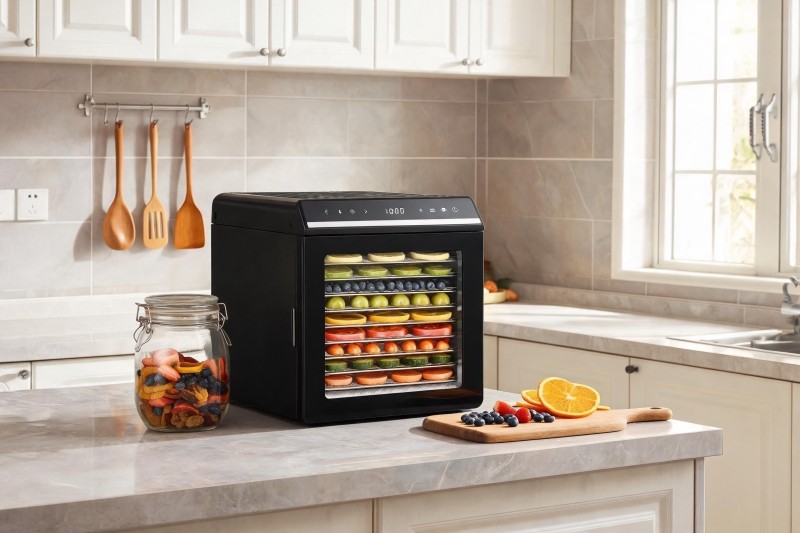
KYS-315 series: digital control panel and BPA-free stainless steel trays — view product details
The US Landscape: DOE Standards, ENERGY STAR and the 2026 Shift
For importers selling into North America, the US regulatory picture in 2026 has three layers: federal DOE standards (mandatory), ENERGY STAR specifications (voluntary but commercially decisive), and state-level rules such as California's Title 20 (mandatory for the state). Each layer changed in 2026 in ways that affect sourcing decisions.
At the federal level, the amended microwave oven standard is the marquee 2026 event because it is the first appliance standard in years to regulate standby power as the primary metric — a signal of where DOE is headed for the rest of the countertop category. The final rule, published June 2023 and effective for products manufactured or imported into the US on or after June 22, 2026, sets maximum average standby power of 0.6 W (countertop microwave-only and countertop convection microwave ovens) and 1.0 W (built-in and over-the-range convection microwave ovens). DOE projects the standards to save 0.06 quads of energy over 2026–2055 — about 19% of the energy the product class would otherwise use — with total conversion costs to industry of $46.1 million. In plain terms: if your microwave-oven product (or a product with a microwave module) has a digital clock or LED standby draw above the limit, it is non-compliant as of the effective date.
On the voluntary side, ENERGY STAR continues its rolling specification updates, and 2026 is a busy year. The December 2025 ENERGY STAR program-planning materials show room air conditioners transitioning to Version 7.0 (anticipated effective 2026), dehumidifiers already on Version 6.0 (effective October 1, 2025), room air cleaners on Version 3.0 (effective October 9, 2025), and furnaces on Version 5.0 (effective July 31, 2026). None of these directly governs a food dehydrator, but the pattern matters for the small-appliance shelf: retailers such as Amazon, Walmart, Best Buy and Home Depot increasingly filter listings by ENERGY STAR and efficiency claims, and an efficiency claim without an ENERGY STAR certification is a compliance risk under the FTC's Green Guides.
| US Milestone | Date | What It Requires |
|---|
| DOE amended microwave oven standards | Effective June 22, 2026 | Standby ≤ 0.6 W (countertop), ≤ 1.0 W (built-in / OTR convection); applies to products manufactured or imported into the US from that date |
| DOE Process Rule NPRM | July 2, 2026 (comments due Aug 6, 2026) | Proposes "significant energy savings" threshold (≥10% over 30 yrs or ≥2 quads) and economic screens before future standards proceed |
| ENERGY STAR Room AC Version 7.0 | Anticipated effective 2026 | Stricter efficiency criteria for room air conditioners |
| ENERGY STAR Dehumidifiers V6.0 | Effective Oct 1, 2025 | New efficiency tiers; affects dehumidifier-adjacent sourcing |
| ENERGY STAR Furnaces V5.0 | Effective July 31, 2026 | Updated criteria; demonstrates the rolling upgrade cadence |
| California Title 20 (CEC) | Continuous; MAEDbS registration required | 58+ appliance categories; state energy efficiency certification and database listing before sale in California |
The strategic read for importers is that federal standards are becoming less frequent but more targeted, while voluntary programs and state rules keep tightening. A product line designed to the strictest current reference (the EU's 0.3 W target, for example) comfortably clears every US standby requirement on the horizon — which is why forward-looking OEMs design once and certify everywhere. Our electrical ratings guide explains why voltage, frequency and power specifications are the foundation of every market-compliant design.
The EU Ecodesign Framework: Regulation (EU) 2023/826 and the 0.5 W Standby Limit
If there is one rule every importer of kitchen appliances into Europe must know by heart in 2026, it is Regulation (EU) 2023/826. This ecodesign regulation governs off-mode, standby and networked standby power for a wide range of energy-related products — and, for the first time, it explicitly names household kitchen appliances including ovens, hobs, microwaves, toasters, air fryers and coffee makers as covered categories. Its standby limits apply through the ErP (Energy-related Products) framework of Directive 2009/125/EC, which is part of the CE marking package.
The regulation works in two phases. Phase I, in force since May 9, 2025, caps off-mode and standby-without-display at 0.5 W (down from the previous 1.0 W — a 50% cut), standby with a display (clock, LED panel) at 0.8–1.0 W, and networked standby for standard devices at 2.0 W. It also requires automatic power management: devices must switch to a low-power mode within 20 minutes of inactivity, and this setting must be enabled by default from the factory. Phase II, effective January 1, 2027, tightens off-mode and standby-without-display to 0.3 W (a further 40% reduction) and standby-with-display to 0.5 W, while networked standby stays at 2.0 W.
| Mode | Phase I (since May 9, 2025) | Phase II (from Jan 1, 2027) | Change |
|---|
| Off mode | ≤ 0.5 W | ≤ 0.3 W | −40% |
| Standby — no display | ≤ 0.5 W | ≤ 0.3 W | −40% |
| Standby — with display | ≤ 0.8–1.0 W | ≤ 0.5 W | −38–50% |
| Networked standby (standard devices) | ≤ 2.0 W | ≤ 2.0 W | No change |
| Automatic power management | Device must enter low-power mode within 20 minutes of inactivity, factory-enabled by default |
The practical implication for H2 2026 purchasing is blunt: any smart or digitally-controlled kitchen appliance ordered today that is not already designed for the 2027 off-mode limit of 0.3 W will require a hardware-level redesign before January 1, 2027. That means new power-supply architecture, possibly a different display driver, and new test reports — a process that typically takes months and must be certified by an accredited lab. Importers signing multi-year supply agreements should include a 2027 compliance upgrade clause, or risk stranded inventory. Market surveillance is active and targeting exactly this category: German, French, Dutch and Italian authorities have prioritized air fryers, coffee makers and multi-cookers for ErP spot-checks in 2026, and products that fail standby tests face market withdrawal, financial penalties and potential import bans.
ErP is only one pillar of the CE package, and the 2025/2026 standard updates raised the bar across the board. The electrical safety side now runs on EN IEC 60335-1:2025 (the 2020 edition with Amendment 1, mandatory for many product types in 2026), the EMC side on Directive 2014/30/EU with stricter limits for switch-mode power supplies, and smart/Wi-Fi devices must additionally satisfy the cybersecurity requirements of RED Annex U. A "CE certificate" from 2023 is increasingly worthless at the border — customs and market surveillance now verify the underlying test data, not the paper. As we detailed in our export compliance guide, the compliance package an importer needs from the factory is no longer a one-page certificate but a full technical file: 50–100 pages of test reports, the NANDO-listed lab's registration number, model-by-model coverage, and the declaration of conformity.
EU Energy Labels: The A–G Rescale and EPREL Registration
Parallel to the standby-power rules, the EU's energy labelling framework (Regulation (EU) 2017/1369) completed its rescale to the new A–G scale on July 1, 2025, retiring the old A+++/A++/A+ system. Products covered by a delegated act — which for the kitchen category includes ovens, hobs, dishwashers, refrigerators and, in the small-appliance space, items such as vacuum cleaners and air conditioners — must display the new label showing the energy class, annual consumption, and a QR code linking to the product's record in the EU's EPREL database.
Three compliance details matter most for importers. First, EPREL registration must be performed by a responsible economic operator established in the EU — a non-EU manufacturer cannot register directly, so you need an EU authorized representative with a signed agreement. Second, the technical documentation must be retained for 10 years after the last unit is placed on the market. Third, the label data must match the test report exactly: label model, nameplate model and EPREL entry must be identical, and discrepancies are a common reason registrations are rejected — or shipments held. Aesthetic aside: since July 2025, the label itself must be printed at least 36 × 72 mm on the product or packaging, and e-commerce listings must display the label and data-sheet images in the product gallery.
For product categories without a specific delegated act — which today includes most food dehydrators — the energy label requirement does not apply, but the standby rules and the CE package still do. This distinction is exactly the kind of nuance that trips up importers, and it is worth confirming category-by-category with your supplier's compliance engineer rather than assuming "no label means no rules."
California Title 20 and the MAEDbS Database: The State Layer
US importers often assume federal preemption means state rules cannot add requirements — and it is true that, once a DOE standard covers a product category, states generally cannot set separate energy efficiency rules for it. But two things keep state compliance real. First, California's Title 20 covers categories that DOE does not regulate at all (state-only standards), and second, even for federally covered products, California requires the manufacturer or importer to certify the product in the CEC's Modernized Appliance Efficiency Database System (MAEDbS) before it can be sold in the state. The California Energy Commission administers Title 20 under Division 15 of the Public Resources Code, and it enforces through the public MAEDbS database: any consumer, competitor or regulator can look up a model number, and a product that is not registered — or that is registered with inaccurate data — is subject to enforcement actions including penalties of up to $2,500 per unit and mandatory removal from sale.
Title 20's 58+ covered categories include refrigeration, heating and cooling equipment, water heaters, plumbing fittings, lighting, electronics, external power supplies and battery chargers. For a food dehydrator with an external power adapter or a digital display, the applicable Title 20 provisions are typically the external power supply (EPS) efficiency requirements — so a supplier's EPS must carry its own CEC-listed efficiency data even though the dehydrator itself is not a covered product. The same logic applies in other states: Maryland, for example, enforces its own appliance efficiency standards from January 1, 2025, for a set of covered products including commercial dishwashers and showerheads, and several states are tracking California's approach. The sourcing implication is simple: ask your OEM partner which states their certifications cover, and whether the power supply components are independently listed. Our OEM sourcing guide covers how to structure these verification questions in a factory audit or RFQ.
What These Rules Mean for Food Dehydrators and Other Small Appliances
Food dehydrators occupy a slightly unusual regulatory position in 2026, and it is worth being precise rather than alarmist. On the US side, there is no federal DOE standard for dehydrator active-mode energy consumption — dehydrators are not currently a covered product under EPCA. On the EU side, there is no delegated energy-label act specifically for dehydrators. But that does not make dehydrators unregulated; three requirements apply to essentially every model on the market:
- Standby and off-mode power (EU ErP 2023/826): a digitally-controlled dehydrator with an LED display, clock or touch panel must meet the 0.5 W (Phase I) and 0.3 W (Phase II) limits for off-mode and standby, and must auto-enter low-power mode within 20 minutes. Dehydrators with a mechanical thermostat and no display can be designed to draw essentially zero in the off state, which is one reason simpler controls have a compliance advantage.
- CE package for the EU (LVD, EMC, ErP, RoHS): the appliance must satisfy EN IEC 60335-1:2025 and the relevant part 2 standard, EMC Directive 2014/30/EU, RoHS/REACH material rules, and food-contact requirements for trays and any surfaces that touch food. The safety standard for food dehydrators is typically IEC 60335-2-9 (grills, toasters and similar portable cooking appliances) or the closest applicable part-2 standard depending on the design.
- Component-level registration (US state rules): if the dehydrator ships with an external power supply, that EPS must meet the federal EPS standards and California's Title 20 requirements, with MAEDbS listing where applicable.
Beyond compliance, active-mode efficiency is where honest engineering shows up. A 600–700 W dehydrator running for 8–12 hours draws 4.8–8.4 kWh per batch — the dominant operating cost of the appliance. The design levers that actually matter are the heating technology (PTC ceramic elements reach 95–99% conversion efficiency and self-regulate, versus nichrome wire's 500–800-hour element life and lower part-load efficiency — we explored this in our heating systems explainer), airflow design (rear-mounted horizontal airflow dries evenly at the same wattage as less efficient layouts — see our temperature control article), and honest control features such as a fan-only mode that dries herbs and flowers at room temperature with heating off. When a supplier quotes "energy efficient," ask for the test report and the standby measurement — not a marketing line.
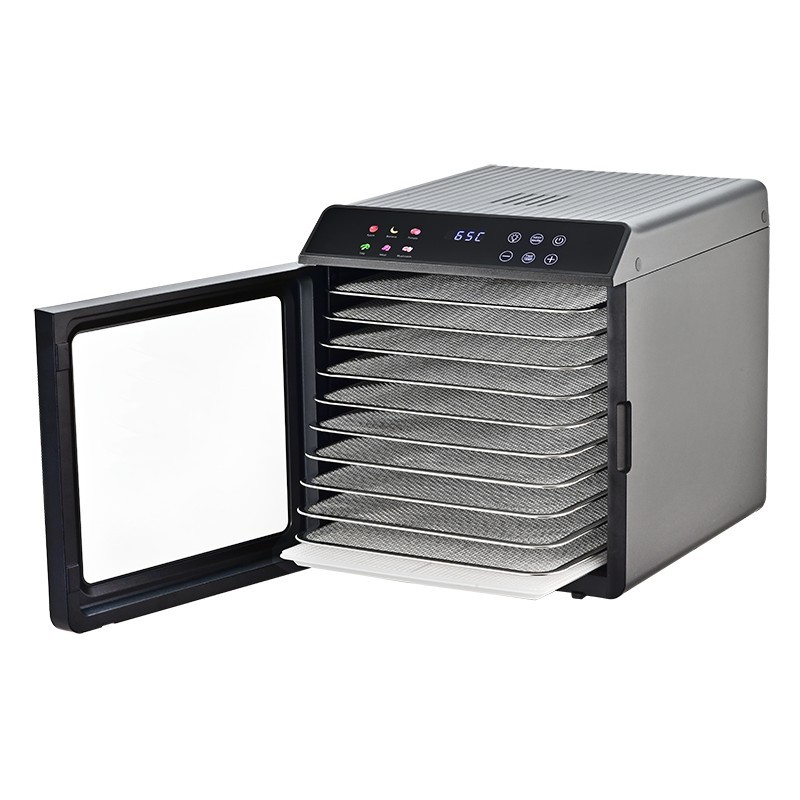
KYS-315 series: digital control panel and BPA-free stainless steel trays — view product details
A Compliance Checklist for Importers Sourcing from China in 2026
Energy efficiency compliance is verifiable at the specification level, and importers should treat it like any other critical spec: written into the RFQ, tested before production, and re-verified before shipment. Here is the checklist we recommend walking through with any potential OEM/ODM partner:
- Request the standby power data sheet for each model: off-mode, standby-no-display, standby-with-display and networked standby values in watts, measured per EN 50564 (EU) or the applicable DOE test procedure. Insist on the measured numbers, not the "designed to meet" language.
- Confirm the 2027 Phase II headroom: for EU-bound products, the model must already meet 0.3 W off-mode/standby, or the supplier must commit in writing to a hardware redesign with a dated plan. A product at 0.5 W today is compliant today and non-compliant in nine months.
- Verify the 20-minute auto low-power mode is factory-enabled by default — a setting the end user can change must still ship enabled.
- Ask which energy labels apply and who registers: for covered categories, confirm the EU EPREL registration (via your EU authorized representative), the A–G label artwork, and the QR code linkage; for the US, confirm whether any ENERGY STAR or CEC MAEDbS registration is needed or planned.
- Review the full test report, not the certificate: check the lab's NANDO registration, the model numbers covered, and that the test report matches the label and nameplate data exactly. A "certificate" that covers only 3 of 20 clauses is not compliance.
- Check component-level listings: external power supplies and battery chargers must individually satisfy US EPS and California Title 20 requirements; food-contact plastics must be documented (LFGB or FDA 21 CFR) per our compliance guide.
- Build the efficiency story into the product spec: for retail channels, documented standby performance and (where applicable) ENERGY STAR qualification convert regulatory compliance into shelf-level marketing — and Gen X buyers, the highest-spending demographic in the appliance market, prioritize durability and energy savings (79%) when choosing appliances, a point we developed in our holiday sales guide.
Finally, keep the tariff and cost picture in view: the tariff environment has been volatile, and 85% of US consumers already expect prices to rise, so efficiency compliance should be engineered into the cost base rather than bolted on later. Our tariff and trade policy guide tracks the current duty landscape, and our private label guide shows how to turn a compliant, efficient product into a brand asset.
Featured Product: Kangye KYS-315 10-Tray Food Dehydrator
Featured Product: KYS-315 10-Tray Home Food Dehydrator (600–700W)
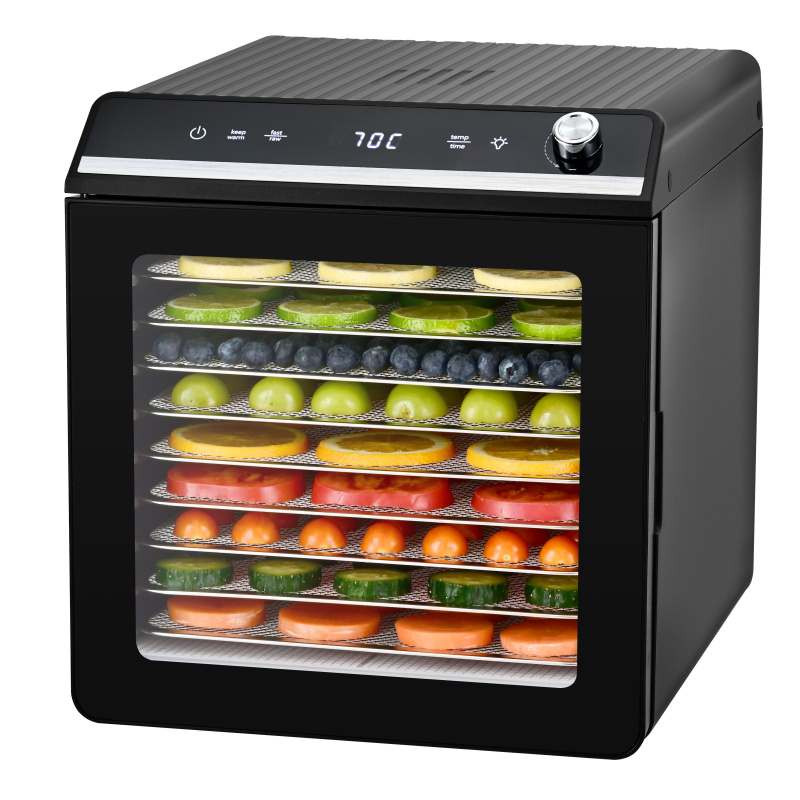
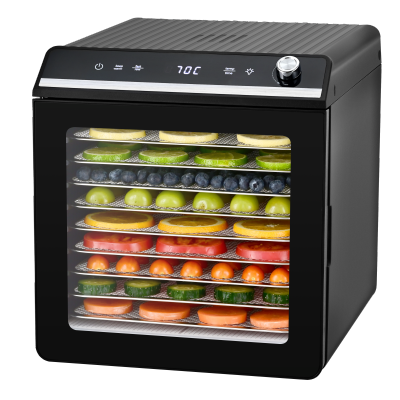
The KYS-315 series 10-tray food dehydrator is engineered for efficiency where it counts: a 600–700W rear-mounted horizontal airflow system dries evenly across all ten BPA-free stainless steel trays without tray rotation, an adjustable 35–75°C (95–167°F) range and a 0.5–48 hour timer let users match energy input to the job, and a fan-only function dries herbs and flowers with the heating element off — drawing a fraction of the power of a full dry cycle. A transparent glass door with interior LED lighting means users never open the door to check progress, avoiding heat loss that wastes energy. Four models (E/F/G/H) cover different color and feature configurations for private-label programs.
- 600–700W, 220–240V 50/60Hz; rear-mounted horizontal airflow
- 35–75°C (95–167°F) adjustable; 0.5–48H timer; fan-only mode
- 10 × BPA-free stainless steel trays (275 × 250 mm) + fruit roll tray
- Digital control; glass door with interior LED lighting
- MOQ from 539 pcs (20GP); CE, RoHS, FDA-compliant materials; OEM/ODM ready
View KYS-315 product details
FAQ: Energy Efficiency Regulations for Kitchen Appliances, Answered
What is the most important energy efficiency regulation for kitchen appliances in 2026?
For the EU, it is Regulation (EU) 2023/826: off-mode and standby-without-display power must be ≤ 0.5 W since May 9, 2025, and drops to ≤ 0.3 W on January 1, 2027, with devices required to auto-enter low-power mode within 20 minutes. For the US, the headline event is the DOE's amended microwave oven standards effective June 22, 2026 (standby ≤ 0.6 W countertop / ≤ 1.0 W built-in), plus the ongoing ENERGY STAR specification updates and California Title 20 registration.
Do energy efficiency regulations apply to food dehydrators?
Partially. There is no federal DOE standard or EU delegated energy-label act specifically for food dehydrators today. But EU standby/off-mode limits (2023/826) apply to any digitally-controlled dehydrator with a display, the CE package (LVD, EMC, ErP, RoHS, food-contact) always applies, and external power supplies must meet US EPS and California Title 20 requirements. Verify the standby measurement and component listings with your supplier rather than assuming exemption.
When does the EU standby limit tighten to 0.3 W?
January 1, 2027. Off-mode and standby-without-display drop from 0.5 W to 0.3 W, and standby-with-display drops to 0.5 W. Any product ordered today should already be designed for the Phase II limits, because retrofitting requires a hardware-level redesign plus new test reports.
What is EPREL and do I need to register my products?
EPREL is the EU's energy label product database. Products covered by an energy-label delegated act must be registered in EPREL with the label artwork displayed and a QR code linking to the record. Registration must be done by an economic operator established in the EU (typically your EU authorized representative), and technical documentation must be kept for 10 years.
How can I verify a supplier's energy efficiency claims?
Ask for the full test report, not a certificate: the measured standby power values (per EN 50564 or the applicable DOE test procedure), the lab's NANDO registration, the exact model numbers covered, and the label/nameplate/EPREL data consistency. For EU-bound products, confirm the 20-minute auto low-power mode is factory-enabled. Treat "energy efficient" in a quotation as a claim to be evidenced, not a spec.
What happens if a product fails energy efficiency checks at the border or in retail?
In the EU, non-compliant products face market withdrawal, financial penalties (fines can reach €100,000), and potential import bans — with the cost landing on the importer. In California, products sold without MAEDbS registration can draw penalties up to $2,500 per unit plus removal from sale. Market surveillance in Germany, France, Italy and the Netherlands is prioritizing air fryers and small kitchen appliances in 2026.
Summary: Compliance Is a Spec, Not a Story
Summary: the appliance energy efficiency regulations of 2026 are defined by hard dates — DOE's amended microwave standards effective June 22, 2026, the EU ErP standby limits already at 0.5 W and tightening to 0.3 W on January 1, 2027, the completed A–G energy label rescale with EPREL registration, and California Title 20's MAEDbS database for covered categories. Small appliances such as food dehydrators are not exempt: EU standby rules and the CE package apply, component-level listings (EPS, battery chargers) apply in the US, and the 2027 Phase II limits force hardware decisions today. For importers, the winning move is treating efficiency as a verifiable specification — measured standby power, full test reports, model-by-model certification coverage, and database registration — written into the RFQ and confirmed before production. Kangye, an OEM/ODM manufacturer in Guangdong, China with 35+ years of experience exporting to 100+ countries, designs and verifies products against these requirements across its dehydrator, grill, air fryer, steamer, vacuum sealer and pet appliance lines.
- EU-bound products must meet 0.5 W standby today and 0.3 W from January 1, 2027 (EU 2023/826).
- US microwave standards effective June 22, 2026; ENERGY STAR specs and California Title 20 keep tightening.
- Verify measured standby power and full test reports — not certificates — before signing the PO.
- Confirm EPREL registration (EU), MAEDbS listing (CA) and 20-minute auto low-power mode by default.
- For dehydrators, prioritize efficient heating, even airflow and fan-only mode — efficiency that shows up in operating cost.
Planning a 2026–2027 appliance program and need help navigating energy efficiency compliance? Kangye is an OEM/ODM manufacturer based in Guangdong, China, with 35+ years of manufacturing experience and exports to 100+ countries. Our product line covers food dehydrators, outdoor and indoor electric grills, BBQ gas grills, pizza ovens, air fryer ovens, electric steamers, vacuum sealers, and pet feeders and water fountains — with dual-voltage options, certification packages (CE, GS, ETL, CB, BSCI, RoHS, REACH, LFGB, FDA, SAA), private label programs, and compliance documentation built into every order. Contact our team to review your target markets and certification requirements, or browse the full product range .