Home / All / Buyer's Guide / Pet Tech Market Outlook: Smart Feeders and Fountains in 2026
Pet Tech Market Outlook: Smart Feeders and Fountains in 2026
Sep 4,2026
Pet Tech Market 2026 at a Glance: Smart Feeders and Fountains
The pet tech market in 2026 is one of the fastest-growing niches in small appliances, and the growth is concentrated exactly where Kangye builds: automatic feeders and water fountains. Across reputable trackers, the automatic and smart pet feeder market is estimated at roughly US$2.2–2.7 billion in 2026 (TBRC: US$2.2B, CAGR 12.5%; 360iResearch: US$2.69B, CAGR 9.09%), while the pet water fountain market runs to about US$1.3 billion on a narrow product definition (pmarketresearch: US$1.29B in 2025, reaching US$2.05B by 2032 at a 6.85% CAGR) and far higher on broader definitions that include bowls and dispensers. North America still holds the largest share (about 40–42%), Asia-Pacific is the fastest-growing region, and the structural drivers — pet humanization, the veterinary weight crisis, and connected-home adoption — are not slowing. For importers, the commercial question in 2026 is no longer whether pet tech will sell, but which models, at what price point, and from which factory will survive a market that is consolidating around reliability, compliance and honest feature claims.
Key takeaway: the smart pet feeder and fountain categories are in a "volume up, ASP down" phase — unit sales are climbing faster than revenue in many price bands, and margin is migrating to brands that combine precise, dependable hardware with genuine differentiation (dual-power backup, quiet cordless pumps, food-safe materials, meaningful app features). Buyers who lock in an OEM/ODM partner with certified food-contact materials, documented battery and radio compliance, and real reliability testing will be better positioned than buyers chasing the lowest landed cost on undifferentiated hardware.
How Big Is the Pet Tech Market in 2026?
The honest answer is: it depends on the definition, and reading the range is part of the job. The pet tech market can mean anything from GPS collars and cameras to feeders, fountains and litter boxes. Persistence Market Research (April 2026) sizes "pet tech products" at US$15.9 billion in 2026, growing to US$36.3 billion by 2033 at a 12.5% CAGR, with North America at 41.8% of the global market and Asia-Pacific the fastest-growing region at a 15.4% CAGR. Global Growth Insights puts the figure at US$13.56 billion in 2026 and US$65.06 billion by 2035 (19.03% CAGR) on a wider scope. The variance is definitional — but every methodology agrees growth is in the double digits.
Within that landscape, feeding and hydration hardware is the most import-relevant slice — manufactured in volume, shipped by container, and sold through channels appliance importers already know. Our earlier market analysis on the pet feeder and fountain buying guide and the pet tech boom industry review documented the same acceleration from the demand and manufacturing sides.
Market Segment
2025 / 2026 Base
Forecast
CAGR
Source
Pet tech products (broad)
US$15.9B (2026E)
US$36.3B by 2033
12.5% (2026–2033)
Persistence Market Research
Pet tech (connected devices scope)
US$13.56B (2026E)
US$65.06B by 2035
19.03% (2026–2035)
Global Growth Insights
Automatic & smart pet feeders
US$2.2B (2026E)
US$3.5B by 2030
12.3% (2026–2030)
The Business Research Company
Automatic & smart pet feeders
US$2.69B (2026E)
US$4.55B by 2032
9.09% (2026–2032)
360iResearch
Pet water fountains (narrow)
US$1.29B (2025)
US$2.05B by 2032
6.85% (2025–2032)
pmarketresearch / PW Consulting
Connected pet ecosystem
US$3.0B (2026E)
US$9.2B by 2034
15.0% (2026–2034)
Stratistics MRC
Two structural points matter more than the exact base year. First, cats are the fastest-growing pet-type segment (13.3% CAGR per PMR) — and cats are also the primary users of fountains and portion-controlled feeders, which is why cat-oriented models lead new launches. Second, per-pet smart-device penetration is still young: IndexBox's China work estimates it climbed from under 9% in 2020 to roughly a third by 2026, and because feeders and fountains carry a longer 4–6 year replacement cycle than bowls, the installed base is still being created — with a replacement wave expected around 2030–2032.
Smart Pet Feeders: Portion Control Meets the Veterinary Weight Crisis
The feeder category's growth is unusually well-supported by an authoritative health narrative. The Association for Pet Obesity Prevention (APOP) reports that roughly 59% of dogs and 61% of cats in the United States are clinically overweight or obese, and its 2025 Pet Weight and Nutrition Opinion Survey found only 37% of dog owners and 43% of cat owners describe their own pet as above ideal weight — a wide perception gap. Even more striking for product positioning: only 3% of cat owners and 16% of dog owners weigh their pet's food; most use measuring cups or estimation. Portion-controlled automatic feeders directly address this documented feeding-precision gap.
The economics line up with the health story. TBRC's automatic and smart pet feeder report (February 2026) shows growth from US$1.96 billion in 2025 to US$2.2 billion in 2026 (12.5% CAGR) and to US$3.5 billion by 2030, driven by AI and IoT integration, portion control and interactive feeding. 360iResearch's August 2026 forecast is more conservative (US$2.69B in 2026, US$4.55B by 2032, 9.09% CAGR), while Accio's sourcing-oriented roundup uses the broadest possible scope and projects US$19.59 billion by 2035 (25.1% CAGR). For sourcing decisions, the practical conclusion is robust regardless of which house you follow: double-digit unit growth, a premium tier forming around health features, and relentless ASP pressure at the entry level (IndexBox puts the China retail ASP of automated feeders down from roughly CNY 400–600 in 2020 to CNY 250–450 in 2025 while unit volumes tripled).
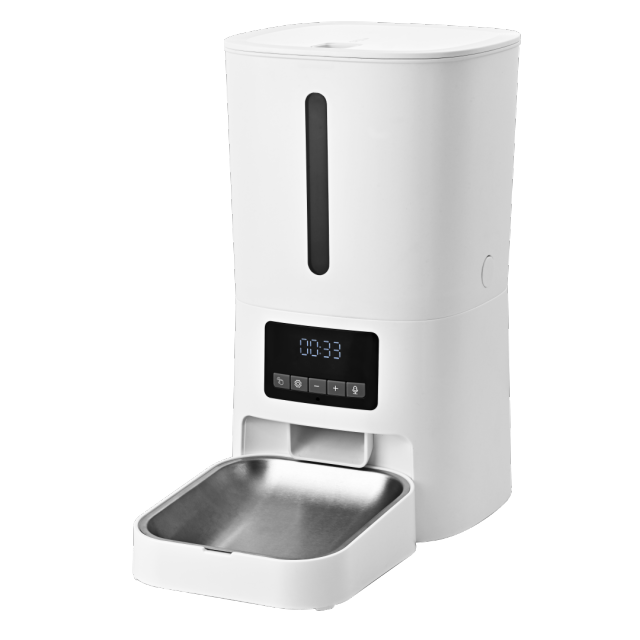
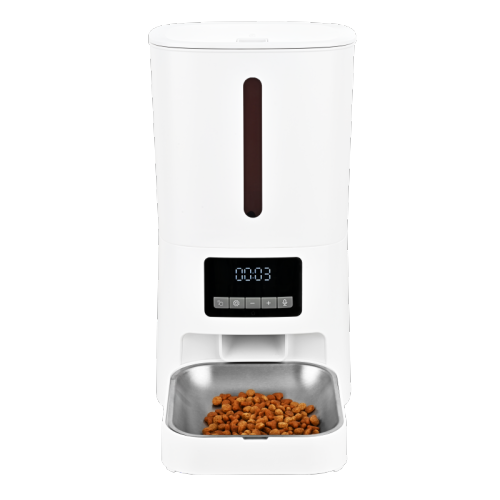
KYS-13B automatic feeder: ~10 g per portion, up to nine scheduled meals a day, with battery backup — the feature set buyers associate with the premium tier of the smart pet feeder market.
What separates order-winning feeders in 2026 is not more "smart" gimmicks but dependable execution of the basics: consistent portion accuracy across food sizes, anti-jam dispensing geometry, easy-to-clean food-grade hoppers, and a battery or backup strategy that survives Wi-Fi and power loss. Our engineering deep-dive on smart pet feeder portion control and anti-jam mechanisms explains why auger, rotary and carousel mechanisms differ in jamming behavior and why portion repeatability — not app polish — is what drives returns down and ratings up. The KYS-13B automatic feeder we manufacture reflects that discipline: an adjustable ~10 g-per-portion dispense (1–5 portions per meal), up to nine meals per day, a 3-liter tank, and Type-C power with four D-cell backup batteries so feeding continues through outages.
Pet Water Fountains: Cordless, Quiet and Filtration-Led
The fountain segment is smaller than feeders but growing steadily, and it has a cleaner health story: pets drinking from circulating, filtered water consume measurably more — industry trackers commonly cite roughly 28% higher intake versus static bowls — which supports kidney and urinary health, a concern veterinarians raise constantly with cat owners. pmarketresearch/PW Consulting sizes the pet water fountain market at US$1.29 billion in 2025, reaching US$2.05 billion by 2032 (6.85% CAGR), with cats representing about 65% of demand and North America the largest regional market at roughly US$482 million. Fact.MR uses a narrower definition (US$198M in 2025 to US$461M by 2036, 8% CAGR) and points to China as the fastest-growing country at a 9.8% CAGR; broader cat-and-dog fountain trackers run far higher at double-digit CAGRs because they include basic dispensers.
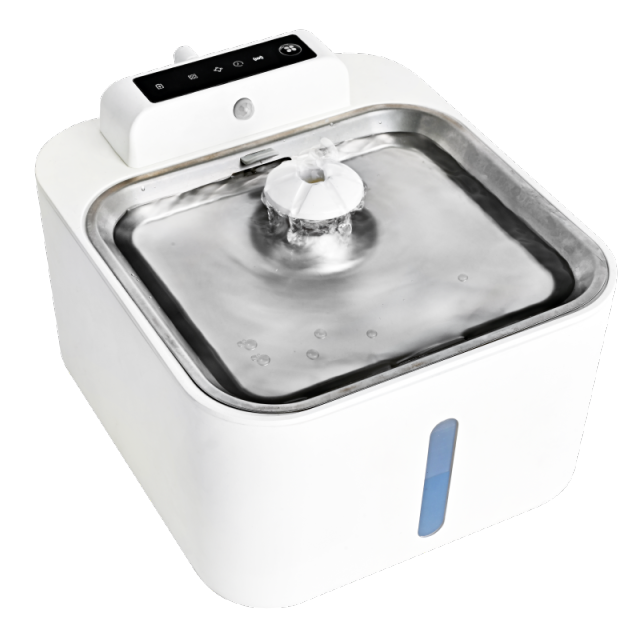
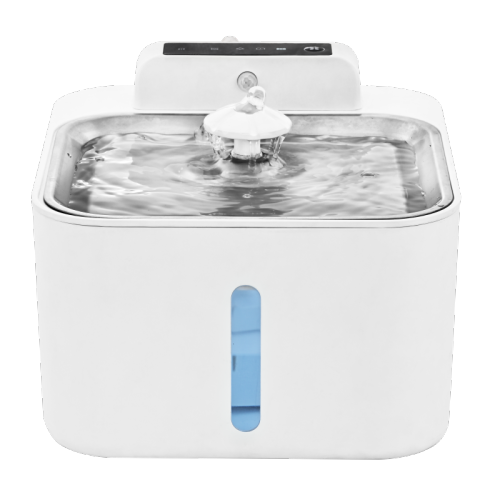
KYS-15B cordless fountain: smart-sensor flow, dual-stage filtration and up to 27 days of battery life — the features driving the wireless fountain subsegment's growth.
Three feature trends define new-model competition in 2026. First, wireless and rechargeable designs — battery-powered fountain models are one of the fastest-growing configurations because they free placement from outlets (no cable next to the food bowls, easier travel use). Second, multi-stage filtration — activated carbon plus ion-exchange resin has become the expected baseline, and filter consumption is a built-in recurring-revenue stream (roughly 30% of smart feeder and fountain buyers purchase companion consumables such as filters within six months, per NIQ data cited in sourcing analyses). Third, quiet operation — low-noise pumps (targeting well under ~30 dB in premium models) are cited as a top satisfaction driver for indoor placement. The KYS-15B fountain we build hits all three: a 3-liter tank, smart-sensor flow that activates when the pet approaches, dual-stage filtration (activated carbon + ion-exchange resin), an ultra-quiet pump, and 2000–3600 mAh battery options delivering up to 27 days between charges on a Type-C input.
Regional Outlook for 2026–2027: Where Demand Concentrates
Feeder and fountain demand is global but not uniform, and the geographic split should shape your certification and channel plan. North America remains the largest market — roughly 40–42% of global pet tech demand — supported by high ownership (APPA data puts pet ownership near two-thirds of US households, more than 86 million families, with dogs in about 65 million homes and cats in about 46 million) and the highest per-pet spending: NIQ-cited analyses show Gen Z and Millennial owners spending over US$1,000 a year per pet, with 68% prioritizing health and wellness features. Europe combines strong premium demand with the strictest material and electronics regulation (plastic restrictions, WEEE, and growing cybersecurity scrutiny on radio-enabled devices), while Asia-Pacific is the fastest-growing region on the strength of China's pet boom and its manufacturing ecosystem — including Guangdong, where much of the world's connected pet hardware is actually made.
Region
Share & Trajectory
What It Means for Sourcing
North America
~40–42% of pet tech; highest per-pet spend; mature premium tier
FCC (and FCC Part 15/15C for wireless), FDA food-contact for hoppers and bowls, UL/ETL options, English-first app UX, strong focus on reliability reviews
Europe
~27–28%; premium and sustainability-led; regulatory heaviest
CE package (RED for radio, EMC, LVD), RoHS/REACH, food-contact compliance, EU authorized representative, longer documentation files
Asia-Pacific
~24% and fastest-growing (~15% CAGR)
Compact designs for apartments; app ecosystems (Tuya-style); strong local OEM/ODM competition — differentiation and quality control are decisive
For importers who already serve the small-kitchen-appliance channel, this regional map is familiar territory — our 2026–2027 US kitchen appliance market guide covers the retail dynamics, and the export compliance guide walks through the certification stack for connected products market by market.
Feature Roadmap: What Importers Should Demand in 2026–2027
Every sourcing conversation in this category eventually reaches the same question: which features actually move units, and which ones inflate cost without improving sell-through? Based on the feature data in the market reports above and our own OEM experience across feeder and fountain programs, the honest answer is that the 2026–2027 roadmap favors a small set of high-value features executed well, not a long list of speculative ones.
Feature
Why It Matters in 2026
Sourcing Check
Portion accuracy & anti-jam
Directly tied to the APOP feeding-precision narrative; top driver of returns when it fails
Dispense repeatability test across kibble sizes; mechanism cycle testing
Battery / power backup
Feeding must survive Wi-Fi drops and outages; cordless fountains free placement
Battery capacity and chemistry; IEC 62133 / UN38.3 for rechargeable cells
App control & scheduling
Table stakes for the connected tier; drives retention and subscription attach
Firmware update path; cloud/regional hosting; RED cybersecurity (Annex V) for EU radio devices
Camera / monitoring
Fast-growing add-on (pet cameras the fastest subsegment in some trackers)
Not required in a first feeder line; adds data-privacy and certification load
Filtration system
Health story for fountains plus recurring filter revenue
Filter lifespan, availability and replacement cost; food-contact materials
Low noise
Quiet pumps cited among top satisfaction factors for indoor devices
dB measurement; pump motor life testing
Food-grade materials
Non-negotiable for hoppers, bowls and fountain reservoirs
FDA 21 CFR / EU food-contact documentation; BPA-free declarations with test reports
Be skeptical of "AI" as a standalone sales point. The genuinely useful AI in this category is narrow and specific — pet recognition in multi-pet households, feeding-pattern anomaly alerts, and personalized portion recommendations — not generic "smart assistant" claims. Ask which of these functions is actually implemented, how it was validated, and what the data-privacy policy is: connected pet devices collect behavioral data, and reliability itself is becoming a compliance feature as both US and EU scrutiny tightens. Our electrical ratings guide explains why voltage, frequency and power-supply design set the ceiling on what a connected pet product can do in each market.
Compliance Stack for Feeders and Fountains: A Practical Checklist
Smart pet products sit at the intersection of electronics, food-contact materials and (increasingly) radio and battery regulation, so the certification stack is wider than for a passive bowl or a simple appliance. Before you commit to a factory program, confirm these layers are covered model-by-model:
Electrical safety & EMC: low-voltage DC devices are generally below the EU LVD threshold, but the CE package still applies through EMC (Directive 2014/30/EU), and mains-powered variants fall under the relevant IEC 60335 series and UL standards. Confirm the test house and report coverage.
Radio / wireless (US FCC; EU RED): app-connected models with Wi-Fi or Bluetooth need FCC certification in the US and Radio Equipment Directive (2014/53/EU) compliance in Europe — including, from August 2025, the RED cybersecurity requirements (Annex V). A feeder with a companion app is a radio device, not just an appliance.
Food-contact materials: hoppers, dispensers, reservoirs and pumps that touch food or water must be documented against FDA 21 CFR (US) and EU food-contact rules (Regulation (EC) 1935/2004, with national rules such as LFGB in Germany). Ask for the material test reports, not a generic "food-safe" line.
Batteries: rechargeable fountains and feeders need IEC 62133 cell safety and UN38.3 transport documentation; battery-powered goods shipped by air freight have strict packing and labeling requirements.
Materials & environment: RoHS/REACH compliance for electronics and plastics, and California Prop 65 considerations for US retail; some EU markets are tightening plastic restrictions for pet-adjacent products.
Reliability evidence: for feeders, anti-jam/auger cycle testing and dispense-repeatability data; for fountains, pump life and motor noise measurements. These are the specs that determine whether your return rate stays under control.
This stack is exactly why sourcing connected pet hardware is closer to sourcing electronics than to buying passive housewares — and why the OEM's manufacturing maturity matters. Kangye is an OEM/ODM manufacturer in Guangdong, China with 35+ years of manufacturing experience exporting to 100+ countries. Our pet line — including the KYS-13B feeder and KYS-15B fountain — is produced alongside our food dehydrators, grills, pizza ovens, air fryer ovens, steamers and vacuum sealers under the same quality system, with certification packages (CE, RoHS, REACH, FDA/LFGB food-contact where applicable), documentation files and private-label programs built into each order. The OEM appliance manufacturing process guide shows how a program moves from mold design to container loading, and the China OEM sourcing guide covers how to structure factory audits and RFQs.
Cost, MOQ and Program Economics for 2026–2027
The price architecture of the feeder and fountain market is compressing at the entry level while a premium tier forms above it. IndexBox's China market analysis is the clearest on this: automated feeder ASPs have fallen roughly 40% since 2020 (from CNY 400–600 to CNY 250–450) while unit volumes roughly tripled — textbook price elasticity — and the premium tier (designer brands, smart-connected, elevated materials) is estimated at 25–30% of market value but only 8–12% of volume. That split is where the margin lives, and it favors importers who can offer a clean private-label story with real features rather than competing on the cheapest white-box hardware.
For planning purposes, the KYS-13B feeder and KYS-15B fountain ship in standard export cartons (1 pc per gift box, 12 gift boxes per carton), with feeder container loads of roughly 2,448 pcs per 20GP / 5,064 pcs per 40GP and fountain loads of 3,528 pcs per 20GP / 7,208 pcs per 40GP. For seasonal buy timing, our holiday and fall season sales guide is a useful companion, and the private label guide covers turning hardware into a differentiated brand SKU rather than a commodity listing.
Featured Products: Kangye KYS-13B Smart Feeder and KYS-15B Cordless Fountain
Featured Product: KYS-13B Automatic Cat Dog Feeder (3L)
The KYS-13B is a 3-liter automatic feeder engineered for dependable daily feeding: an adjustable ~10 g per portion dispense (1–5 portions per meal) supports portion-controlled diets, scheduling up to 9 meals per day covers even demanding routines, an anti-jam design keeps kibble flowing, and Type-C (5V/2A) power with a 4 × 1.5V D-cell backup keeps the schedule running through power outages. The compact footprint (302 × 172 × 312 mm) suits multi-pet households and apartment kitchens alike.
3L food tank; ~10 g/portion adjustable 1–5; up to 9 meals/day
Featured Product: KYS-15B Wireless Pet Water Fountain (3L)
The KYS-15B is a 3-liter cordless fountain built around the three trends reshaping the hydration category: smart-sensor flow that activates water when your cat or dog approaches, dual-stage filtration (activated carbon + ion-exchange resin) that keeps water fresh and reduces odor, and an ultra-quiet pump suited to bedrooms and living spaces. Rechargeable 2000–3600 mAh battery options (Type-C 5V/1A input) deliver up to 27 days of cordless operation, freeing placement from wall outlets.
A market outlook that only lists upside would not be a useful buying document, so here is the honest counterweight. First, consolidation pressure is real. The research literature consistently names a handful of scaled players (PetSafe/Radio Systems with roughly 18% global unit share in feeders, PETKIT, Petlibro, Petoneer, Xiaomi, Dogness and others) while hundreds of smaller factories compete on price — the classic setup for margin compression among importers who cannot differentiate. Second, reliability risk is the hidden cost driver. Feeder jams, portion drift and fountain pump failures are the most common complaint themes in retailer data, and they translate directly into returns and negative reviews. The best defense is engineering evidence — cycle testing, dispense repeatability data, pump life measurements — not marketing claims. Third, the data-privacy and cybersecurity layer is tightening. Connected devices collect behavioral data, and both the EU's RED cybersecurity requirements (in force August 2025) and US consumer expectations are raising the bar for app security and transparent privacy policies. Finally, feature inflation cuts both ways: app problems, cloud dependencies and subscription fatigue can depress a product that would have sold perfectly well as a dependable scheduled feeder.
None of these risks argues against the category — they argue for buying from manufacturers that treat reliability and compliance as engineering disciplines, which is the position Kangye takes across its pet, food preservation and kitchen appliance lines.
FAQ: Smart Feeders and Fountains in the 2026 Market
How big is the pet tech market in 2026?
Depending on scope, the pet tech market is estimated at roughly US$13.6–15.9 billion in 2026, growing at double-digit CAGRs (12.5–19%) over the next decade. The automatic and smart pet feeder category specifically is around US$2.2–2.7 billion in 2026, and pet water fountains at roughly US$1.3 billion on a narrow product definition. Definitions vary by research house, but all major trackers agree growth is firmly in double digits.
Which region is the biggest market for smart pet feeders and fountains?
North America is the largest, holding roughly 40–42% of global pet tech demand, with the highest per-pet spending and nearly two-thirds of US households owning pets. Asia-Pacific is the fastest-growing region (about 15% CAGR) driven by China's pet boom, and Europe is the most regulation-intensive premium market.
Why are smart feeders growing so fast if basic bowls still dominate volume?
Two drivers: the veterinary weight crisis — APOP data shows about 59% of US dogs and 61% of cats are overweight or obese, while only 3% of cat owners weigh their pet's food — makes portion control a genuine health tool; and busy urban households increasingly rely on scheduled feeding and remote monitoring. Basic bowls still lead unit volume, but feeders and fountains are the fastest-growing value segments.
What certifications do smart feeders and fountains need?
They combine food-contact materials, electronics and, for app-connected models, radio transceivers — so the typical stack includes FCC (US) and RED (EU) for wireless, EMC compliance, RoHS/REACH, FDA 21 CFR or EU food-contact documentation, IEC 62133 plus UN38.3 for rechargeable batteries, and RED cybersecurity (Annex V) for EU-bound connected models from August 2025.
Is the "AI pet feeder" trend real or marketing?
The useful AI is narrow and specific: pet recognition in multi-pet households, feeding-pattern anomaly alerts, and personalized portion recommendations. Broad "smart assistant" claims are often marketing. Ask which functions are actually implemented, how they were validated, and what the data-privacy policy is before paying a premium.
What should I look for in an OEM partner for pet products?
Look for documented food-contact materials, radio and battery certifications, reliability evidence (anti-jam cycle tests, dispense repeatability, pump life and noise measurements), a genuine private-label program, and container-load planning support. A manufacturer with an established quality system across adjacent appliance lines — as Kangye has with 35+ years in Guangdong, China and exports to 100+ countries — de-risks a pet product program significantly.
Summary: Prepare for a Double-Digit Growth Category with Disciplined Sourcing
Summary: the pet tech market in 2026 is a double-digit growth category, and smart feeders and fountains are its most import-relevant hardware segments — roughly US$2.2–2.7 billion (feeders) and US$1.3 billion and rising (fountains) on standard definitions, with North America the largest market, Asia-Pacific the fastest-growing, and cats the fastest-growing user segment. Growth is anchored in durable drivers: pet humanization, the veterinary-documented feeding-precision gap, and connected-home adoption. But the category is consolidating, and margin is shifting toward reliable, compliant hardware with genuine features rather than the cheapest white-box units. Importers should demand dispense accuracy and anti-jam evidence on feeders, quiet, truly wireless designs with real filtration on fountains, complete certification stacks (FCC/RED, food-contact, battery, cybersecurity), and a manufacturer with the engineering and documentation maturity to stand behind a multi-year program.
Feeders ~US$2.2–2.7B in 2026, growing 9–12%+ CAGR; fountains on a steady 7–8% CAGR (narrow scope).
North America leads; Asia-Pacific grows fastest; cats drive new-model demand.
Health story is evidence-based: APOP reports ~59% of dogs and ~61% of cats overweight, and only 3% of cat owners weigh food.
Differentiation lives in portion accuracy, anti-jam, battery backup, quiet cordless pumps and real filtration — not vague AI claims.
Compliance stack is wide: FCC/RED, food-contact, battery (IEC 62133/UN38.3), cybersecurity — verify model by model.
Planning a 2026–2027 smart feeder or fountain program and need a partner who builds, certifies and private-labels it end to end? Kangye is an OEM/ODM manufacturer based in Guangdong, China, with 35+ years of manufacturing experience and exports to 100+ countries. Our product line covers pet feeders and water fountains, food dehydrators, outdoor and indoor electric grills, BBQ gas grills, pizza ovens, air fryer ovens, electric steamers and vacuum sealers — with dual-voltage options, certification packages (CE, GS, ETL, CB, BSCI, RoHS, REACH, LFGB, FDA, SAA), private label programs and documentation files built into every order. Contact our team to discuss your target markets and program volumes, or browse the full product range .
Since its establishment in 1989, Kangye Electric Appliances has always focused on the research and development and manufacturing of kitchen appliances and outdoor cooking utensils.