Pet Food Dehydrator Guide: Making Healthy Treats at Home
Pet Food Dehydrator Guide: Making Healthy Treats at Home
Making healthy treats at home with a pet food dehydrator has moved from a hobby niche into one of the fastest-growing uses of small kitchen appliances. Owners want single-ingredient treats, and a dehydrator lets them control exactly what goes into every chew and strip. But "healthy" and "safe" are not the same thing: meat and poultry treats carry real food-safety requirements a dehydrator alone cannot meet, plus regulatory history every brand should understand. This guide covers the market case, the science of low-temperature drying, USDA food-safety rules, ingredient guidance, choosing a pet food dehydrator, and compliance for retail programs.
Key takeaway: a dehydrator preserves nutrients by removing water at low temperature, but it is not a pasteurizer. For meat and poultry, food safety comes from an initial heat step (160 °F / 71 °C for meat, 165 °F / 74 °C for poultry) plus a steady 130–140 °F drying pass. Brands that pair honest engineering with this science — and with traceable sourcing — win in a market where owners read labels and regulators look closely at pet treats.
Why Homemade Pet Treats Are Growing: Humanization, Clean Labels and the Numbers
The driver is pet humanization: owners feed dogs and cats the way they feed their families — recognizable ingredients, no artificial anything. Industry trackers quantify the shift clearly: Stratistics MRC sizes the global dog treats and functional snacks market at US$8.75 billion in 2026, reaching US$15.96 billion by 2034 (7.8% CAGR), while Value Market Research estimates US$5.12 billion in 2025 growing to US$9.74 billion by 2034 (7.4% CAGR). Different scopes, same conclusion: treats are a double-digit growth category, and clean-label, single-ingredient products are the fastest-moving slice.
That is exactly the gap a pet food dehydrator fills for home users and small treat businesses. You cannot make a cleaner label than one ingredient: chicken breast, lean beef, sweet potato or liver, sliced and dried. Sourcing analyses such as Accio's 2026 roundup put the dehydrated pet-food sector on a roughly 7% CAGR through 2035, with household dehydrators selling from about US$8–50 and stainless-steel commercial-style units from US$60 to over US$220 as "start a treat brand" kits. IndexBox's China analysis reports that pet-food dehydration now accounts for an estimated 10–15% of domestic food dehydrator unit sales in the world's largest dehydrator market. For appliance importers, the conclusion is practical: a dehydrator sold with a credible pet-treat story is a higher-margin product than the same box sold for dried apples.
| Market | 2026 Base | Forecast | CAGR | Source |
|---|---|---|---|---|
| Dog treats & functional snacks | US$8.75B | US$15.96B by 2034 | 7.8% | Stratistics MRC |
| Dog treats (narrower scope) | US$5.50B | US$9.74B by 2034 | 7.4% | Value Market Research |
| Pet food dryer / dehydrator equipment | ~US$886M (2025) | US$1.33B by 2032 | 6.1% | LP Information |
| Dehydrated pet-food application in China | 10–15% of domestic unit sales (2025) | Growing with pet boom | — | IndexBox |
The Health Case: Treat Calories and the Canine Obesity Crisis
"Healthy treats" is not just marketing language — it is the answer to a documented veterinary problem. The Association for Pet Obesity Prevention (APOP) has reported for years that roughly 56–59% of dogs and up to 61% of cats in the United States are clinically overweight or obese, making treats a genuine health lever. The companion guidance veterinarians repeat constantly is the "10% rule": treats — including training rewards, dental chews and table scraps — should contribute no more than 10% of a pet's daily caloric intake. For a moderately active 20-pound dog eating around 400–500 kcal per day, that means treats should stay under roughly 40–50 kcal daily.
Homemade dehydrated treats fit this guidance better than most commercial biscuits. A dehydrated sweet-potato slice or thin chicken strip is nutrient-dense but relatively low-calorie, free of added sugar and fat, and easy to break into small training pieces. The honest core of the value proposition: homemade treats are not automatically healthier — a fatty, salty homemade biscuit still is — but dehydrating lets the owner choose lean, whole, single ingredients and control portion size, precisely the behavior APOP and veterinary nutritionists recommend. Our pet feeder and fountain buying guide and pet tech boom review document the same health-led demand from the connected-device side of the category.
Dehydration vs Baking vs Freeze-Drying: What the Process Actually Does
Understanding the difference between preservation methods matters because it explains both the benefit and the limit of a pet food dehydrator. Dehydration removes water at low temperature with moving air. Keeping the process cool — typically 95–167 °F (35–75 °C) at the tray — retains heat-sensitive nutrients (B vitamins, enzymes) better than high-heat baking, and needs no oils or preservatives. The result — chewy for meat, crisp for produce — is the texture that makes jerky strips and produce chews the core of homemade treat recipes. Our deep-dive on the science behind food dehydration explains the temperature-and-airflow fundamentals in detail.
Baking (250 °F+) drives out moisture with more heat, producing a drier, crunchier treat with higher nutrient loss — fine for biscuits, but it changes the character of meat and produce. Freeze-drying sublimates water under vacuum at very low temperature, retaining the most nutrients and structure (and commanding premium prices), but freeze-dryers are expensive and impractical for most homes. Air-drying without heat (adiabatic drying) suits some high-acid produce but is not recommended for meat or poultry.
The critical point is what dehydration is not. Low-temperature drying removes water — it does not reliably kill bacteria. As the USDA's Food Safety and Inspection Service (FSIS) explains, most of the heat in a dehydrator is absorbed by evaporating moisture, so the food's internal temperature barely rises until most water is gone; by the time it rises, surviving bacteria have become more heat-resistant. That single fact drives the entire food-safety protocol below.
Food Safety First: What the USDA Actually Requires for Meat and Poultry Treats
If you make or source meat-based treats — chicken, beef, turkey, duck, liver or fish — the relevant authority is clear. The USDA FSIS Meat and Poultry Hotline recommendation for making jerky safely is to heat meat to 160 °F (71 °C) and poultry to 165 °F (74 °C) before dehydrating, using moist or wet heat (steaming, boiling in marinade, or roasting). This step is what destroys pathogens such as Salmonella and E. coli O157:H7. After it, dry at a constant 130–140 °F (54–60 °C) — fast enough to dry before spoilage, and removing enough water that microorganisms cannot multiply. FSIS stresses that most dehydrator instructions omit the pre-heat step and that a dehydrator alone may never reach 160–165 °F at the product's core.
Why the pre-heat step matters: FSIS has documented foodborne illness from homemade jerky, because a dehydrator's heat is absorbed by evaporating moisture — raw meat can look fully dried while never reaching a pathogen-killing temperature, and bacteria that survive drying become more heat-resistant. For commercial jerky, FSIS Appendix A guidelines accept validated lethality schedules such as product internal temperature of 145 °F (62.8 °C) held for 4 minutes with controlled humidity (90%+ RH for at least 25% of cook time, or continuous steam/sealed oven for at least 50%). University of Wisconsin research (Dr. Barbara Ingham, shared by NDSU Extension) also documents time–temperature lethality combinations from 125 °F for 10 hours to 155 °F for 4 hours, with a practical recommendation to dry at 145 °F or higher and verify dehydrator temperature with a thermometer.
The practical recipe-level translation, consistent across USDA, university Extension and commercial guidance, is: steam, boil or roast lean meat to 160–165 °F first; slice thin and uniform; then dehydrate at 130–140 °F for four to eight hours (longer for thicker strips) until the pieces bend without breaking and show no moisture. Produce such as sweet potato, pumpkin and apple does not carry the same pathogen risk profile as raw meat — it is commonly dried directly at 125–135 °F for six to ten hours — but should still be washed, thinly sliced and fully dried to prevent mold. For a comparison of dehydrators against ovens for this kind of drying work, see our earlier guide Food Dehydrator vs Oven Drying.
What You Can (and Cannot) Dehydrate for Pets
The ingredients that dehydrate well for pets are the same single-ingredient whole foods veterinarians recommend as treats — with an important safety list of exclusions. Below is the practical matrix we share with customers building pet-treat programs.
| Ingredient | Safe for pets | Prep notes | Dehydrate | Notes |
|---|---|---|---|---|
| Chicken / turkey breast | Yes | Lean, skinless; steam or boil to 165 °F first | 130–140 °F, 4–8 h | Poultry needs the 165 °F kill step before drying |
| Lean beef / venison | Yes | Trim fat; cook to 160 °F first | 130–140 °F, 4–8 h | FSIS Appendix A schedules for commercial batches |
| Liver (chicken / beef) | Yes, in moderation | Cook first; very rich — feed sparingly | 130–140 °F, 4–6 h | High vitamin A; small training bits only |
| White fish | Yes | Cook first; remove all bones | 130–140 °F, 4–6 h | Bones are a choking hazard — remove thoroughly |
| Sweet potato | Yes | Wash, slice 1/8–1/4 in | 135 °F, 6–10 h | The classic dog chew; fiber-rich |
| Apple / pear | Yes | Core and remove seeds | 135 °F, 6–10 h | Seeds contain trace cyanide compounds |
| Pumpkin | Yes | Use plain purée on liner trays | 135 °F, 6–10 h | Fruit-roll liner makes pumpkin leathers |
| Onion, garlic, chives | No | Toxic family (Allium) for dogs and cats | — | Never use, even as "flavor" |
| Grapes / raisins | No | Linked to kidney failure in dogs | — | Exclude from recipes entirely |
| Xylitol / sweeteners | No | Xylitol is acutely toxic to dogs | — | Check peanut butter and "natural" flavorings |
| High-fat cuts / cooked bones | No | Fat risk + splintering bones | — | Lean meat only; no cooked poultry bones |
Two cross-cutting rules apply regardless of ingredient. First, treats are not meals: size every treat for the pet, offer it under supervision, and introduce new ingredients one at a time to watch for digestive upset. Second, moisture is the enemy of shelf life — store fully dried treats airtight, refrigerate or freeze anything still pliable, and discard any batch with mold or off-odor. That single-ingredient, traceable philosophy is also exactly what pet-food regulators reward when a brand formalizes a recipe.
Step-by-Step: Two Safe Recipes to Put the Dehydrator to Work
These two recipes cover the two ingredient families — produce chews and meat treats — and map to the different safety protocols described above.
Recipe 1: Sweet Potato Chews (no pre-cook needed)
- Wash (do not peel — the skin adds fiber) and slice sweet potatoes to a uniform 1/8–1/4 inch with a mandoline.
- Arrange in a single layer, no overlap, on the dehydrator trays.
- Dehydrate at 135 °F (57 °C) for 6–10 hours until firm — flexible but not soggy, snapping rather than bending when fully dried.
- Cool completely before storing airtight; refrigerate ~2–3 weeks or freeze up to 3 months.
Recipe 2: Chicken Jerky Strips (pre-cook required)
- Use lean, skinless chicken or turkey breast; slice into thin uniform strips against the grain (1/8–1/4 inch).
- Steam or boil until the internal temperature reaches 165 °F (74 °C) — verify with a probe thermometer; do not skip this step.
- Pat dry, arrange in a single layer, then dehydrate at 130–140 °F for 4–8 hours until leathery with no visible center moisture.
- Cool fully, store airtight and refrigerate: homemade jerky is not shelf-stable to the standard of USDA-inspected commercial product.
The produce protocol extends to apple coins (core and seeds removed), pear slices and pumpkin "leathers" made on a fruit-roll liner; the meat protocol extends to lean beef and venison with the 160 °F pre-cook step. For batches destined for sale, move from home recipes to validated commercial schedules — our commercial food dehydrator buying guide walks through capacity and validation planning for treat businesses.
How to Choose a Pet Food Dehydrator: Tray Count, Wattage and Temperature Range
Once you know the recipes, the machine choice becomes concrete. The three specifications that matter most for pet-treat work are temperature control range and stability, tray count and material, and airflow design — in that order.
- Temperature range and control. You need a real 130–140 °F (≈55–60 °C) band for the meat drying step and 125–135 °F for produce. Digital thermostatic control beats bimetallic thermostats for consistency; look for a documented range such as 95–167 °F (35–75 °C) with a 24–48 h timer for safe overnight runs. Our article on dehydrator temperature control explains why ±3–5 °F drift matters for food safety and case-hardening.
- Tray count and batch size. A 4–5 tray compact unit suits a single-dog household or first-time treat makers; 8–12 tray units suit multi-pet homes, small treat businesses and anyone drying fruit leathers plus jerky in the same run. More trays mean more wattage to keep airflow and temperature even.
- Airflow design. Horizontal airflow from rear-mounted fans dries most evenly across trays; bottom-heat stackable units need rotation. Our heating systems explainer and the heating technologies comparison show why rear heat with horizontal airflow is the design of choice for meat work.
- Material. For pet use, choose food-contact-safe trays — stainless steel or BPA-free plastic. Stainless is easier to sanitize after meat runs and longer-lived; see our stainless steel grades comparison for why 304 food-contact surfaces beat 430 for repeated wet cleaning.
| Spec | KYS-308A/B/C (compact) | KYS-315J/K (10-layer pet treat) |
|---|---|---|
| Tray count | 4 stainless-steel trays | 10 stainless-steel trays |
| Power | 320–380 W (220–240 V) | 600–700 W (220–240 V) / 600 W (120 V) |
| Temperature range | Back heating, digital control | 35–75 °C / 95–167 °F, fan-only mode |
| Timer | 24-hour timer | 00:30–48:00 hour timer |
| Footprint | 300 × 255 × 210 mm | 313 × 372 × 342 mm |
| Accessories | Fruit-roll liner | Fruit-roll liner + mesh options |
| Best for | Single-dog homes, first treat batches | Multi-pet households and small treat brands |
Both units are rear-heat designs with stainless-steel trays — the material and airflow choices that keep produce chews and post-cook meat strips drying evenly and sanitizing easily between batches. For the buying logic that covers tray count, heating type and power more broadly, our home dehydrator selection guide is the companion read.
Featured Products: Kangye Pet Food Dehydrators for Home Treat Making
Featured Product: KYS-315J/K 10-Layer Pet Treat Dehydrator

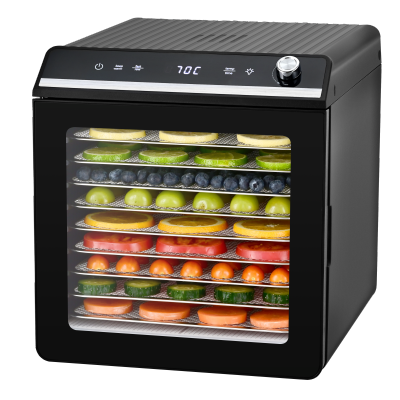
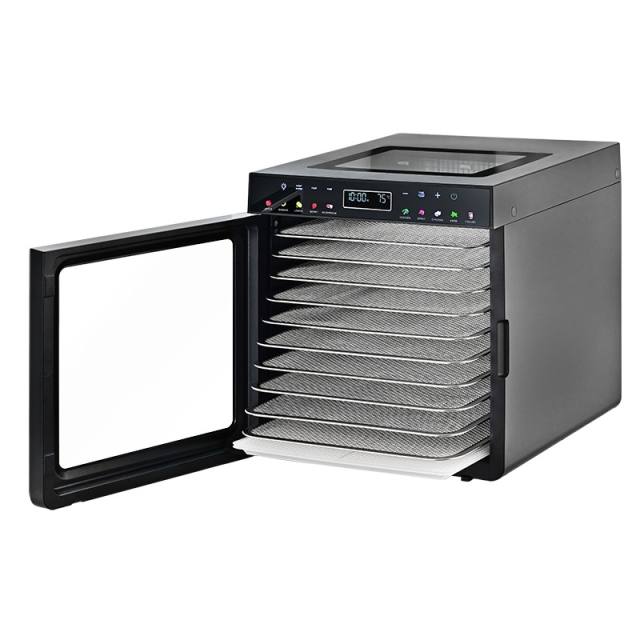
The KYS-315J/K is a 10-layer stainless-steel pet treat dehydrator for owners who make treats weekly and for small treat brands starting out: a 35–75 °C / 95–167 °F digital range covers produce chews (125–135 °F) and the post-cook meat drying step (130–140 °F), a 00:30–48:00 timer handles overnight runs, and fan-only mode finishes drying without heat. Rear-heat horizontal airflow keeps ten trays even, and stainless trays plus fruit-roll liner are food-contact friendly and easy to sanitize after meat batches.
- 10 stainless-steel trays; rear-heat horizontal airflow
- 35–75 °C / 95–167 °F; fan-only mode; 00:30–48:00 timer
- 600–700 W (220–240 V) / 600 W (120 V)
- 313 × 372 × 342 mm; fruit-roll liner included
- 20GP 539 pcs / 40GP 1,079 pcs; OEM/ODM + private label ready
Featured Product: KYS-308A/B/C 4-Tray Compact Dehydrator
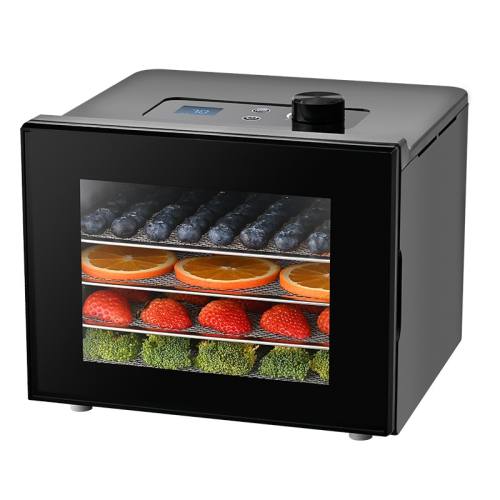
For first-time treat makers and single-dog households, the KYS-308A/B/C keeps the same food-safety-friendly design in a compact footprint: four stainless-steel trays, rear-heat back heating, a 24-hour timer and a 320–380 W heating element (220–240 V). The 300 × 255 × 210 mm body fits on a countertop next to the kibble bin, and the included fruit-roll liner extends it to pumpkin and liver leathers.
- 4 stainless-steel trays; rear-heat back heating
- 24-hour timer; 320–380 W (220–240 V)
- Compact 300 × 255 × 210 mm footprint
- Fruit-roll liner included; easy-clean SS trays
- 20GP 1,016 pcs / 40GP 2,132 pcs; OEM/ODM + private label ready
Compliance and Sourcing Reality: The FDA Jerky-Treat Lesson
Any brand moving from homemade batches to a retail treat program — even one where the equipment is the product — should understand why regulators scrutinize this category. The reference case is the FDA's long-running investigation into illnesses linked to dried poultry pet treats. FDA's Center for Veterinary Medicine has tracked complaints since 2007: by the end of 2015 roughly 5,200 reports involving more than 6,200 dogs and more than 1,140 canine deaths, most frequently linked to chicken, duck or sweet-potato jerky imported from China. The agency never isolated a single cause, but its analyses identified trace residues of antibiotics (sulfaclozine, tilmicosin, trimethoprim, enrofloxacin, sulfaquinoxaline) and antivirals (amantadine, rimantadine, memantine) in poultry jerky-type treats, leading to FDA Import Alert 72-07 — detention without physical examination — most recently revised in January 2025.
The lessons for treat brands — and for anyone sourcing dehydrators from China — are practical, not alarmist. First, the raw material is the risk. Poultry carrying prohibited or unapproved veterinary drugs keeps that residue through drying; dehydration concentrates residues rather than eliminating them. Brands selling meat treats need suppliers who can document veterinary-drug compliance, with third-party testing as the standard answer to DWPE. Second, sourcing transparency matters to owners. Manufacturers are not required to list the country of origin for every ingredient, but post-investigation, owners and retailers actively look for it. Third, the equipment benefits from the same rigor. A dehydrator sold for pet food should use documented food-contact-safe materials (EU 1935/2004 or FDA expectations), carry destination-market electrical certifications (CE/GS for Europe, ETL/cUL for North America, SAA for Australia), and come from a factory whose quality system proves material and component traceability. Our export compliance guide and electrical ratings explainer cover the certification stack and the 120 V vs 220–240 V decisions in detail.
Honest positioning matters here. A pet food dehydrator is a tool that helps owners make single-ingredient treats with clean labels — it does not, by itself, make meat safe. The brands that win owner trust are the ones whose marketing says exactly that, and whose manuals teach the 160/165 °F pre-cook step as prominently as the drying time.
OEM/ODM Considerations: Sourcing a Pet Food Dehydrator From China
When a retail brand or distributor sources pet food dehydrators from China — which produces most of the world's dehydrators, with pet-food application now a meaningful share of domestic sales per IndexBox — the selection criteria are the same as for any appliance line, plus two pet-specific additions.
- Build and electrical compliance. Verify dual-voltage options across 120 V and 220–240 V markets, real certification files (CE, GS, ETL/cUL, CB, RoHS/REACH, LFGB or FDA food-contact documentation for trays and liners), and a factory that keeps documentation current as rules change.
- Food-contact honesty. Ask what trays and liners are made of, and request the migration test reports (EU 1935/2004-based or LFGB) rather than a verbal "food-grade" claim. Stainless-steel trays are the defensible answer for a pet-treat positioning.
- Private label and packaging. A pet-treat dehydrator sells on its health story, so your manual and quick-start card should teach safe drying temperatures and the pre-cook rule for meat — a differentiator most white-box imports ignore.
- Factory maturity. The capabilities that de-risk kitchen appliances — long manufacturing experience, exports to 100+ countries, in-house tooling and testing, BSCI-style social audits — also de-risk a pet line. Kangye is an OEM/ODM manufacturer based in Guangdong, China, building food dehydrators, pet products and kitchen appliances under one quality system. Our OEM sourcing guide and manufacturing process overview explain what to audit before you commit.
FAQ: Making Healthy Pet Treats at Home
What is a pet food dehydrator and how is it different from a regular one?
Functionally it is the same low-temperature dryer with fans, but "pet" models add features owners value: food-contact stainless-steel trays, precise 95–167 °F (35–75 °C) control with 24–48 h timers, fan-only modes and rear-heat airflow. The KYS-315J/K is engineered for pet-treat work with a 48-hour timer and fruit-roll options for pumpkin and liver leathers.
Is dehydrated meat safe for dogs?
Yes, when the meat is first cooked to a safe internal temperature — 160 °F (71 °C) for meat, 165 °F (74 °C) for poultry — and then dried at a steady 130–140 °F until fully dry, per USDA FSIS guidance. Drying raw meat in a dehydrator is not safe, because the appliance does not reliably reach pathogen-killing temperatures before the meat dries.
What temperature do I use for sweet potato dog treats?
About 135 °F (57 °C) for 6–10 hours, depending on slice thickness. Slice 1/8–1/4 inch uniform with a mandoline, arrange in a single layer without overlap, and dry until firm — fully dried produce should bend and then snap rather than feel soggy. Produce does not need the meat pre-cook step.
How long do homemade dehydrated treats last?
Fully dried produce treats stored airtight keep roughly 2–3 weeks at room temperature and up to 3 months frozen. Homemade meat jerky has a shorter shelf life than USDA-inspected commercial jerky — refrigerate and use within a week or two, or freeze. Discard any batch that feels pliable, shows condensation or smells off: moisture is what lets mold and bacteria grow.
Can cats eat dehydrated treats made for dogs?
Many single-ingredient dehydrated treats (chicken, fish, liver) are fine for cats in moderation and correctly sized, but cats are obligate carnivores with different needs — check with your veterinarian before sharing dog-formulated or produce-heavy treats. Cats also need fresh water, so dehydrated treats should never replace hydration.
What should I verify before sourcing a pet food dehydrator as a brand?
Verify food-contact material test reports for trays and liners (not just the word "food-grade"), destination-market electrical certifications, dual-voltage capability for 120 V and 220–240 V markets, real temperature accuracy across the 130–140 °F band, and factory quality-system documentation. Then make your manual teach the 160/165 °F pre-cook rule for meat — it protects your customers' pets and your brand.
Summary: Build a Home-Treat Program on Safety and Transparency
Summary: homemade pet treats — and the pet food dehydrators behind them — are growing on pet humanization and clean-label demand: dog treats are a US$5.5–8.75 billion category growing 7%+ a year. The health story is real but must be earned: APOP's 56–59% canine obesity rate and the veterinary 10%-of-calories rule make lean single-ingredient treats genuinely useful, and low-temperature dehydration preserves nutrients better than baking. But a dehydrator removes water — it does not pasteurize — so meat and poultry treats require the USDA-recommended 160 °F (meat) / 165 °F (poultry) pre-cook step followed by steady 130–140 °F drying. Pick a machine with precise low-temperature control, enough trays, rear-heat airflow and food-contact-safe stainless trays — the KYS-315J/K 10-layer and KYS-308A/B/C deliver that spec — and demand certifications and material reports for retail.
- Dog treats: US$5.5–8.75B in 2026, growing ~7%+; clean-label, single-ingredient products lead.
- 56–59% of US dogs are overweight; the 10% treat-calorie rule makes homemade lean treats useful.
- Meat needs a 160–165 °F cook first, then 130–140 °F drying (USDA FSIS).
- Pick a dehydrator by temperature control, tray count and rear-heat airflow, with food-contact-safe stainless trays.
- For retail, verify food-contact reports, certifications and traceable sourcing — the FDA jerky history shows why.
Planning a pet food dehydrator program — for home retail, e-commerce or a treat-business customer base — and need a partner who builds, certifies and private-labels it end to end? Kangye is an OEM/ODM manufacturer based in Guangdong, China, with 35+ years of manufacturing experience and exports to 100+ countries. Our product line covers pet treat dehydrators and pet products, food dehydrators, outdoor and indoor electric grills, BBQ gas grills, pizza ovens, air fryer ovens, electric steamers and vacuum sealers — with dual-voltage options, certification packages (CE, GS, ETL, CB, BSCI, RoHS, REACH, LFGB, FDA, SAA), private label programs and documentation files built into every order. Contact our team to discuss your target markets and program volumes, or browse the full product range .